
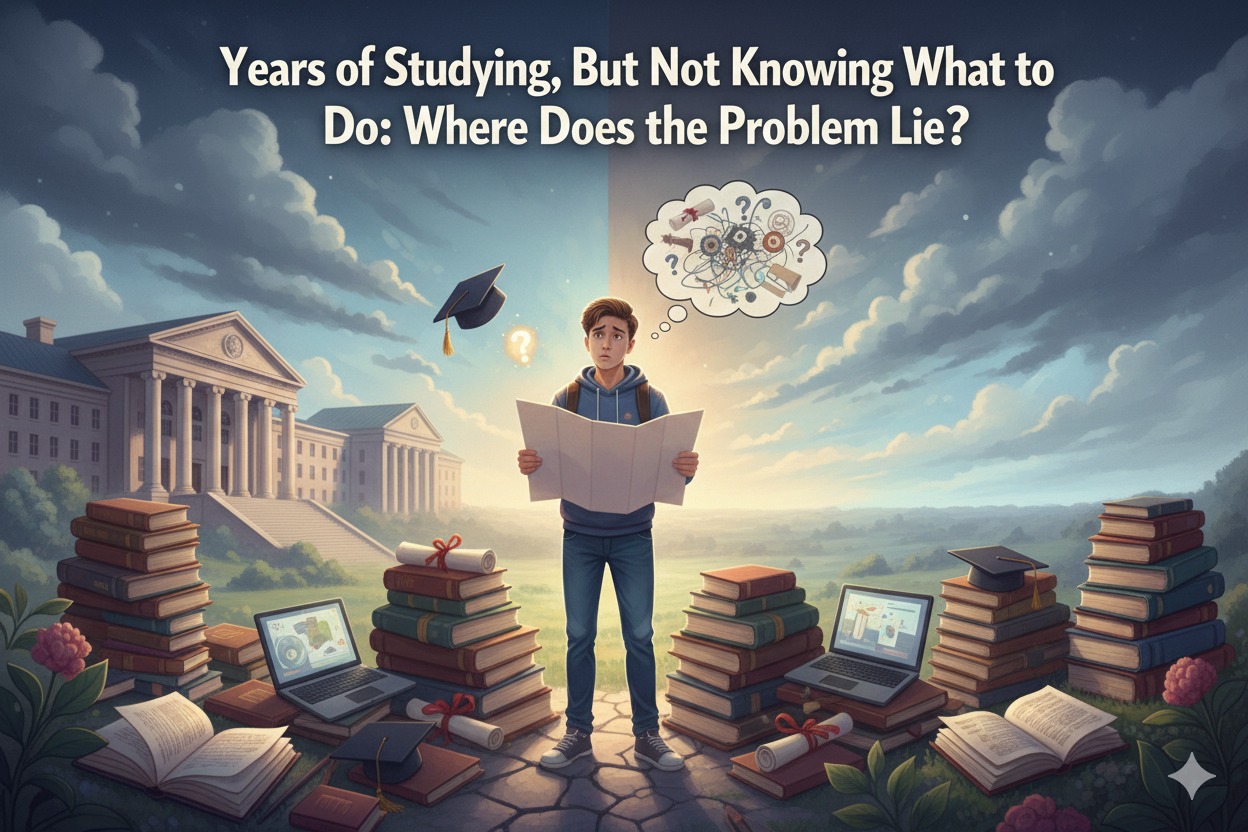
The phenomenon of university graduates feeling confused about their life direction is no longer an individual story. Many students spend four to five years in college, earn academic degrees, yet still lack a clear picture of their professional future. This raises a fundamental question: if higher education is meant to prepare individuals for life, why do so many graduates feel lost after graduation?
Post-Graduation Confusion Is Not an Isolated Case
If confusion about life direction were experienced by only a few individuals, it could reasonably be seen as a personal issue. However, when this phenomenon affects graduates across different majors and universities, it strongly indicates a systemic problem.
The fact that thousands of degree holders feel unprepared to face the working world highlights a gap between the goals of higher education and its actual outcomes.
Misleading Assumptions About the Meaning of College
Many students enter university with the assumption that college will automatically lead them to a specific career path. A degree is seen as a determinant of the future, rather than as a tool. This assumption is rarely challenged early on—either by educational institutions or by the surrounding social environment.
When reality does not match expectations, confusion emerges. Not because students are incapable, but because their expectations were built on fragile foundations.
A Curriculum Focused on Theory, Not Life Direction
Most university curricula remain heavily oriented toward theoretical mastery and academic assessment. Students are trained to pass courses, write theses, and achieve high GPAs. However, little space is provided to address a fundamental question: what comes next?
Without integrating academic learning with career and life orientation, students graduate without a clear roadmap for their professional lives.
Limited Exploration and Hidden Major Mismatch
Many first-year students choose their majors without a deep understanding of the field. An education system that demands quick decisions often limits opportunities for exploration. As a result, many students realize their mismatch only after progressing too far to change direction.
Instead of facilitating adjustment, the system often forces students to persist for the sake of administrative graduation requirements.
Marginalized Career Guidance
Career guidance on campus often exists as a formality rather than a foundation. Career seminars are usually held near graduation, when students are already confused. In fact, career reflection should begin early in a student’s academic journey.
Without continuous guidance, students are left to plan their future under time pressure and uncertainty.
Social Pressure and Narrow Definitions of Success
Social expectations further intensify confusion. Graduates are expected to quickly secure jobs, achieve stability, and meet specific standards of “success.” This pressure leaves little room for a natural period of self-discovery after college.
As a result, confusion becomes not only a career issue but also a psychological one.
Are Students Entirely to Blame?
Placing full blame on students reflects a bias that ignores context. While individuals must be proactive and reflective, demanding independence without providing support systems is a contradiction.
Students do not develop in a vacuum. The way they think, choose, and plan their future is shaped by the education system they experience.
Where Does the Real Problem Lie?
The issue does not lie in a single factor, but in the relationship between:
an overly academic-oriented education system,
a curriculum lacking life orientation, and
individuals shaped to comply rather than explore.
As long as college is understood merely as a process of graduating and earning a degree, post-graduation confusion will continue to repeat itself.
Toward More Honest and Relevant Education
Universities need to be more honest about what formal education can and cannot promise. Students should be actively involved in self-reflection processes, not merely academic evaluation.
Without a shift in perspective, years of higher education will continue to produce graduates asking the same question: what am I supposed to become now?
Tentang Penulis
Gusti Ayu Tita P
Penulis — Universitas STEKOM
Penulis aktif yang berfokus pada isu-isu akademik, teknologi pendidikan, dan pengembangan sumber daya manusia di lingkungan kampus.