
Studying and Working: A Strategic Choice in a Dynamic Era
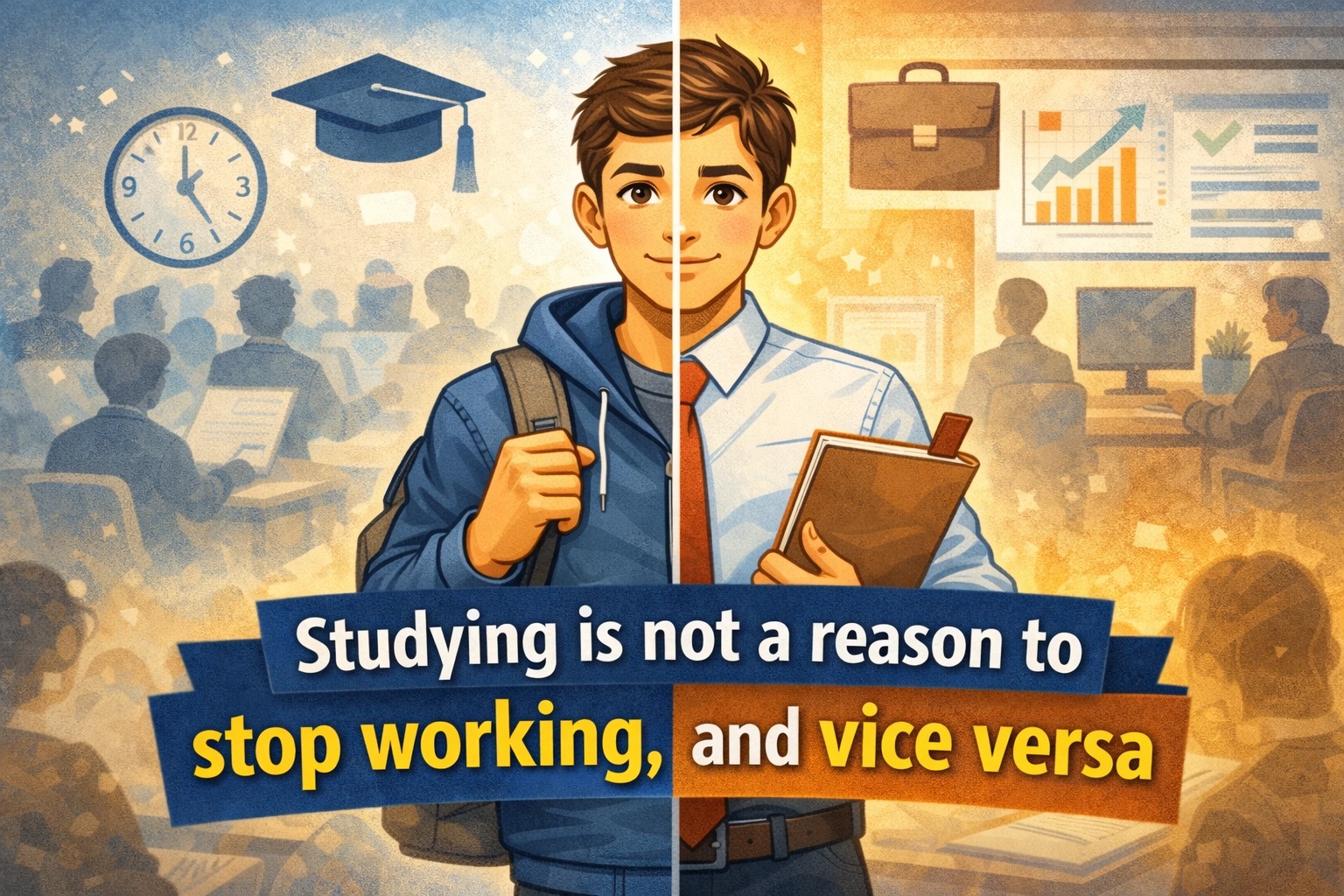
Amid rapid changes in the world of work and education, the belief that a person must choose between studying or working is gradually losing its relevance. Many people still assume that focusing on college means giving up work, while working is often seen as a sign of abandoning education. In reality, in today’s modern era, studying and working can go hand in hand and even strengthen each other. Choosing to study while working is not merely about economic necessity, but also a smart strategy to build a more stable and competitive future.
An Outdated Paradigm That Still Persists
In society, there is still a widespread paradigm that college is a full-time learning phase, while work comes only after graduation. This mindset causes many individuals to feel guilty about working during college or hesitant to continue their education once they have started working.
However, real-life conditions are not always ideal. Economic factors, family responsibilities, and the desire for independence often require individuals to enter the workforce early. Viewing these circumstances as obstacles can limit personal potential. It is time to replace outdated paradigms with a more realistic and adaptive perspective.
The Rise of More Flexible Education Systems
Advancements in technology and education systems have opened up new opportunities. Today, students are no longer limited to conventional classroom-based education. The availability of evening classes, employee programs, and online learning allows individuals to pursue higher education without leaving their jobs.
This flexibility serves as a solution for working professionals who wish to improve their academic qualifications, as well as students who need financial support. With proper scheduling, studying and working no longer have to be conflicting choices.
The Added Value of Working While Studying
Combining work and study offers both short-term and long-term benefits. It is not only about earning income, but also about character development and career readiness.
First, early work experience helps individuals gain real-world professional insight. Second, financial independence encourages greater responsibility in managing personal finances. Third, academic theories learned in college can be directly applied in the workplace, making the learning process more practical and meaningful.
Moreover, graduates with work experience often have a competitive advantage, as they are more accustomed to pressure and responsibility.
Real Challenges That Cannot Be Ignored
Despite its advantages, studying while working is not without challenges. Busy schedules can lead to physical and mental exhaustion. Lack of sufficient rest may negatively affect academic performance and work productivity.
In addition, balancing dual responsibilities requires strong time management skills. Without proper planning, individuals may experience burnout, lose motivation, or fail to perform well in both areas.
Strategies to Balance Study and Work Effectively
To maintain balance, careful planning is essential. Setting clear priorities is a crucial first step. Working students need to recognize when to focus on academic responsibilities and when to maximize work performance.
Creating a realistic daily schedule, using free time efficiently, and maintaining open communication with lecturers and employers are highly beneficial. Equally important is prioritizing physical and mental health to ensure long-term stamina and well-being.
Studying and Working as a Long-Term Investment
Combining study and work is not just a practical choice, but a long-term investment. Education provides intellectual foundations and critical thinking skills, while work builds discipline, work ethic, and social competence.
Together, these elements shape individuals who are not only academically capable, but also professionally mature. This combination is a valuable asset in facing an increasingly competitive and ever-changing job market.
Conclusion
Studying is not a reason to stop working, nor is working a reason to abandon education. Both can coexist when managed with strong planning and commitment. In an era that demands flexibility and adaptability, continuing to learn while working is a strategic step toward building a stronger and more competitive future.
Tentang Penulis
Gusti Ayu Tita
Penulis — Universitas STEKOM
Penulis aktif yang berfokus pada isu-isu akademik, teknologi pendidikan, dan pengembangan sumber daya manusia di lingkungan kampus.



