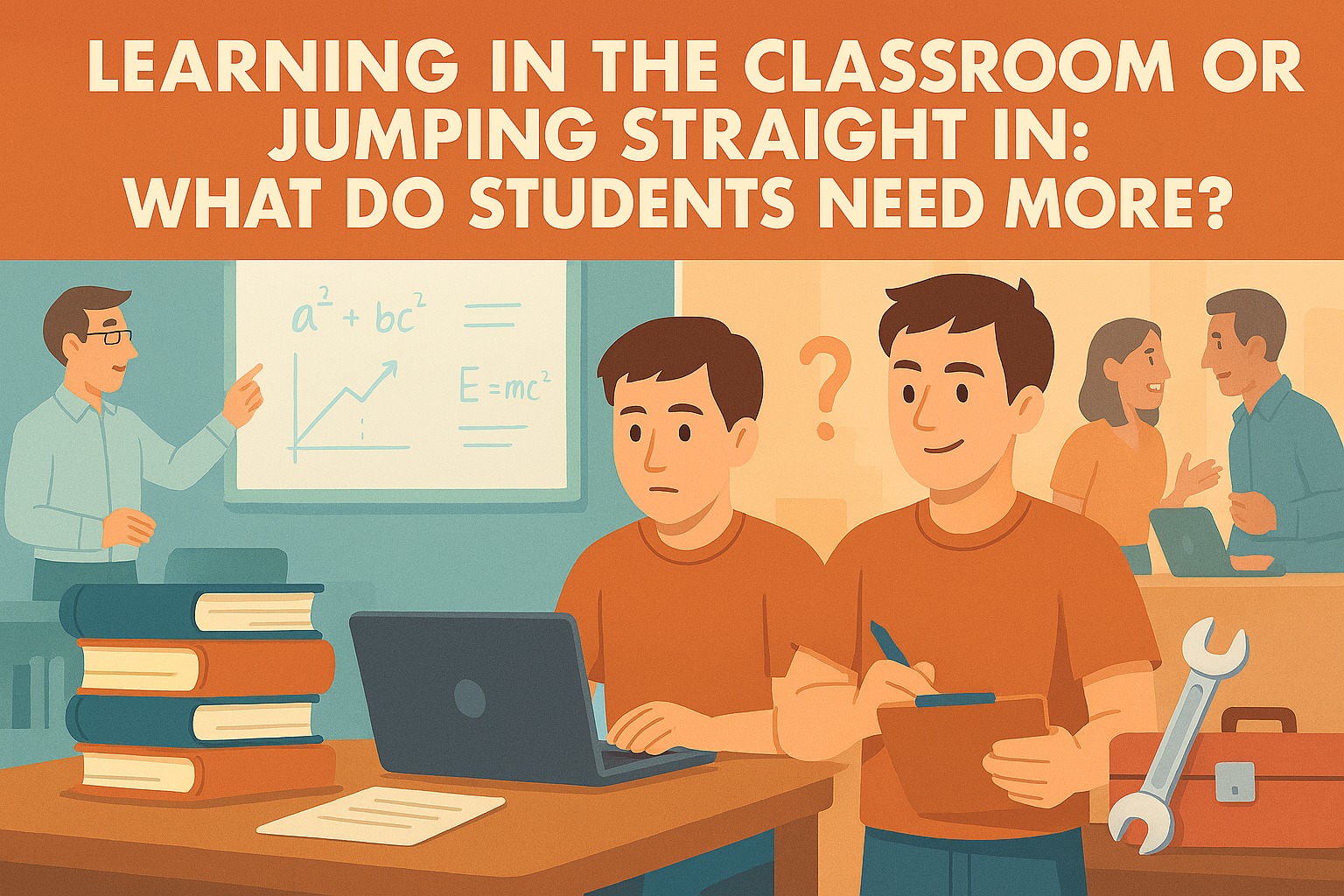
Education has always been associated with classrooms, textbooks, lectures, and exams. Students are expected to sit, listen, take notes, and absorb knowledge before entering the professional world. However, in recent years, many students and employers have started asking an important question: is learning in the classroom enough, or should students jump straight into real-world experiences? This debate reflects a growing awareness that academic knowledge and practical skills do not always develop at the same pace. Understanding the role of both approaches can help students prepare more effectively for their future careers.
THE PURPOSE OF CLASSROOM LEARNING
Classroom learning provides structure and guidance. It is where students build their theoretical foundation, understand key concepts, and learn the principles of their chosen field.
Through lectures, discussions, and assignments, students develop critical thinking skills and gain knowledge that helps them understand how systems work. For example, business students learn about management theories, while engineering students study formulas and design principles.
This structured environment allows students to learn step by step. Mistakes can be corrected in a safe setting, and concepts can be explained in detail before being applied in real situations.
THE APPEAL OF JUMPING STRAIGHT INTO PRACTICE
Some students feel that real-world experience teaches more than classroom lessons. They believe that working directly in the field helps them understand what truly matters in a profession.
In practical environments, students face real deadlines, real clients, and real consequences. They must communicate with others, solve problems, and adapt to changing situations. These experiences often feel more meaningful because they are directly connected to real outcomes.
This is why internships, part-time jobs, and hands-on projects have become increasingly popular among students who want to build practical skills early.
THE RISKS OF RELYING ONLY ON ONE APPROACH
Focusing only on classroom learning can create graduates who understand theory but struggle to apply it. They may perform well in exams but feel unsure when facing real-world challenges.
On the other hand, jumping straight into practice without a strong theoretical foundation can also create problems. Students may learn how to perform tasks, but they might not understand the deeper principles behind their actions. This can limit their ability to grow, adapt, or solve complex problems.
Both approaches have strengths and weaknesses. Relying on only one can create gaps in knowledge or skills.
HOW THEORY AND PRACTICE COMPLEMENT EACH OTHER
Theory and practice are not opposites. They are complementary parts of the learning process. Theory provides understanding, while practice builds skill and confidence.
When students learn a concept in the classroom and then apply it in real situations, the knowledge becomes more meaningful. They begin to see how theories function outside textbooks and how real challenges require flexible thinking.
Students who combine both approaches usually develop stronger communication skills, better problem-solving abilities, and greater confidence in their professional roles.
WHAT STUDENTS ACTUALLY NEED
Most students do not need to choose between classroom learning and practical experience. What they truly need is balance.
Classroom learning gives them the foundation to understand their field, while practical experience helps them apply that knowledge. When both are integrated, students become more adaptable and prepared for real-world challenges.
Education becomes more effective when it does not stop at theory but also encourages hands-on experiences that reflect real professional environments.
CONCLUSION
The question is not whether classroom learning or real-world practice is more important. Both are essential parts of a student’s development. Classroom learning builds understanding, while practical experience builds skill and confidence.
Students who balance these two approaches are better prepared for the demands of the professional world. In the end, the most effective education is one that combines strong theoretical foundations with meaningful practical exposure.
Tentang Penulis
Gusti Ayu Tita
Penulis — Universitas STEKOM
Penulis aktif yang berfokus pada isu-isu akademik, teknologi pendidikan, dan pengembangan sumber daya manusia di lingkungan kampus.