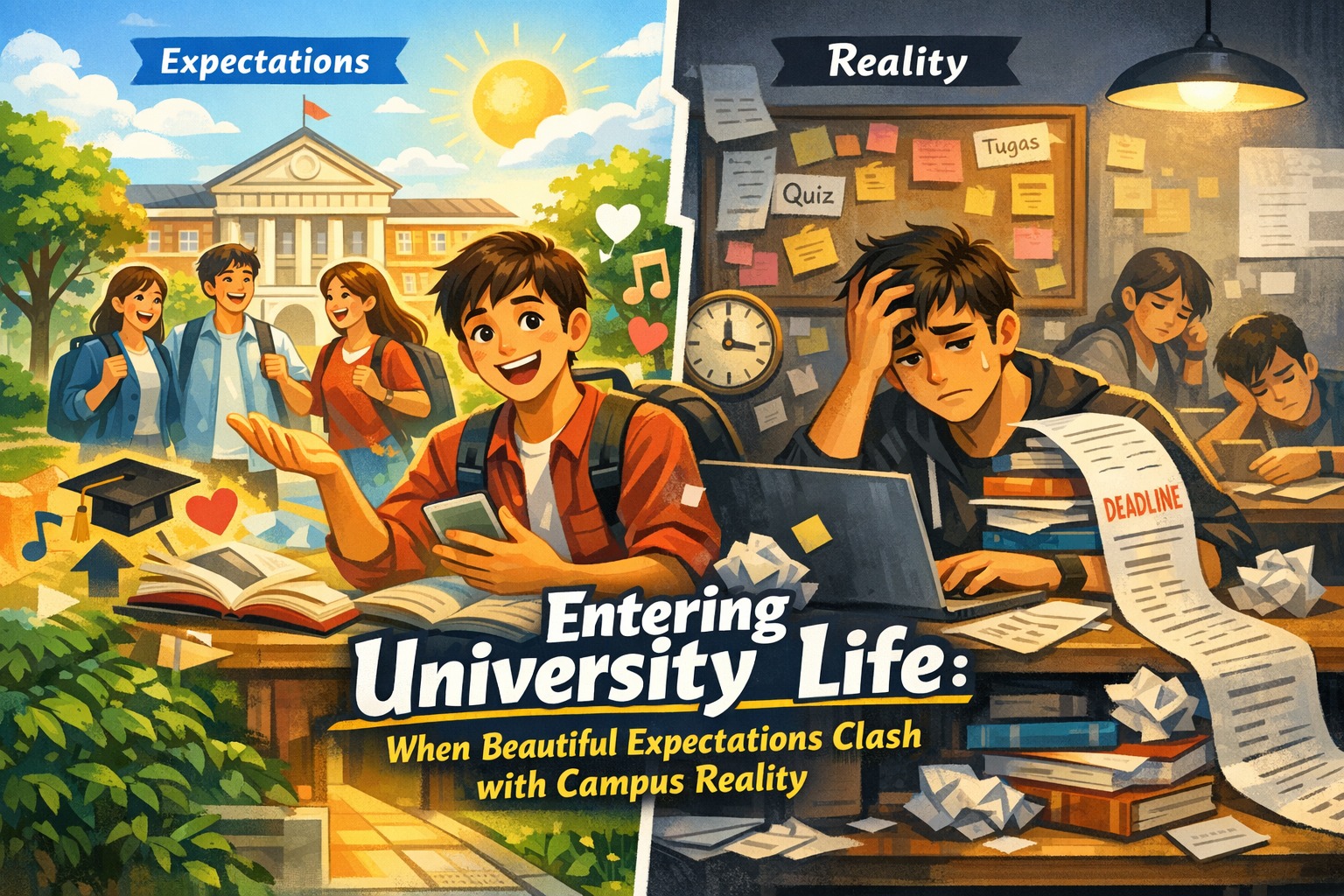
Entering university life is often imagined as a phase full of freedom, fun friendships, and unforgettable experiences. Many freshmen arrive with idealized expectations: flexible schedules, light assignments, and an exciting social life. But over time, the real face of college begins to emerge. Many students are surprised to discover that campus life is far different from what they imagined.
BEAUTIFUL EXPECTATIONS BEFORE STARTING UNIVERSITY
Before officially becoming university students, many young people create ideal images of campus life. These expectations often come from seniors’ stories, social media, and campus-themed films or series.
Students imagine easygoing lecturers, assignments that can be done close to deadlines, and plenty of free time. They also assume student organizations are purely fun, pressure-free activities. Everything seems balanced and full of freedom.
THE UNEXPECTED REALITY OF COLLEGE
As classes begin, reality slowly collides with expectations. Assignments pile up, course materials are dense, and the learning system demands high independence. There are no teachers constantly reminding students; all responsibilities fall on their own shoulders.
Beyond academics, mental pressure also arises. Adjusting to a new environment, academic demands, and poor time management often leave students overwhelmed. For many, this phase becomes one of the toughest parts of early university life.
THE DIFFERENCE BETWEEN SCHOOL AND UNIVERSITY LEARNING SYSTEMS
One of the major reasons behind this clash is the difference in learning systems. In university, students are expected to independently search for references, read journals, and understand materials on their own. Lecturers act as facilitators—not the central source of learning as in school.
Without preparation for this shift, students may feel left behind and lose motivation. Independent learning becomes an essential skill to survive and grow in university.
STUDENT ORGANIZATIONS: BETWEEN SELF-DEVELOPMENT AND TIME PRESSURE
Many students expect organizations to be fun and social. In reality, organizations come with responsibilities—meetings, work programs, and internal conflicts.
However, when approached wisely, student organizations help develop soft skills such as leadership, communication, and teamwork. The challenge lies in balancing academics and non-academic activities so both can run smoothly.
LEARNING TO ACCEPT AND ADAPT TO REALITY
The clash between expectations and reality is normal. It is a crucial part of personal growth. Students who can accept and adapt to change will be better prepared for future challenges.
Managing time well, setting priorities, and seeking help when needed are essential steps to navigating campus life. In the end, college reality may not be as beautiful as imagined—but it is where many valuable life lessons are learned.
**Keywords:**
Tentang Penulis
Gusti Ayu Tita
Penulis — Universitas STEKOM
Penulis aktif yang berfokus pada isu-isu akademik, teknologi pendidikan, dan pengembangan sumber daya manusia di lingkungan kampus.