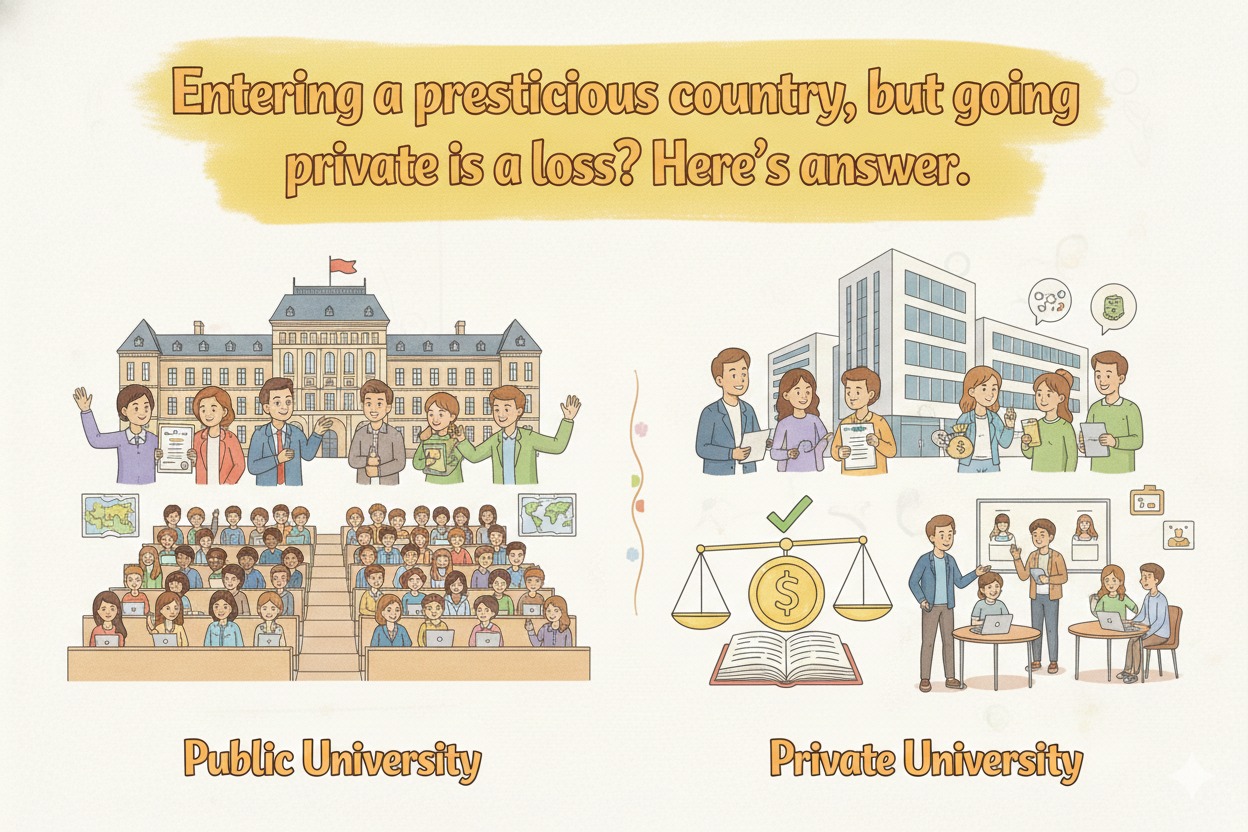
Is Private University a Loss Compared to Public University?
The belief that entering a public university is prestigious while studying at a private university is a waste is still common in society. This narrative often makes prospective students feel doubtful or insecure when they fail to pass public university selection. But is it true that private universities always cause losses? This article will discuss the answer objectively and realistically.
ORIGIN OF THE PUBLIC UNIVERSITY PRESTIGE
Public universities are associated with strict selection and limited quotas. This creates the perception that students accepted are “the best.” The relatively affordable tuition fees also strengthen the positive image of public universities in society.
However, this prestige is often built from a social perspective, not from actual outcomes after graduation. Many public university graduates still struggle to compete in the workforce if they lack relevant skills.
THE STIGMA OF PRIVATE UNIVERSITIES BEING A LOSS
The label “loss” on private universities usually arises because tuition fees are higher. **In reality, it is not that simple.** Many private universities offer modern facilities, more conducive class environments, and curricula aligned with industry needs.
This stigma makes the advantages of private universities often overlooked, especially in terms of flexibility and practical approaches.
ACADEMIC FACTS THAT ARE OFTEN OVERLOOKED
Both public and private universities have their own academic standards. Public universities generally emphasize theory and research, while private universities often combine theory with practice. Both face equally challenging demands, only with different approaches.
The reality that is rarely realized is that learning quality depends heavily on the student’s active role, not just the campus status.
CAREER OPPORTUNITIES ARE NOT AS UNIFORM AS ASSUMED
In today’s job market, companies do not only look at the university’s reputation. Internships, communication skills, portfolios, and professional attitudes become primary considerations. Private university graduates who are active and skilled have equal opportunities as public university graduates.
In fact, some industries value graduates who are job-ready more than those from prestigious universities.
WHAT IS TRULY DISADVANTAGEOUS?
The real disadvantage is not the university choice but not maximizing the college years. Entering a public university without self-development or studying at a private university without initiative can both produce graduates who are not ready to compete.
College decisions should be aligned with individual needs, learning styles, and career goals.
CONCLUSION
Entering a public university does have prestige, but attending a private university does not mean a loss. Both offer different opportunities and challenges. In the era of global competition, personal quality, adaptability, and willingness to learn determine the future more than the label of public or private. So, the answer is clear: campus choice is not about prestige, but strategy toward life goals.
Tentang Penulis
Gusti Ayu Tita
Penulis — Universitas STEKOM
Penulis aktif yang berfokus pada isu-isu akademik, teknologi pendidikan, dan pengembangan sumber daya manusia di lingkungan kampus.