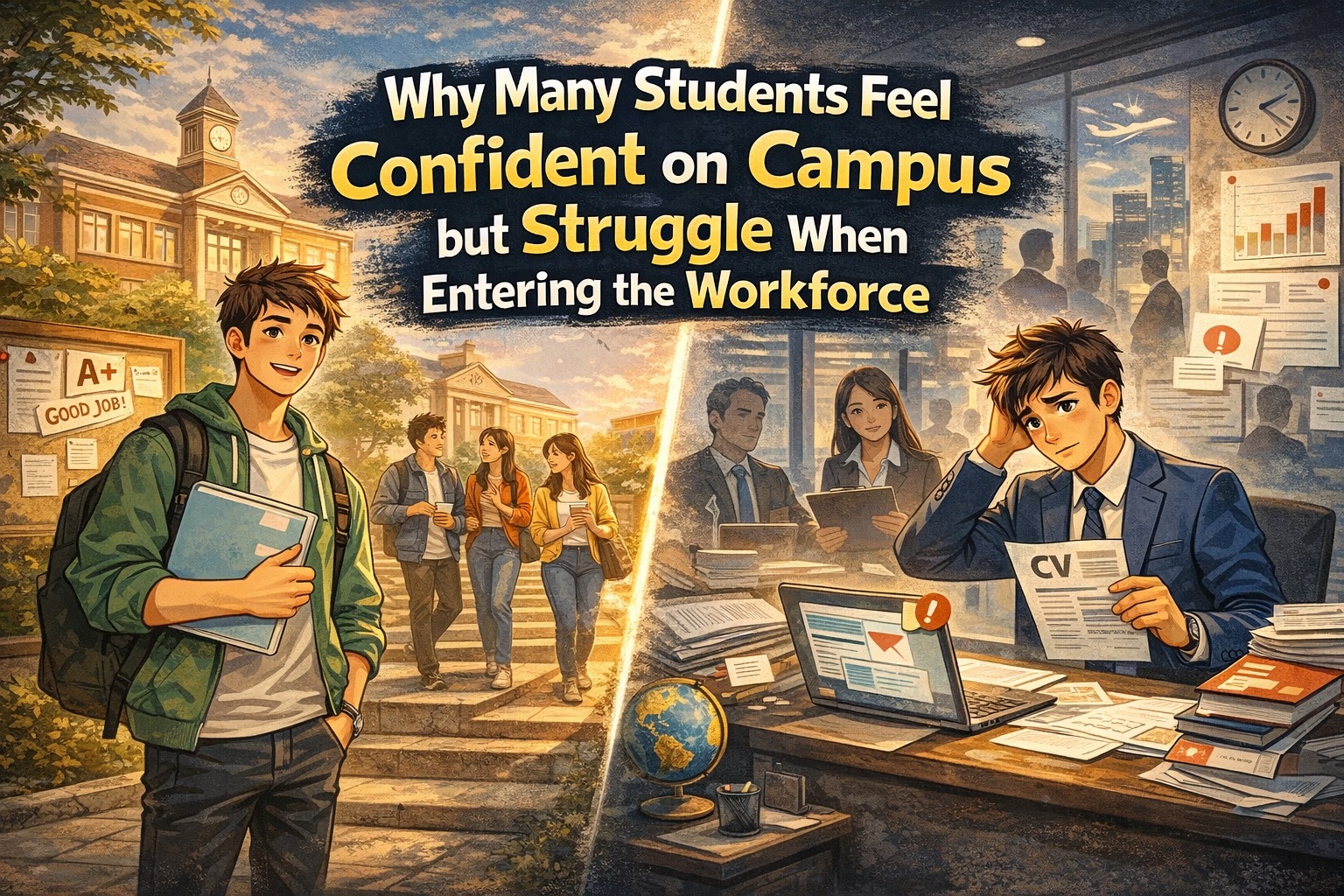
Many students feel confident during their college years. Good academic performance, active participation in organizations, and experience in public speaking often become indicators of self-readiness. However, when entering the workforce, many of them begin to feel doubtful, anxious, or even lost. This phenomenon highlights the gap between confidence built in academic environments and the professional realities faced after graduation.
DIFFERENCES BETWEEN CAMPUS LIFE AND THE WORKING WORLD
A Transition That Is Not Always Smooth
The campus environment provides a safe space for students to learn, experiment, and make mistakes. Success is often clearly measured through grades, GPA, or recognition from lecturers. In contrast, the workplace demands real results, fast adaptation, and responsibilities that directly impact the organization. This environmental shift often leaves graduates feeling as though they have lost the solid footing they once had in college.
CONFIDENCE BUILT FROM THE ACADEMIC SYSTEM
Validation Based on Grades and Recognition
Students’ confidence is often formed through structured feedback systems such as exam scores or competition achievements. Unfortunately, the workplace does not always provide validation as quickly or as clearly. When hard work is not immediately recognized, some graduates begin to doubt their abilities, even though they are actually competent.
THE GAP BETWEEN THEORY AND PRACTICE
Workplace Reality Is More Complex
College learning focuses heavily on ideal concepts and theories. In the workplace, graduates face real-world problems that involve time pressure, team dynamics, and business interests. Being unprepared for these conditions can cause previously strong confidence to weaken.
The academic environment is designed as a relatively safe learning space. Students are allowed to make mistakes without severe consequences, as failure is considered part of the learning process. The clear and structured assessment system also helps students understand standards of success.
LACK OF EXPOSURE TO THE PROFESSIONAL WORLD
Limited Real Experience Before Graduation
Students who rarely participate in internships, industry projects, or part-time jobs tend to have an idealized picture of the workplace. When expectations do not match reality, fear of failure and uncertainty arise. This is not due to a lack of ability, but rather a lack of direct experience that shapes professional mentality.
HIGHER AND MORE DYNAMIC WORK STANDARDS
Performance Pressure and Competition
In the workplace, evaluation standards are not only based on individual ability but also on contributions to the team and organization. Intense competition and constant demands for growth can become new sources of pressure. Students who once excelled on campus may feel average or left behind, affecting their self-confidence.
Course materials generally focus on ideal concepts and simulations. When faced with complex field conditions, limitations, and often non-ideal situations, graduates experience a reality shock. This situation can weaken confidence because what was learned does not always fully match job demands.
CONCLUSION
Students’ declining confidence when entering the workforce is not a sign of failure, but a natural adaptation process. Differences in systems, expectations, and professional realities require time to understand and navigate. By equipping themselves with practical experience, soft skill development, and mental readiness, students can rebuild more realistic and sustainable confidence in the professional world.
Confidence in college does not always reflect readiness for the workplace. Differences in environment, evaluation systems, responsibilities, and pressures cause many graduates to experience mental challenges when entering professional life. Therefore, students need to build more realistic confidence through real experiences, mental resilience, and readiness to face uncertainty while still in college.
Tentang Penulis
Gusti Ayu Tita
Penulis — Universitas STEKOM
Penulis aktif yang berfokus pada isu-isu akademik, teknologi pendidikan, dan pengembangan sumber daya manusia di lingkungan kampus.