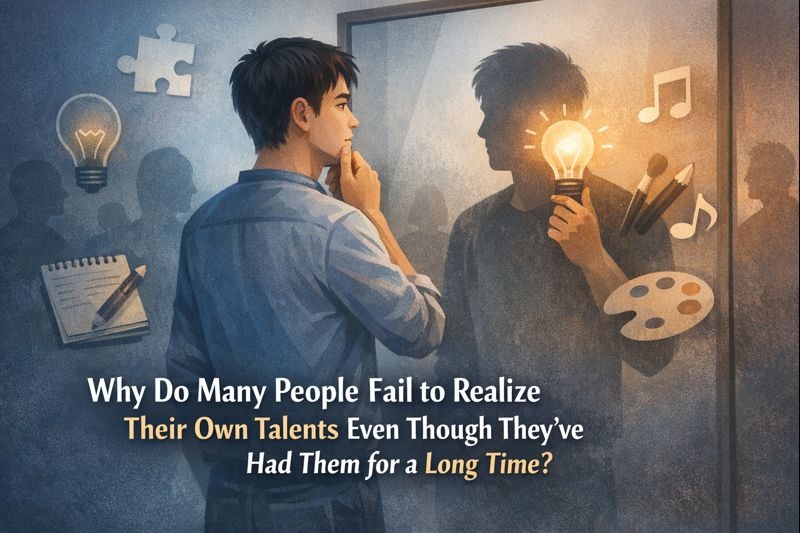
Many people go through life feeling “ordinary,” never realizing that they actually possess valuable talents. Talent does not always appear in the form of extraordinary abilities or major achievements from an early age. In fact, most talents develop gradually and are often hidden behind daily routines.
So, why do many people fail to recognize their talents even though they have had them for a long time? This article explores the various factors behind this phenomenon and offers a new perspective on how talent works in human life.
TALENT IS OFTEN ASSUMED TO BE SOMETHING EXTRAORDINARY
One of the main reasons people fail to recognize their talent is a misunderstanding of what talent really means. Many believe that talent must be something highly exceptional, rare, and publicly recognized.
As a result, abilities that feel “easy” or “ordinary” are often underestimated. In reality, abilities that feel natural and effortless are often strong indicators of genuine talent. When people focus too much on comparing themselves to others, their unique potential becomes invisible.
BEING TOO USED TO ONE’S OWN ABILITIES
Talent often goes unnoticed because it has become part of everyday life. Someone who has been good at writing for years, for example, may see it as normal simply because they have always done it.
This phenomenon is known as a “capability blind spot,” where individuals fail to recognize their strengths because those abilities feel too natural. Since it does not feel difficult, the ability is not considered special, even though others may struggle with it.
ENVIRONMENTAL PRESSURE AND SOCIAL EXPECTATIONS
The environment plays a major role in shaping awareness of talent. From an early age, many individuals are directed toward certain standards, such as academic achievement, popular majors, or “secure” career paths.
When someone’s talent does not align with family or societal expectations, it is often ignored or even suppressed. Over time, this causes individuals to lose sensitivity toward their own interests and potential, as they focus more on meeting external demands.
LACK OF SELF-REFLECTION AND EXPLORATION
In the midst of modern life’s busyness, self-reflection is often neglected. Many people go through routines without ever stopping to ask what they truly enjoy and excel at.
Without exploration, talent is difficult to recognize. Talent does not always emerge on its own; it is often discovered through trying, failing, learning, and growing. When someone rarely steps outside their comfort zone, the opportunity to uncover potential becomes even smaller.
FEAR OF FAILURE AND LOW SELF-CONFIDENCE
Fear of failure is another major barrier to recognizing talent. Many people have genuine interests and abilities but choose not to develop them because they worry they are not good enough.
Low self-confidence makes people hesitant to try new things or showcase their abilities. As a result, talents that could have grown remain buried for years.
TALENT IS NOT STATIC
It is important to understand that talent is not fixed or instantly visible. In many cases, talent develops over time through practice, experience, and learning.
Someone may not realize their talent at a young age and only discover it later in life. Recognizing talent is not about finding one “perfect” ability, but about understanding evolving tendencies, interests, and strengths.
THE IMPORTANCE OF SELF-AWARENESS IN DISCOVERING TALENT
Self-awareness is the key to recognizing long-held talents. By paying attention to activities that provide energy, skills that are learned quickly, and feedback from others, individuals can begin to see patterns that were previously overlooked.
When people are honest with themselves and brave enough to explore their potential, talent no longer feels mysterious. Instead, it becomes a natural part of personal growth.
CONCLUSION
Many people fail to recognize their talents not because they lack them, but due to flawed perspectives, environmental pressure, lack of reflection, and fear of trying. Talent is often hidden in simple things done easily and consistently.
By shifting perspectives, allowing room for exploration, and building confidence, everyone has the opportunity to recognize and develop the talents they have long possessed.
Keywords:
Tentang Penulis
Gusti Ayu Tita
Penulis — Universitas STEKOM
Penulis aktif yang berfokus pada isu-isu akademik, teknologi pendidikan, dan pengembangan sumber daya manusia di lingkungan kampus.