WHY EDUCATION MUST BE STRONGLY CONNECTED TO MODERN INDUSTRY NEEDS
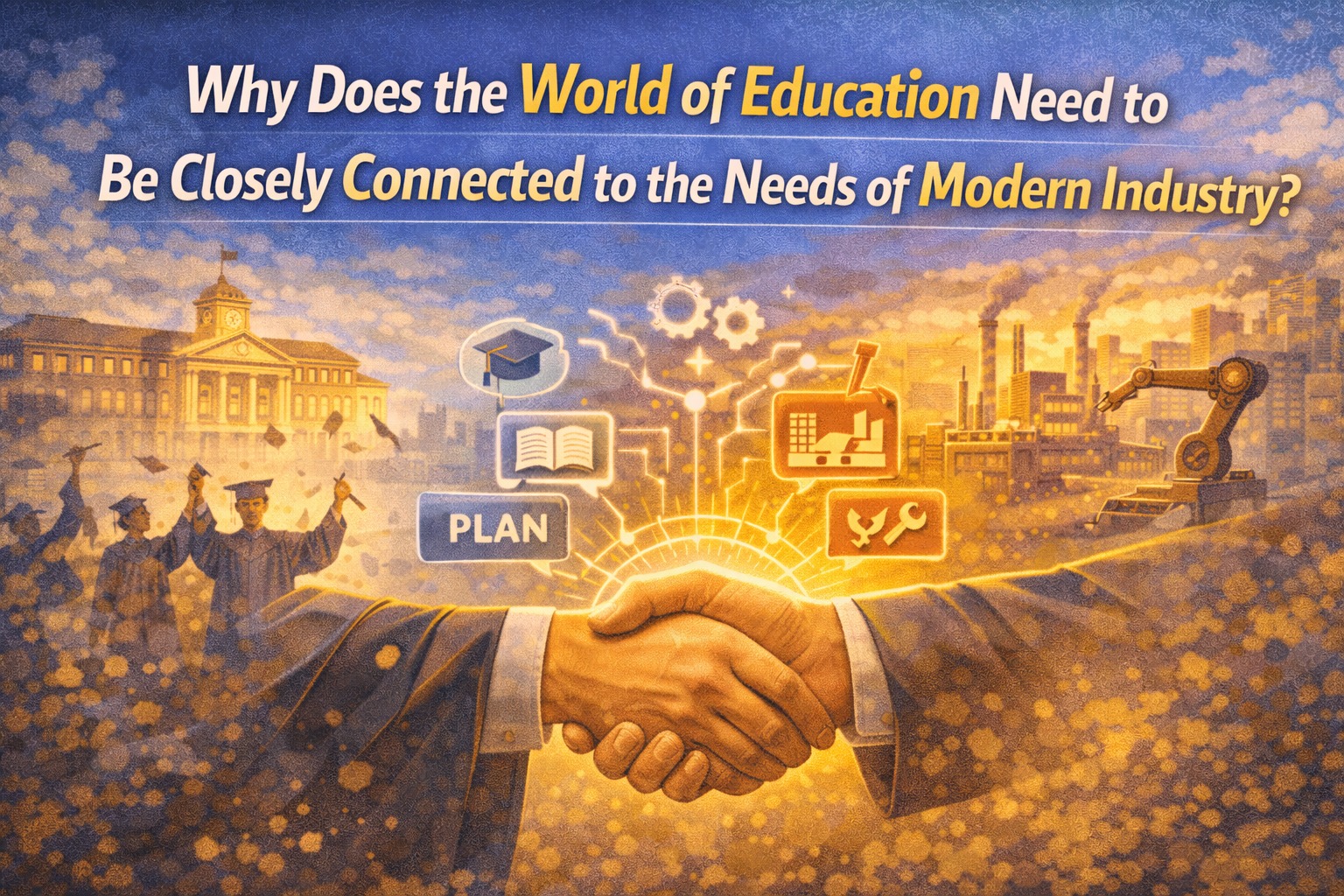
The world of education must be closely connected to the needs of modern industry because today’s job market demands relevant, adaptive, and job-ready competencies. Rapid technological advancements continuously change the skills required by industries, making education no longer sufficient if it focuses only on theory. Instead, it must integrate practical experience, technological understanding, and essential soft skills needed in the workplace.
A strong connection between education and industry enables graduates to be better prepared for employment, while companies benefit from a workforce that meets their specific needs. This relationship ultimately creates a mutually beneficial ecosystem for students, educational institutions, and the industrial sector.
1. ENSURING GRADUATES HAVE SKILLS RELEVANT TO THE JOB MARKET
Industries continue to evolve, especially with the emergence of new technologies. If education fails to keep pace, graduates risk falling behind. Strong collaboration between universities and industry ensures that students learn skills that are truly needed in today’s workforce.
2. IMPROVING GRADUATES’ GLOBAL COMPETITIVENESS
Job competition is no longer limited to domestic institutions but extends across national borders. With curricula aligned to modern industry demands, students are better prepared to compete globally and possess competencies comparable to international talent.
3. ENCOURAGING INNOVATION THROUGH ACADEMIC–INDUSTRY COLLABORATION
When education and industry collaborate, innovation thrives through:
* joint research,
* new technology development,
* real-world projects tested directly in the field.
This transforms campuses into innovation hubs that benefit society beyond academic learning.
4. BRIDGING THE GAP BETWEEN THEORY AND PRACTICE
Universities provide knowledge, while industry offers real-world experience. When both are connected, students can:
* understand how theory is applied,
* observe real industry challenges,
* learn to solve practical problems.
This prepares graduates to be job-ready from day one.
5. MAKING LEARNING MORE CONTEXTUAL AND RELEVANT
Learning materials become directly linked to:
* future careers,
* technological trends,
* real industry needs.
This approach increases student engagement and helps them better understand their career direction.
6. SUPPORTING THE DEVELOPMENT OF JOB-READY TALENT
Strong university–industry connections produce graduates who are not only knowledgeable but also ready to work. They are familiar with:
* professional environments,
* workplace rhythms,
* industry standards,
* digital tools,
* modern work culture.
7. INCREASING GRADUATE EMPLOYABILITY
The closer universities are to industry, the greater the opportunities for students to:
* participate in internships,
* receive mentorship,
* join industry training programs,
* even secure employment before graduation.
This helps reduce graduate unemployment while improving workforce quality.
CONCLUSION
A strong connection between education and modern industry is essential for producing competent, adaptive, and job-ready graduates. The sooner educational institutions collaborate with industry, the greater the chances for students to succeed in their future careers.
Tentang Penulis
Gusti Ayu Tita
Penulis — Universitas STEKOM
Penulis aktif yang berfokus pada isu-isu akademik, teknologi pendidikan, dan pengembangan sumber daya manusia di lingkungan kampus.