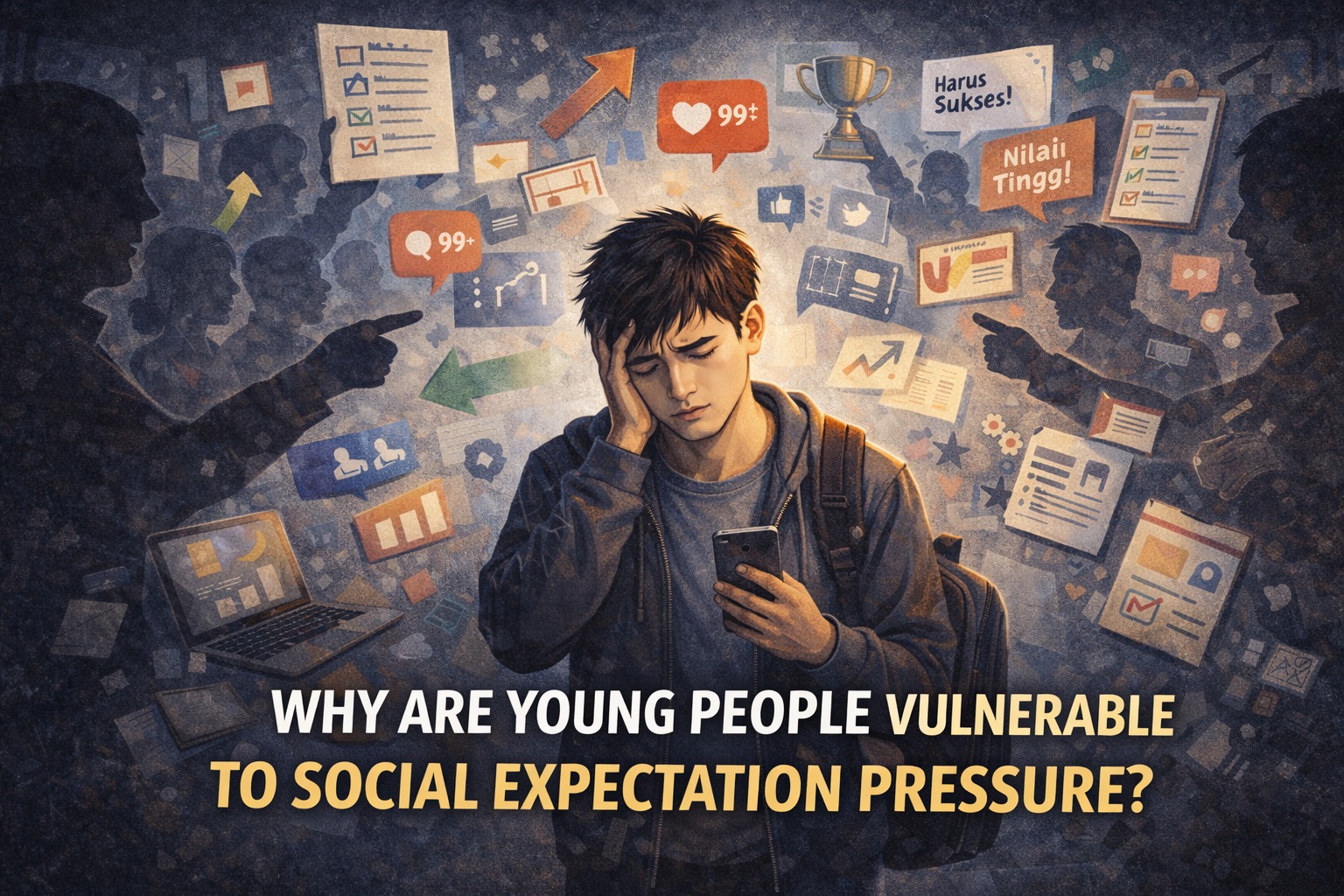
Young people are often described as the freest generation in history. Access to information is open, opportunities are vast, and freedom of expression seems limitless. Yet behind this freedom lies a major irony—the more choices available, the greater the pressure. Social expectations grow like a giant shadow, silently burdening young people’s learning processes and personal development.
So, why are young people so vulnerable to social expectation pressure?
AN OVERLY NOISY SOCIAL ENVIRONMENT
Young people live in an era where external voices rarely fall silent. Family, schools, peers, and social media continuously present standards of what an “ideal life” should look like.
Unconsciously, these environments create unwritten demands:
Must achieve early
Must know life direction quickly
Must succeed before a certain age
This pressure can feel like a race with no finish line—exhausting, isolating, and frightening.
SOCIAL MEDIA AND FALSE STANDARDS OF PERFECTION
Social media accelerates the spread of social expectations in subtle ways. Other people’s achievements are displayed without the struggles behind them, making success appear effortless.
For young people, this fuels extreme social comparison. Learning, which should be a space for exploration, turns into a stage for constant proof. When others’ lives appear “perfect,” even small failures can feel devastating.
AN IDENTITY STILL IN THE PROCESS OF FORMATION
Youth is a phase of identity exploration. At this stage, individuals are still discovering their values, interests, and life goals. Unfortunately, this process is often disrupted by overwhelming external expectations.
Instead of asking, “What do I want to learn?” many young people focus on “What do others expect from me?” As a result, identity is shaped by pressure rather than self-awareness.
ACHIEVEMENT PRESSURE AS A MEASURE OF SELF-WORTH
In many environments, academic success and material achievements are seen as the primary indicators of value. Grades, rankings, and titles often overshadow the learning process itself. Consequently, young people learn to fear failure—not because failure is bad, but because it means disappointing others. Over time, this pressure erodes confidence and strips learning of its meaning.
THE LACK OF SAFE SPACES TO FAIL
Ironically, failure is essential for personal growth. Yet young people are rarely given safe spaces to fail and recover. Minor mistakes are often magnified, while expectations for success continue to rise.
In such conditions, mental pressure becomes inevitable. Many feel they must stay strong at all times, forgetting that fatigue is not weakness, but a signal.
THE IMPORTANCE OF AWARENESS AND BOUNDARIES
Facing social expectations does not mean rejecting all external hopes. What matters is awareness—being able to distinguish expectations that are constructive from those that are burdensome.
Young people need to understand that personal development is not always linear or fast. Slow progress, uncertainty, and even getting lost still hold value. Life is not a never-ending stage for validation, but a long journey of self-discovery.
CONCLUSION
Young people are vulnerable to social expectation pressure because they live amid demands that are often unrealistic. These pressures come from multiple directions and subtly infiltrate the learning process. By fostering self-awareness, safe spaces, and more humane definitions of success, young people can reclaim learning as a process of growth rather than a destructive burden.
Tentang Penulis
Gusti Ayu Tita
Penulis — Universitas STEKOM
Penulis aktif yang berfokus pada isu-isu akademik, teknologi pendidikan, dan pengembangan sumber daya manusia di lingkungan kampus.