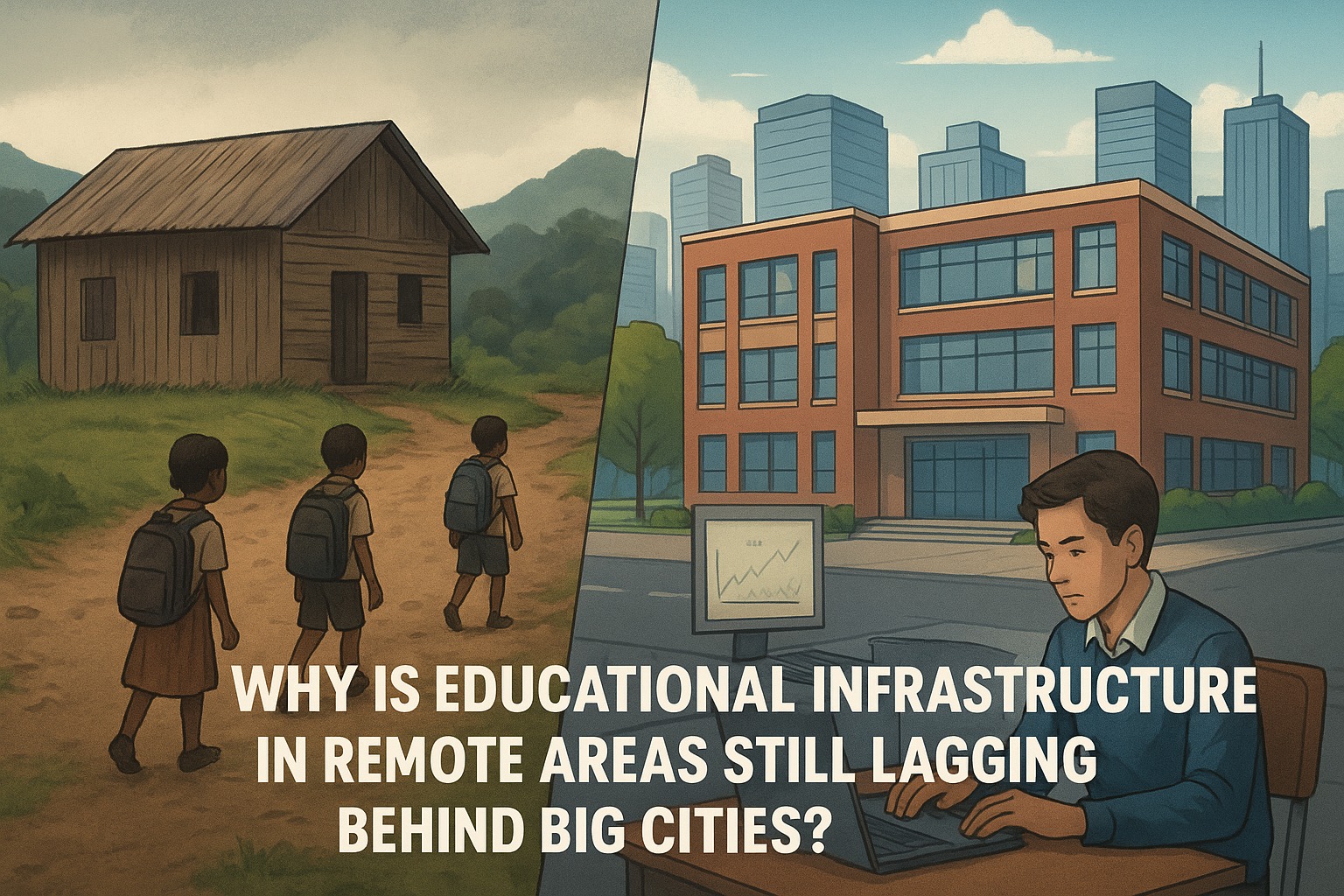
Educational development is one of the main foundations of a nation’s progress. However, the quality of education in Indonesia still faces significant gaps. One of the biggest challenges is the lagging educational infrastructure in remote areas compared to the facilities available in major cities. So, what causes this issue? Why does it continue to occur even though the government keeps pushing for development efforts?
This article explains the key factors behind the underdeveloped educational infrastructure in remote regions and its impact on students’ learning quality.
CONDITION OF EDUCATIONAL INFRASTRUCTURE: BIG CITIES VS REMOTE AREAS
The differences between schools in big cities and those in remote regions can be seen clearly in several aspects:
Availability of Proper Classrooms
In cities, schools generally have well-maintained permanent buildings, while in remote areas many schools still rely on semi-permanent structures—some even close to collapsing.
Teaching and Learning Facilities
Urban schools are equipped with laboratories, libraries, computers, internet access, and multimedia rooms. On the other hand, many remote schools only have very basic facilities.
Access to Transportation and Electricity
Some schools in remote regions are difficult to reach due to poor road conditions. Problems with electricity and internet connectivity also severely hinder the learning process.
CAUSES OF UNDERDEVELOPED EDUCATIONAL INFRASTRUCTURE IN REMOTE AREAS
a. Geographical Challenges
Certain regions have extreme geographical conditions, such as mountainous areas, small islands, and border regions. Building infrastructure in these locations requires higher costs and longer time.
b. Limited Budget Allocation
Although the education budget continues to increase, its distribution is not always equitable. Remote areas often face high construction costs due to difficult access.
c. Lack of Skilled Workers
Constructing schools requires builders, supervisors, electricians, and internet technicians. In remote areas, skilled workers are hard to find, causing delays in development.
d. Uneven Development Priorities
Some local governments prioritize development in city centers, leaving rural and remote regions with less attention and fewer resources.
e. Limited Basic Infrastructure
Without proper roads, reliable electricity, and access to technology, school construction and improvement efforts naturally become limited.
IMPACTS OF LAGGING EDUCATIONAL INFRASTRUCTURE
Infrastructure inequality affects more than just buildings and facilities—it impacts the overall quality of education:
- Decreased motivation to learn due to uncomfortable and unsafe learning environments.
- Lost opportunities for digital-based learning, especially as technology becomes increasingly important in education.
- Lower teaching quality, since many educators are reluctant to work in areas with inadequate infrastructure.
- Unequal future opportunities for students in remote areas compared to those in urban regions.
EFFORTS TO REDUCE THE INEQUALITY
a. Accelerating Basic Infrastructure Development
Improving road access, electricity, and internet connectivity must be prioritized to support school development.
b. Utilizing Educational Technology
Digital platforms, online classes, and mobile learning devices can help bridge the educational gap.
c. Government–Private Sector Partnerships
Corporate CSR programs can contribute to building schools or providing learning facilities.
d. Fairer Budget Allocation
More equitable distribution of funds and strict oversight are necessary to ensure resources reach remote regions.
CONCLUSION
The lagging educational infrastructure in remote areas is a complex issue influenced by geographical, economic, and policy-related factors. However, with the right strategies, cross-sector collaboration, and fair budget distribution, Indonesia can move toward a more equal education system.
Infrastructure development is not just about constructing buildings—it is about opening better future opportunities for every student, no matter where they live.
Tentang Penulis
Gusti Ayu Tita
Penulis — Universitas STEKOM
Penulis aktif yang berfokus pada isu-isu akademik, teknologi pendidikan, dan pengembangan sumber daya manusia di lingkungan kampus.