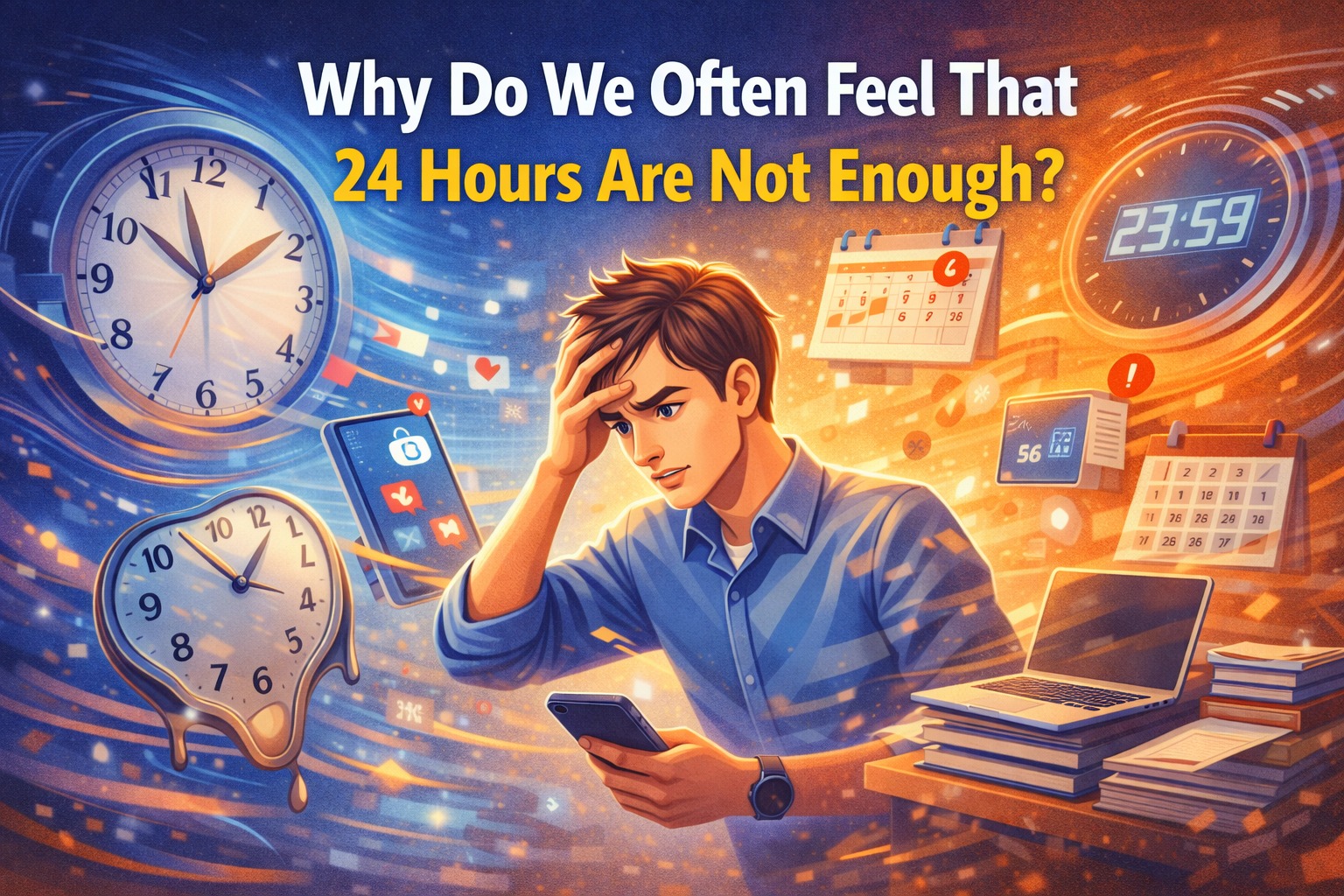
Have you ever looked at the clock and been shocked to realize it is already late afternoon, while your to-do list is still long? The phrase “I don’t have time” has become a modern mantra spoken by almost everyone—students, employees, and homemakers alike. Ironically, time is the fairest resource in the world. A billionaire, a president, and a part-time worker all have exactly the same allocation: 24 hours a day. If the amount of time is the same, why can some people accomplish great things and still rest, while others feel breathless due to a lack of time? The answer rarely lies in insufficient duration but rather in leaked focus and flawed perceptions of time itself. Here are the fundamental reasons why your days feel so short.
THE ILLUSION OF BUSYNESS IN THE DIGITAL ERA
We live in an era where being “busy” is often mistaken for being “productive.” In reality, these two are very different. You may spend hours replying to instant messages, checking social media notifications, or attending meetings without clear agendas. At the end of the day, you feel extremely exhausted, yet no substantial work has been completed.
This phenomenon is often referred to as time fragmentation. Our attention is divided into small chunks of five or ten minutes due to digital distractions. As a result, we lose the ability to enter a state of deep work. The 24 hours feel insufficient because most of that time is spent switching focus rather than completing meaningful tasks.
THE UNCONSCIOUS APPLICATION OF PARKINSON’S LAW
There is a well-known productivity principle called Parkinson’s Law, which states: “Work expands to fill the time available for its completion.”
If you give yourself one week to complete a report that could realistically be finished in three hours, your brain will psychologically make the task feel heavier and more complex, causing it to actually take a week. We often feel short on time because we fail to set tight internal deadlines. As a result, simple tasks drag on throughout the day without us realizing it.
LOSING OUR MAIN PRIORITIES
Another reason time feels scarce is that we try to do everything. We live in a culture of FOMO (Fear of Missing Out), where we are afraid of missing trends, news, or opportunities. We say “yes” to too many requests and pile up responsibilities that are not actually our priorities.
When everything is considered important, nothing truly is. Our time is spent putting out “small fires” and serving other people’s agendas. When it is finally time to work on our own dreams or personal goals, our energy and time are already depleted. This feeling of lacking time is actually regret over not allocating time to what truly matters.
AN ENERGY PROBLEM, NOT A TIME PROBLEM
Often, time management issues are actually energy management issues. Think about moments when you are sick with the flu or extremely tired. Simple tasks like replying to emails can take an hour because your brain struggles to concentrate. Conversely, when your body is fit and your mind is fresh, the same tasks can be completed in ten minutes.
We feel that 24 hours are not enough because we work against our biological rhythms. We force ourselves to stay up late, eat poorly, and remain inactive. As a result, work efficiency drops dramatically. We need three times longer to complete tasks that should be quick. So, it is not that time is lacking, but that our capacity to use it has declined.
THE TRAP OF SOCIAL COMPARISON
The final psychological factor is the habit of comparing ourselves to others. Social media displays curated glimpses of seemingly perfect lives: waking up early, exercising, working successfully, and still socializing. Seeing this makes our own daily achievements feel insignificant.
This anxiety creates a distorted perception of time. We feel pressured to run faster to catch up with an imaginary gap. This mental pressure makes time feel like it is moving faster and more oppressively, leaving us constantly feeling short on time.
Changing this feeling begins with stopping the blame on the clock. Start with an honest audit of where your attention goes, learn to say no, and take care of your physical energy. Twenty-four hours is more than enough when used for the right things.
**Keywords:**
Tentang Penulis
Gusti Ayu Tita
Penulis — Universitas STEKOM
Penulis aktif yang berfokus pada isu-isu akademik, teknologi pendidikan, dan pengembangan sumber daya manusia di lingkungan kampus.