
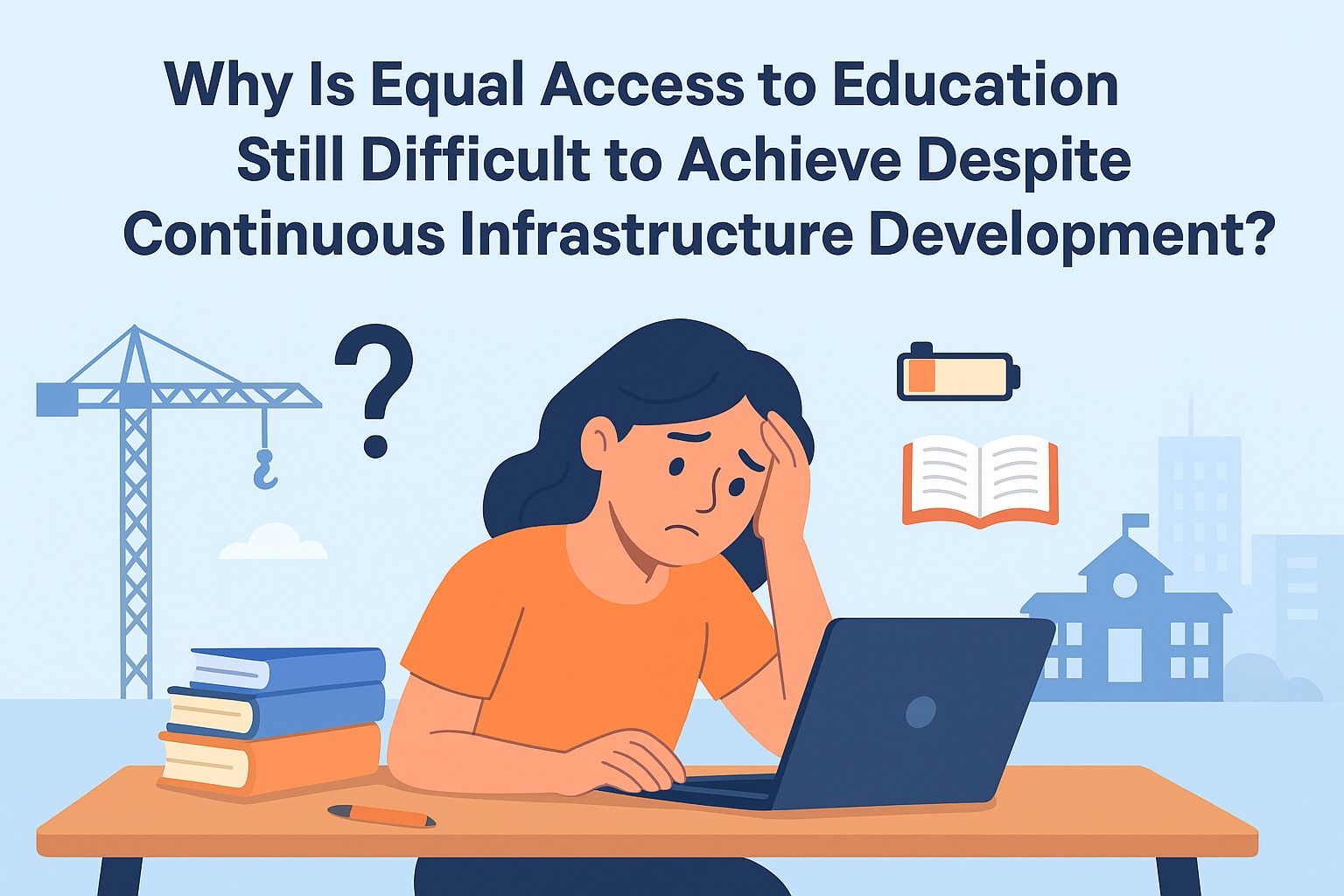
Equal access to education is one of the major goals of the Indonesian government in creating high-quality human resources across all regions. Various school infrastructure developments have been carried out, especially in underdeveloped areas. However, despite ongoing physical development, educational inequality remains a serious issue. So, why has equal access to education not been fully achieved?
INFRASTRUCTURE ALONE IS NOT ENOUGH
Infrastructure development is indeed essential as the foundation of education. However, equal access to education does not rely solely on physical facilities. There are other supporting factors that are equally important to ensure all students have equal learning opportunities.
Key Challenges That Still Persist:
- Uneven distribution of teachers
- Differences in teacher quality between regions
- Limited access to technology and internet connectivity
- Socioeconomic disparities among communities
- Lack of additional educational support services
If these factors are not addressed, the construction of school buildings will not deliver maximum results.
INEQUALITY IN TEACHING QUALITY
Teachers play a crucial role in determining the quality of learning. However, many remote areas face a shortage of teachers, especially highly qualified ones.
Impacts of Teacher Inequality:
- Learning processes do not run optimally
- Students struggle to keep up with updated curricula
- Limited opportunities to enhance students’ competencies
As a result, even with new school buildings, the quality of learning remains far behind.
SOCIOECONOMIC CHALLENGES IN COMMUNITIES
A family’s ability to support educational needs greatly influences student success. Children from low-income families often face obstacles such as
- Lack of funds for transportation and school supplier
- The need to help parents with work
- Low awareness of the importance of education
This contributes to higher dropout rates in several regions.
UNEQUAL ACCESS TO TECHNOLOGY
The digital era demands technological skills as part of modern learning. However:
- Many schools in remote areas lack internet access
- Digital devices remain too expensive
- Teachers are not fully proficient in using technology
As a result, the benefits of digital learning are only enjoyed by certain areas.
EFFORTS NEEDED TO ACHIEVE EDUCATIONAL EQUITY
To truly equalize education, the solutions offered must be comprehensive—not merely focused on physical development.
Strategic Steps:
- Enhancing teacher competencies through intensive training
- Providing technology facilities tailored to each school’s needs
- mplementing educational assistance programs for low-income families
- Encouraging collaboration between government, private sectors, and communities in funding education
- Conducting continuous evaluation and mapping of educational quality in every region
A multidimensional approach will bring more tangible outcomes for educational equality.
CONCLUSION
Why hasn’t equal access to education been achieved even though infrastructure continues to improve?
Because physical development is only one part of a much larger challenge. Educational equity requires support in teaching quality, technology, economic stability, and community welfare.
With comprehensive strategies and consistent implementation, Indonesia can achieve fairer and more equitable education for all its young generations.
Tentang Penulis
Gusti Ayu Tita
Penulis — Universitas STEKOM
Penulis aktif yang berfokus pada isu-isu akademik, teknologi pendidikan, dan pengembangan sumber daya manusia di lingkungan kampus.



