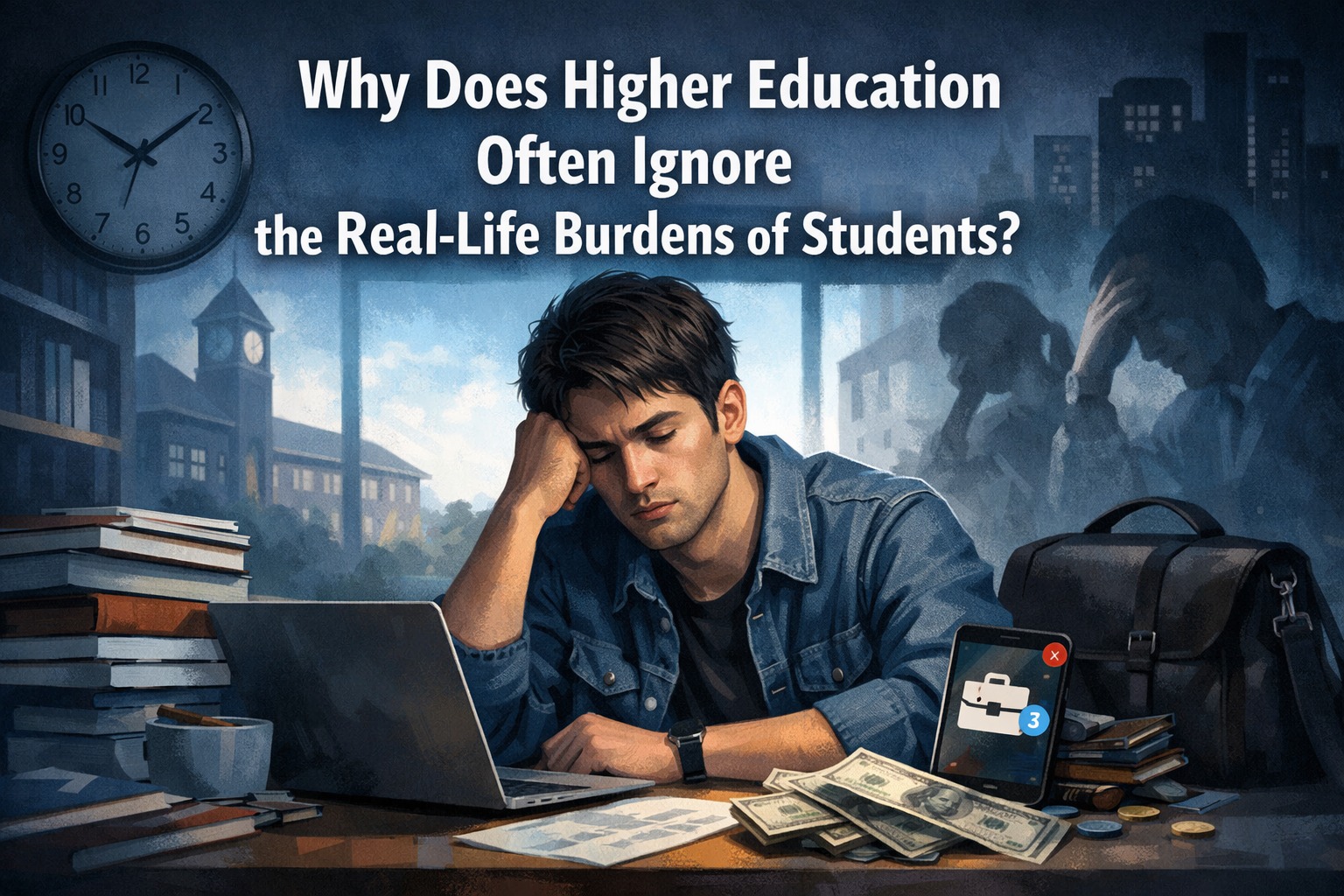
Higher education is often positioned as an ideal space—a place for thinking, discussion, and intellectual development. In practice, however, many students face realities that are far from ideal. Economic pressure, work demands, family responsibilities, and limited time are part of their daily lives.
The question is simple but uncomfortable: why does higher education often ignore the real-life burdens of students? Is the system outdated, or have students’ realities never truly been taken into account?
OUTDATED ASSUMPTIONS THAT ARE STILL MAINTAINED
One of the root problems lies in old assumptions that have yet to be abandoned. Many higher education systems still operate on the belief that students:
- Have learning as their sole focus
- Possess sufficient financial support
- Do not bear economic responsibilities
- Are fully able to follow a full-time academic rhythm
These assumptions may have made sense decades ago, when higher education was accessible only to certain groups. Today, as higher education becomes more inclusive, such assumptions are no longer relevant and are deeply unfair.
EXCESSIVE FOCUS ON ADMINISTRATION AND FORMALITIES
Higher education is also often trapped in formalities:
- Physical attendance is valued more than quality of understanding
- Academic grades outweigh the learning process
- Administrative systems run neatly, while the people within them are left behind
In such systems, students’ living conditions have no place. As long as assignments are submitted and grades are recorded, everything is considered fine.
Behind the scenes, however, many students study while exhausted, stressed, and merely surviving.
HIGHER EDUCATION SHOULD START FROM REALITY
Throughout history, strong education has always emerged from real life, not from sterile spaces. Higher education should:
- Recognize students as adults
- Understand that learning and living happen simultaneously
- Teach resilience, not just compliance
- Serve as a training ground for reality, not an escape from it
Academic standards do not need to be lowered. What must change is how the human beings within the system are viewed.
DIRECT IMPACT ON STUDENTS
This neglect is not without consequences. Students experience:
- Declining learning quality
- Prolonged stress
- A disconnect between education and real life
- Cynicism toward education itself
When higher education feels detached from lived reality, students no longer see it as a formative process, but merely as an administrative obligation to obtain a degree.
CONCLUSION
Higher education often ignores students’ real-life burdens because it remains tied to outdated assumptions, excessive formalities, and a fear of change. Meanwhile, students’ realities continue to move forward without waiting for the system to catch up.
If higher education is to remain meaningful, it must be willing to confront reality as it is. Because good education is not the neatest on paper, but the most relevant to real life.
Tentang Penulis
Gusti Ayu Tita
Penulis — Universitas STEKOM
Penulis aktif yang berfokus pada isu-isu akademik, teknologi pendidikan, dan pengembangan sumber daya manusia di lingkungan kampus.