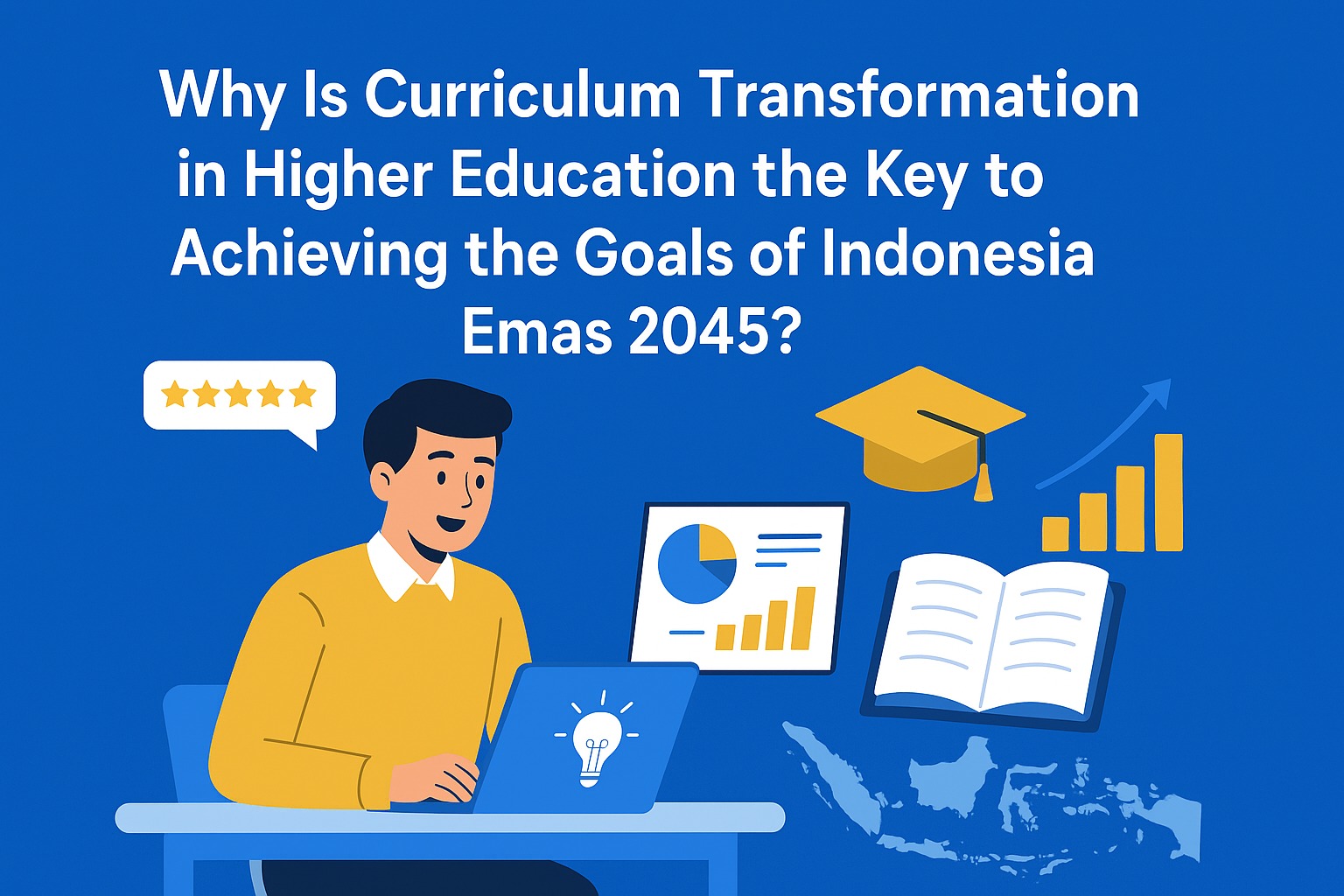
Indonesia has set its sights on the Golden Indonesia 2045 vision—a pivotal milestone where the nation aims to become a fully developed country with highly competitive and excellent human resources (HR). To achieve this vision, universities play a crucial role, particularly through curriculum transformation that is more adaptive, relevant, and innovative. But why is curriculum reform so essential? And how will this transformation shape Indonesia’s future?
THE MEANING OF CURRICULUM TRANSFORMATION IN THE MODERN ERA
Curriculum transformation today is no longer just about updating teaching materials; it involves a comprehensive shift in educational perspectives. Universities must:
- Align learning with technological advancements
- Effectively integrate both soft skills and hard skills
- Prepare students for future jobs that may not yet exist
By implementing an up-to-date curriculum, universities can produce graduates equipped with global competencies.
WHY CURRICULUM TRANSFORMATION IS KEY TO ACHIEVING GOLDEN INDONESIA 2045
1. Responding to Future Industry Needs
Industry 4.0 and Society 5.0 require a workforce capable of adapting to automation, artificial intelligence, and digitalization. Without curriculum renewal, universities risk producing graduates who fall behind labor market demands.
2. Strengthening Global Competitiveness
To achieve the Golden Indonesia vision, the nation’s workforce must be globally competitive. Curriculum transformation enables universities to design programs aligned with international standards and emerging global education trends.
3. Developing Creative and Innovative Human Resources
Modern curricula place greater emphasis on problem-solving, collaboration, research, and creativity—key elements for nurturing a generation that drives innovation rather than simply following existing trends.
4. Supporting the Research and Technology Ecosystem
Universities serve as national research centers. By adopting curricula that enhance research and technological development, they can produce innovations that directly support economic growth.
5. Expanding Access and Educational Equity
Curriculum transformation also includes digitalization and technology-based learning, allowing students across all regions to access quality education through online and hybrid learning systems.
EFFECTIVE STRATEGIES FOR CURRICULUM TRANSFORMATION
1. Integrating Digital Technology
The use of AI, simulations, virtual laboratories, and data-driven learning is essential to ensure education remains relevant and future-ready.
2. Strengthening Industry Collaboration
Curricula must be synchronized with industry needs, enabling students to gain real-world experience through internships, collaborative projects, and industry mentorship.
3. Implementing Project-Based Learning
This approach encourages students to think critically and creatively while solving real-life problems.
4. Developing Flexible Curricula
Students should have the freedom to choose courses based on their interests, talents, and career aspirations, as promoted through the Merdeka Belajar Kampus Merdeka (MBKM) program.
5. Strengthening Soft Skills
Communication, teamwork, leadership, digital literacy, and time management must be integral components of modern curricula.
POSITIVE IMPACTS OF CURRICULUM TRANSFORMATION
When implemented effectively, curriculum reform enables universities to produce:
- Job-ready graduates who can create new opportunities
- Highly skilled HR capable of contributing to national technological innovation
- A generation that is critical, creative, and adaptive to global changes
- Increased national competitiveness on the international stage
All of these achievements contribute significantly to realizing the Golden Indonesia 2045 vision.
CONCLUSION
Curriculum transformation in higher education is not just important—it is the fundamental cornerstone of the Golden Indonesia 2045 mission. With a curriculum that is relevant, adaptive, and aligned with global developments, universities can produce excellent and innovative graduates who are prepared to face global challenges. This transformation forms a strong foundation for building a progressive, advanced, and highly competitive nation.
Tentang Penulis
Gusti Ayu Tita
Penulis — Universitas STEKOM
Penulis aktif yang berfokus pada isu-isu akademik, teknologi pendidikan, dan pengembangan sumber daya manusia di lingkungan kampus.