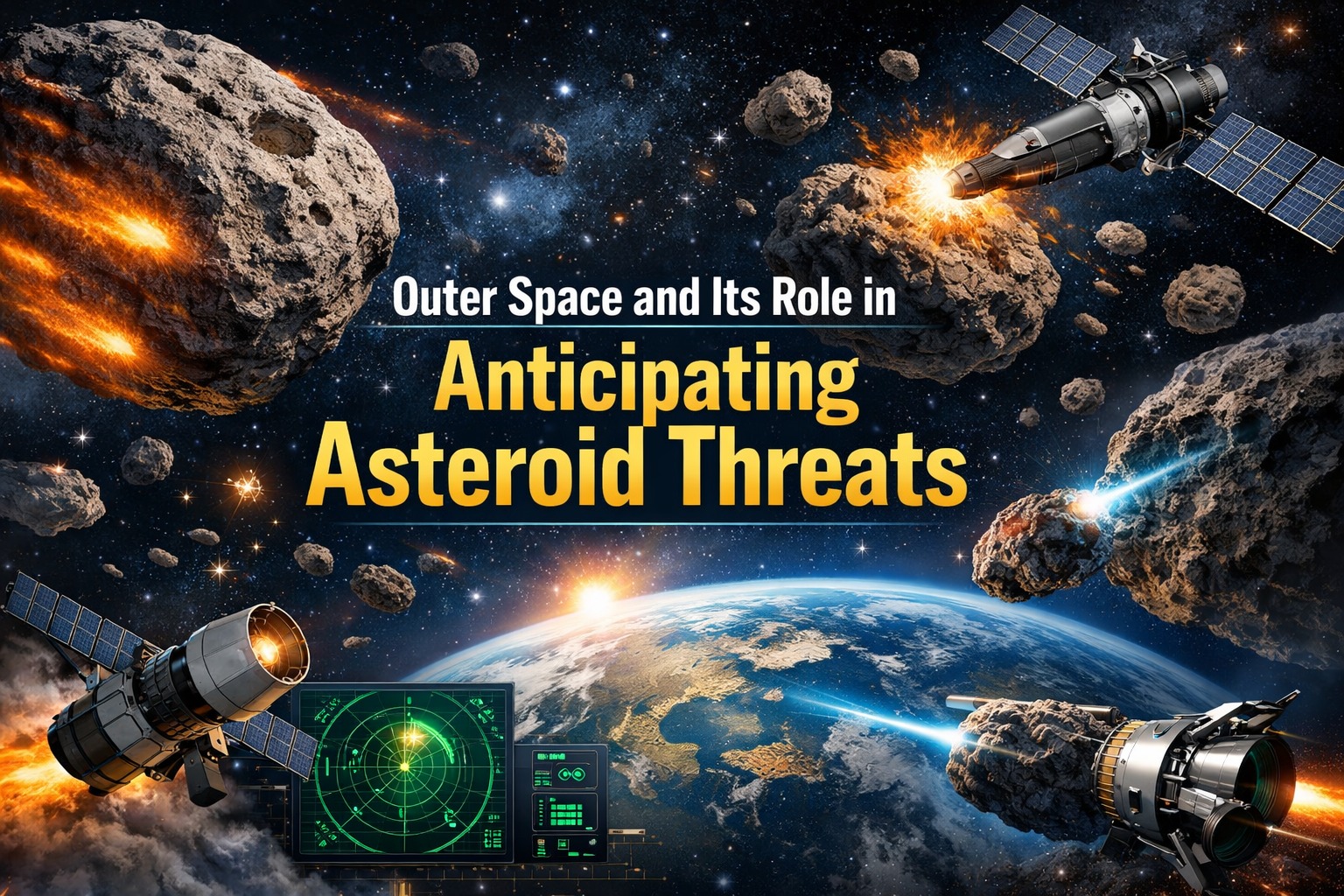
Outer space is not only a vast and mysterious frontier but also a crucial domain for protecting Earth from potential cosmic hazards. Among these threats, asteroids stand out as one of the most significant risks due to their unpredictable trajectories and potential to cause catastrophic damage upon impact. Understanding how outer space research helps anticipate asteroid threats is essential for safeguarding our planet’s future.
UNDERSTANDING ASTEROID THREATS
Asteroids are rocky objects that orbit the Sun, many of which are located in the asteroid belt between Mars and Jupiter. While most remain in stable orbits, some are nudged by gravitational forces into paths that cross Earth’s orbit. These are known as Near-Earth Objects (NEOs). When such objects come too close, they are considered potential threats.
The impact of a large asteroid can be devastating, leading to regional destruction or even global environmental consequences. This makes early detection and tracking a top priority for space agencies around the world.
THE ROLE OF SPACE OBSERVATORIES
Modern space observatories play a vital role in identifying and monitoring asteroids. Telescopes both on Earth and in orbit continuously scan the sky for moving objects. Advanced imaging technology allows scientists to detect even relatively small asteroids far from Earth.
Space-based telescopes have an advantage because they are not affected by atmospheric distortion. This enables clearer and more accurate detection of objects that might otherwise go unnoticed.
EARLY WARNING SYSTEMS AND TRACKING TECHNOLOGY
Once an asteroid is detected, its orbit is carefully calculated using advanced computer models. These models predict whether the asteroid’s path could intersect with Earth in the future. If a potential collision is identified, scientists can issue early warnings years or even decades in advance.
Organizations like NASA and ESA have developed dedicated planetary defense systems that continuously track thousands of NEOs. These systems are essential for providing timely data and reducing uncertainty about future risks.
PLANETARY DEFENSE STRATEGIES
Beyond detection, outer space research also focuses on developing methods to prevent asteroid impacts. One of the most well-known strategies is the kinetic impact method, where a spacecraft is sent to collide with an asteroid to slightly alter its trajectory.
Other theoretical approaches include gravitational tractors and nuclear deflection techniques. While some of these methods are still in development, recent missions have shown that asteroid deflection is scientifically possible.
THE IMPORTANCE OF INTERNATIONAL COOPERATION
Asteroid threats are a global concern, and no single country can address them alone. International collaboration between space agencies, research institutions, and governments is essential. Shared data and joint missions improve detection accuracy and ensure a coordinated response in case of danger.
Global initiatives also help raise public awareness about the importance of monitoring outer space and investing in planetary defense technologies.
CONCLUSION
Outer space research plays a critical role in anticipating and mitigating asteroid threats. Through advanced observation systems, predictive modeling, and international cooperation, humanity is becoming increasingly capable of detecting and responding to potential cosmic dangers. While the risk of a catastrophic impact remains low, continued investment in space science ensures that Earth is better protected for the future.
Tentang Penulis
Gusti Ayu Tita
Penulis — Universitas STEKOM
Penulis aktif yang berfokus pada isu-isu akademik, teknologi pendidikan, dan pengembangan sumber daya manusia di lingkungan kampus.