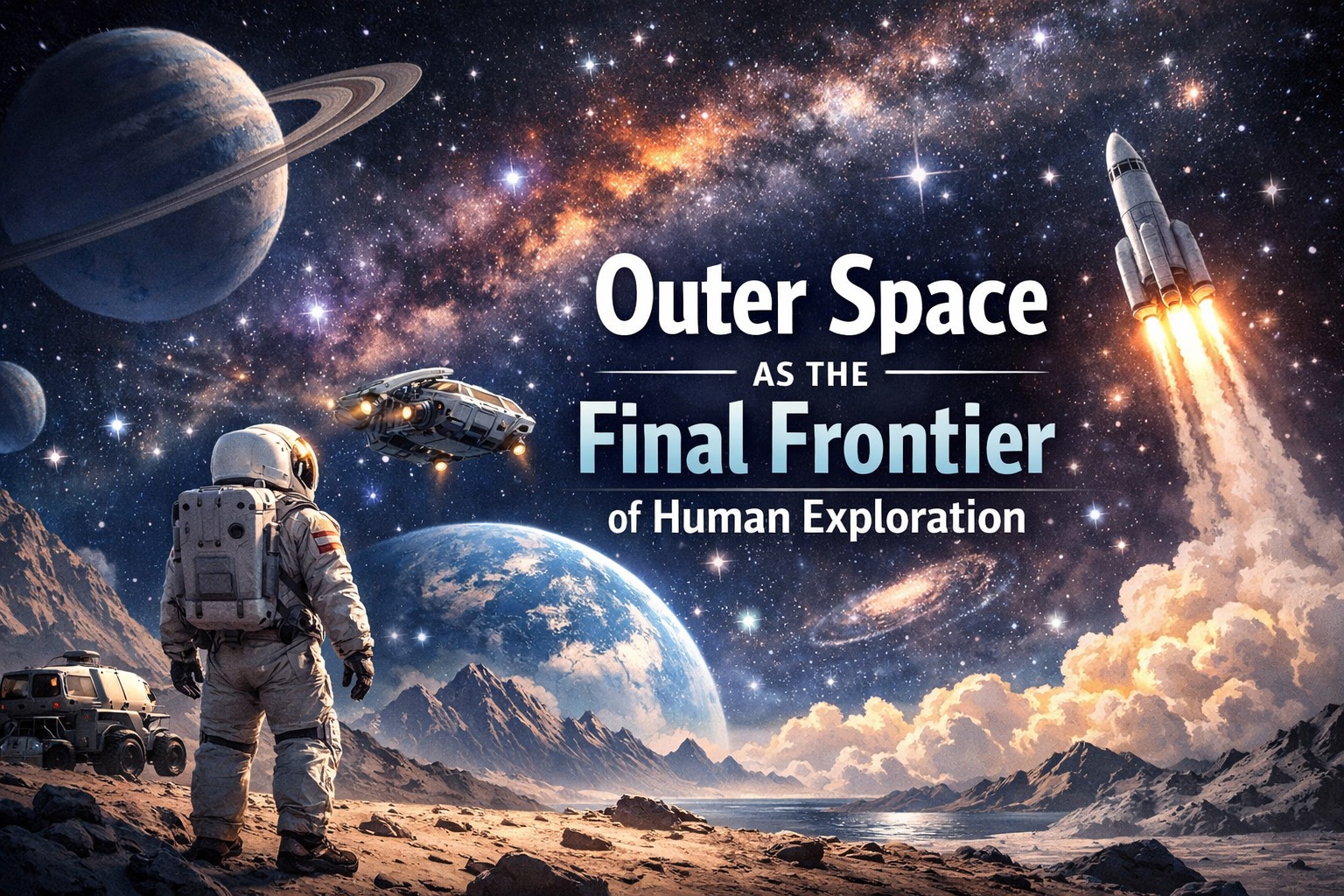
Outer space has long been regarded as the ultimate boundary of human curiosity and scientific ambition. From ancient civilizations observing the stars to modern space missions reaching distant planets, humanity has continuously sought to understand what lies beyond Earth. Today, outer space is not only a symbol of exploration but also a critical field for technological advancement, scientific discovery, and the future survival of human civilization.
THE MEANING OF THE FINAL FRONTIER
The term “final frontier” refers to the vast, largely unexplored region beyond Earth’s atmosphere. Unlike land or oceans, space presents an environment that is extreme, silent, and largely unknown. It challenges human limits in physics, biology, and engineering.
Space exploration is driven by the desire to answer fundamental questions: How did the universe begin? Are we alone? What resources exist beyond Earth? These questions make outer space the ultimate destination for exploration.
THE ROLE OF SPACE AGENCIES IN EXPLORATION
Modern space exploration is led by advanced organizations and companies that push the boundaries of human capability. One of the most influential is NASA, which has conducted missions ranging from the Moon landing to Mars rover explorations.
Similarly, European Space Agency contributes significantly to international space research, satellite systems, and interplanetary missions. In the private sector, SpaceX has revolutionized space travel with reusable rockets and ambitious plans for Mars colonization.
These organizations work together and independently to expand humanity’s reach into space, making exploration more efficient and accessible than ever before.
TECHNOLOGICAL ADVANCEMENTS BEYOND EARTH
Outer space exploration has driven rapid technological innovation. Satellite technology improves global communication, GPS navigation, and weather forecasting. Space telescopes allow scientists to observe galaxies billions of light-years away, revealing the structure of the universe.
Additionally, innovations in rocket engineering, robotics, and artificial intelligence are directly influenced by space missions. These advancements often return to Earth in the form of improved medical devices, transportation systems, and environmental monitoring tools.
WHY OUTER SPACE MATTERS FOR HUMANITY
Exploring space is not just about discovery; it is about survival and progress. Earth faces challenges such as climate change, overpopulation, and resource depletion. Space offers potential solutions, including alternative energy sources, asteroid mining, and even future human settlement beyond Earth.
Moreover, understanding space helps scientists better understand Earth itself. Climate systems, atmospheric behavior, and geological processes can all be studied more accurately through space-based observation.
THE FUTURE OF SPACE EXPLORATION
The future of space exploration is moving toward deeper and more ambitious goals. Plans for lunar bases, Mars colonization, and interstellar probes are already being developed. Private companies and international collaborations are expected to play a major role in this new era.
As technology continues to evolve, the possibility of humans living and working in space is becoming less science fiction and more scientific reality.
Outer space remains the final frontier not because it is unreachable, but because it constantly expands the limits of human understanding. Each discovery leads to new questions, ensuring that exploration will never truly end.
Tentang Penulis
Gusti Ayu Tita
Penulis — Universitas STEKOM
Penulis aktif yang berfokus pada isu-isu akademik, teknologi pendidikan, dan pengembangan sumber daya manusia di lingkungan kampus.