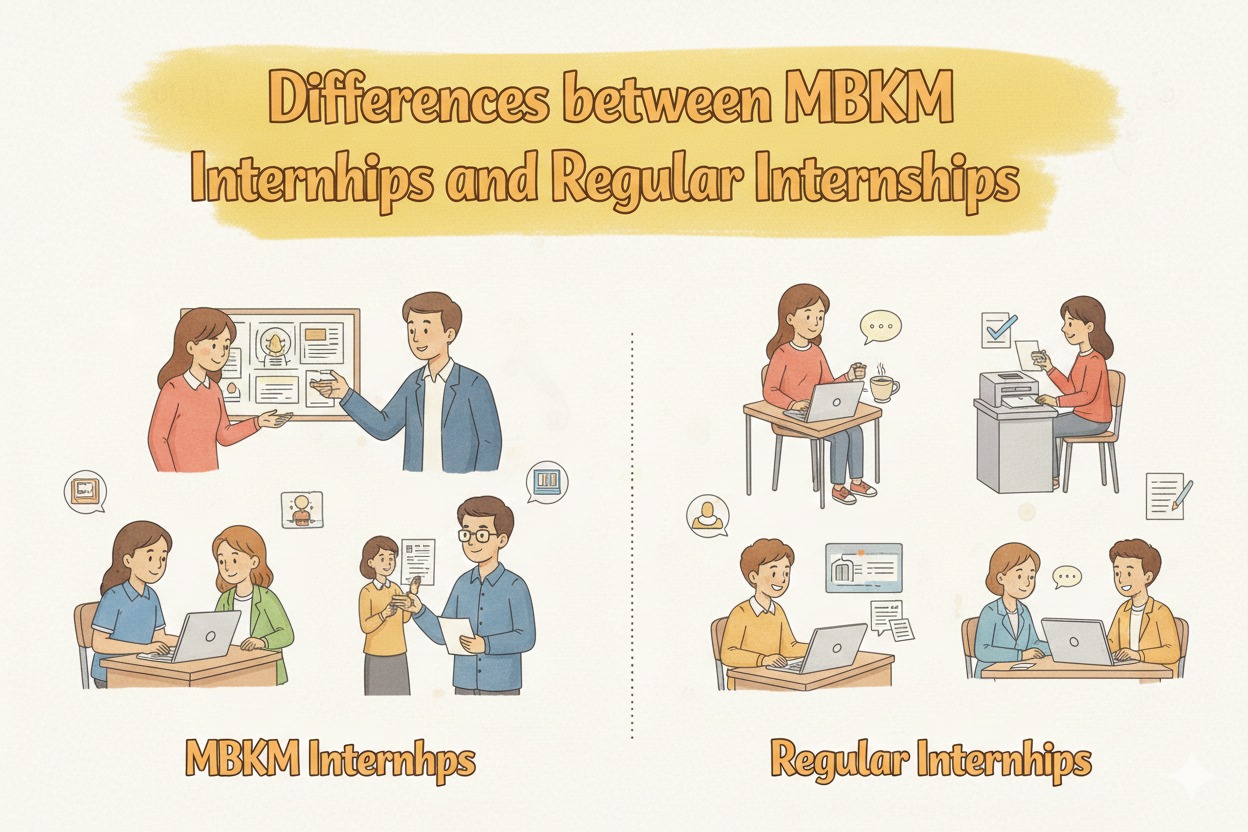
Internship MBKM vs Regular Internship: What’s the Difference?
Internship programs are one of the most important ways for students to understand the working world before graduating. Today, there are two common types of internships for students: MBKM internship and regular internship. Although both aim to provide work experience, they have significant differences. This article explains the differences between MBKM internships and regular internships so students can choose the program that best suits them.
DEFINITION OF MBKM INTERNSHIP
MBKM internship is part of the “Merdeka Belajar Kampus Merdeka” program initiated by the Ministry of Education, Culture, Research, and Technology. This program gives students the opportunity to learn outside campus for one to two semesters.
In MBKM internships, students can replace some academic credits (SKS) with internship activities at companies, government agencies, or partner organizations that collaborate with the campus.
DEFINITION OF REGULAR INTERNSHIP
A regular internship is a program that is generally required or recommended by the campus as an academic requirement, such as a practical work course or internship.
The duration of a regular internship is usually shorter than MBKM and does not always replace many credits. This program is more flexible and is often adjusted to the academic calendar of each university.
DIFFERENCE IN INTERNSHIP DURATION
One of the main differences between MBKM internships and regular internships is the duration. MBKM internships usually last 6 to 12 months, depending on the number of credits converted.
Meanwhile, regular internships typically last 1 to 3 months, depending on campus policy and student needs.
DIFFERENCE IN ACADEMIC CREDIT SYSTEM
In MBKM internships, internship activities can be converted into 20–40 credits, so students do not need to attend regular courses during the program.
In contrast, regular internships usually only convert to a few credits or simply become a graduation requirement without large credit conversion.
DIFFERENCE IN APPLICATION PROCESS
MBKM internship registration is usually done through the official MBKM platform or through campus with fairly strict procedures. Students must meet administrative requirements and be selected by partners.
Meanwhile, regular internships usually have a simpler application process. Students can find internships independently or through campus recommendations.
DIFFERENCE IN RESPONSIBILITY AND WORKLOAD
Because of its longer duration, MBKM internships usually have greater responsibility and workload. Students are expected to contribute actively like junior employees.
In regular internships, the workload is usually lighter and focuses on introducing the work environment and applying basic knowledge learned at campus.
DIFFERENCE IN BENEFITS
MBKM internships provide deeper work experience, broader professional networks, and greater career development opportunities.
While regular internships still provide initial work experience, the scale and intensity are more limited.
ADVANTAGES AND DISADVANTAGES OF EACH PROGRAM
MBKM internships have advantages in longer duration and larger credit conversion, but require high time and energy commitment.
On the other hand, regular internships are more flexible and do not interfere too much with class schedules, but the experience gained is relatively shorter.
CONCLUSION
The differences between MBKM internships and regular internships lie in duration, academic system, application process, and benefits gained. MBKM internships are suitable for students who want to focus on long-term work experience and career development. Meanwhile, regular internships are suitable for students who want to gain work experience without fully leaving campus activities. By understanding the differences, students can choose the internship that best matches their needs and future plans.
Tentang Penulis
Gusti Ayu Tita P
Penulis — Universitas STEKOM
Penulis aktif yang berfokus pada isu-isu akademik, teknologi pendidikan, dan pengembangan sumber daya manusia di lingkungan kampus.