
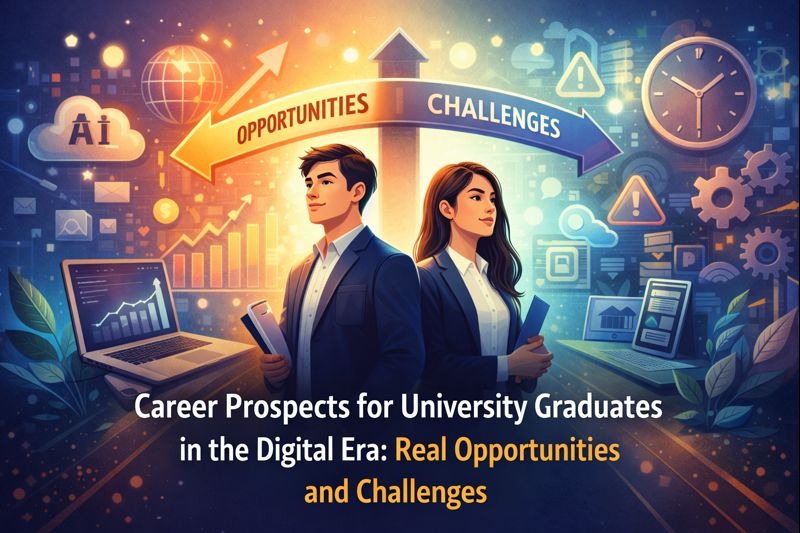
The rapid development of digital technology has transformed nearly every aspect of life, including the world of work. University graduates now face a new reality that differs significantly from previous generations. Academic degrees remain important, but they are no longer the sole determinant of career success. In the digital era, job opportunities are expanding, but competition and challenges are becoming increasingly intense.
This article discusses the career prospects for university graduates in the digital era, covering available opportunities as well as the challenges that must be addressed.
Changes in the World of Work in the Digital Era
The digital era is characterized by rapid advancements in technology such as the internet, artificial intelligence, big data, and automation. As a result, many new job roles have emerged, while some traditional jobs have declined or disappeared.
Companies now seek not only graduates with specific academic backgrounds but also individuals who are adaptable, technologically literate, and quick to learn new skills. Work systems have also become more flexible, including remote work, freelance arrangements, and project-based jobs.
Job Opportunities for University Graduates
Amid these changes, university graduates have many promising career opportunities, including:
1. Digital and Technology Fields
Graduates from various disciplines can enter the digital sector as digital marketers, data analysts, UI/UX designers, content strategists, or software developers. Interestingly, many of these roles emphasize skills and portfolios rather than specific academic majors.
2. Creative Industries
The digital era has accelerated the growth of creative industries. University graduates can work as content creators, copywriters, video editors, or social media specialists. Creativity and trend awareness are highly valuable assets.
3. Startups and Digital Companies
Digital startups provide numerous job opportunities for fresh graduates. Their dynamic work environments enable graduates to learn quickly, develop skills, and expand professional networks.
4. Flexible and Freelance Careers
Digitalization allows graduates to work freelance or remotely, even for international companies. This opens access to competitive income opportunities without geographical limitations.
Real Challenges That Must Be Faced
Despite abundant opportunities, university graduates also encounter serious challenges in the digital era:
1. Intense Competition
Graduates compete not only with fellow degree holders but also with bootcamp participants, course graduates, and self-taught professionals. Practical skills often become the key differentiator.
2. Skills Gap
Not all university graduates possess skills aligned with industry demands. Many companies report a gap between academic theory and real-world practice.
3. Demand for Rapid Adaptation
Fast-paced technological change requires continuous learning. Graduates who fail to adapt risk being left behind.
4. Mental Pressure and Expectations
High expectations after graduation can create psychological pressure, especially when securing a first job proves difficult. This presents a significant mental challenge for fresh graduates.
The Role of Higher Education in the Digital Era
Higher education institutions still play a crucial role in preparing graduates for the digital era. Universities are not merely places to earn degrees but also spaces for developing character, critical thinking, and analytical skills.
Collaboration between universities and industry, internship programs, real-world projects, and technology-based learning are key to improving graduate readiness. Students must also proactively develop themselves beyond the formal curriculum.
Strategies for University Graduates to Stay Relevant
To remain competitive in the digital era, university graduates should adopt the following strategies:
- Master basic digital skills aligned with personal interests
- Build a portfolio while still in university
- Actively participate in internships, organizations, or freelance projects
- Continuously learn through online courses and certifications
- Develop soft skills such as communication and problem-solving
With the right strategies, graduates can not only survive but thrive amid changes in the world of work.
Conclusion
Career prospects for university graduates in the digital era remain highly promising and more diverse than ever before. However, these opportunities come with real challenges. Academic degrees must be supported by skills, experience, and an adaptive mindset.
Graduates who can leverage technology, continuously learn, and step outside their comfort zones will be better positioned in the digital workplace. In this era, success belongs not to those who are the smartest, but to those who are the most prepared for change.
**Keywords:**
Tentang Penulis
Gusti Ayu Tita
Penulis — Universitas STEKOM
Penulis aktif yang berfokus pada isu-isu akademik, teknologi pendidikan, dan pengembangan sumber daya manusia di lingkungan kampus.



