Higher Education and Equal Access: Does KIP Kuliah Truly Reach All Regions?
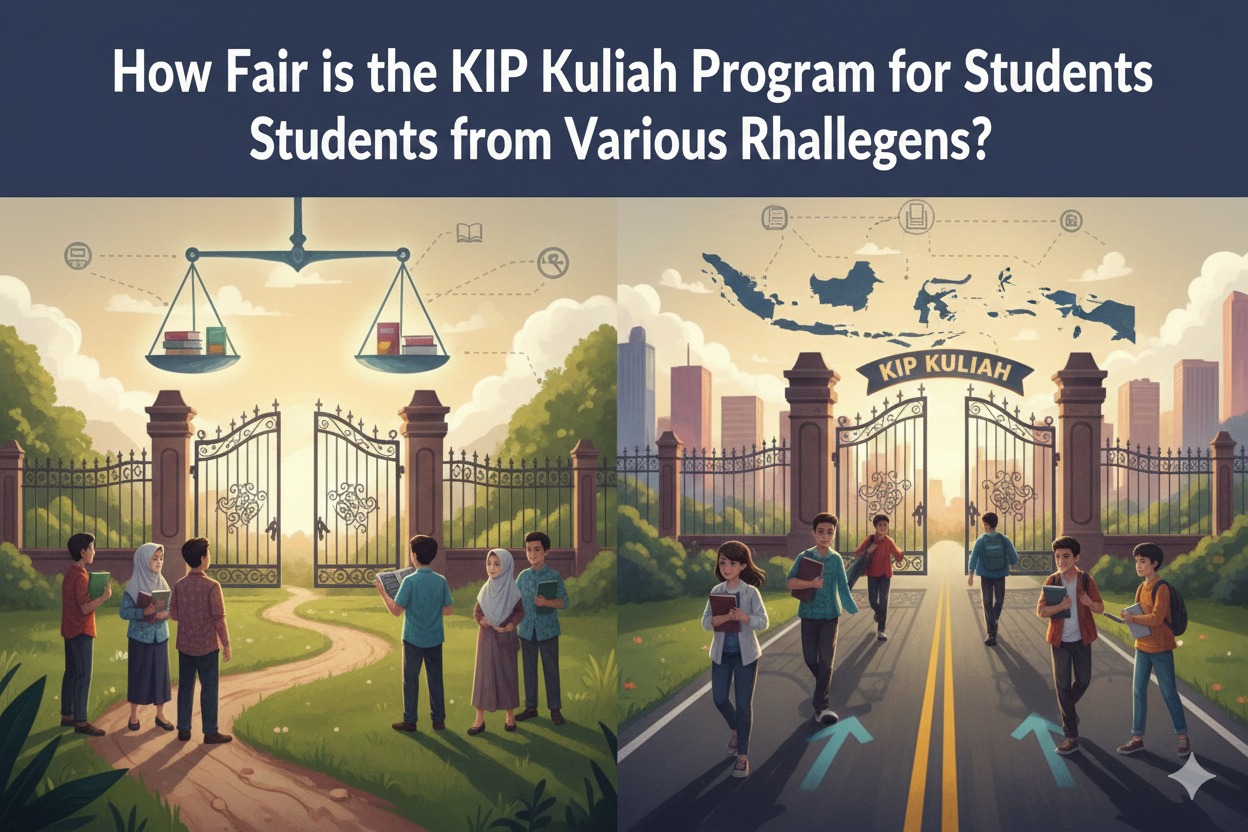
Higher education serves as a gateway to a brighter future. However, in Indonesia, economic and geographic disparities remain major barriers for many students who wish to pursue university education. In response, the government introduced the Kartu Indonesia Pintar Kuliah (KIP Kuliah) program as a commitment to expanding equal access to higher education across all regions of the country. This raises an important question: does the KIP Kuliah program truly provide fairness for students from different regions, or is it still dominated by certain areas?
THE GOALS AND BASIC PRINCIPLES OF KIP KULIAH
KIP Kuliah is a government-funded financial aid program for economically disadvantaged students who demonstrate strong academic potential and motivation. Its main objectives include:
* Ensuring equal access to higher education,
* Increasing participation among students from low-income families,
* Removing financial barriers to continuing education,
* Promoting equitable human resource development throughout Indonesia.
The program is intended not only to benefit students in major cities but also to reach remote areas—from Sabang to Merauke.
REAL OPPORTUNITIES FOR STUDENTS FROM REGIONAL AREAS
KIP Kuliah has opened doors for many students outside Java who previously found it difficult to imagine attending university. Some positive impacts include:
* An increase in the number of students from underdeveloped and 3T regions (frontier, outermost, and disadvantaged areas),
* Broader access to both public and private universities across different regions,
* Improved confidence and motivation among regional students to compete in university admissions.
This program contributes to improving equity in higher education quality by giving all regions the opportunity to produce capable and competitive graduates.
PERSISTING INEQUALITIES IN IMPLEMENTATION
Despite its positive impact, realities on the ground show that equal distribution of KIP Kuliah benefits has not yet been fully achieved. Key challenges include:
* Unequal access to information, where urban students often receive updates and register faster than those in rural areas,
* Limited digital infrastructure, making online registration difficult in areas with unstable internet access,
* Uneven distribution of higher education institutions, as many highly accredited universities are concentrated on Java Island,
* Inconsistent selection and verification processes, resulting in unequal quotas among regions.
These issues create the perception that KIP Kuliah is more accessible to students in urban areas than those in remote regions.
STEPS TOWARD ACHIEVING REGIONAL EQUITY
To ensure that KIP Kuliah truly provides equal opportunities for all Indonesian students, several concrete actions are needed:
* Expanding program outreach to remote schools by involving local education authorities,
* Strengthening digital infrastructure to support smooth online registration in underserved areas,
* Increasing quotas for underdeveloped and 3T regions as a form of affirmative policy,
* Building strategic collaboration between universities and local governments to support KIP recipients sustainably.
Through these measures, the program can more accurately reflect social justice in the education sector.
CONCLUSION
KIP Kuliah has become an important breakthrough in expanding access to higher education for students from diverse economic backgrounds. However, geographic equity remains a significant challenge that must be addressed.
As long as access to information, infrastructure, and quota distribution remains uneven, educational equity will remain relative rather than absolute. Nevertheless, with sustained government commitment and community support, KIP Kuliah has the potential to become a truly fair and inclusive program for all Indonesian students—from urban centers to the most remote regions.
Tentang Penulis
Gusti Ayu Tita
Penulis — Universitas STEKOM
Penulis aktif yang berfokus pada isu-isu akademik, teknologi pendidikan, dan pengembangan sumber daya manusia di lingkungan kampus.