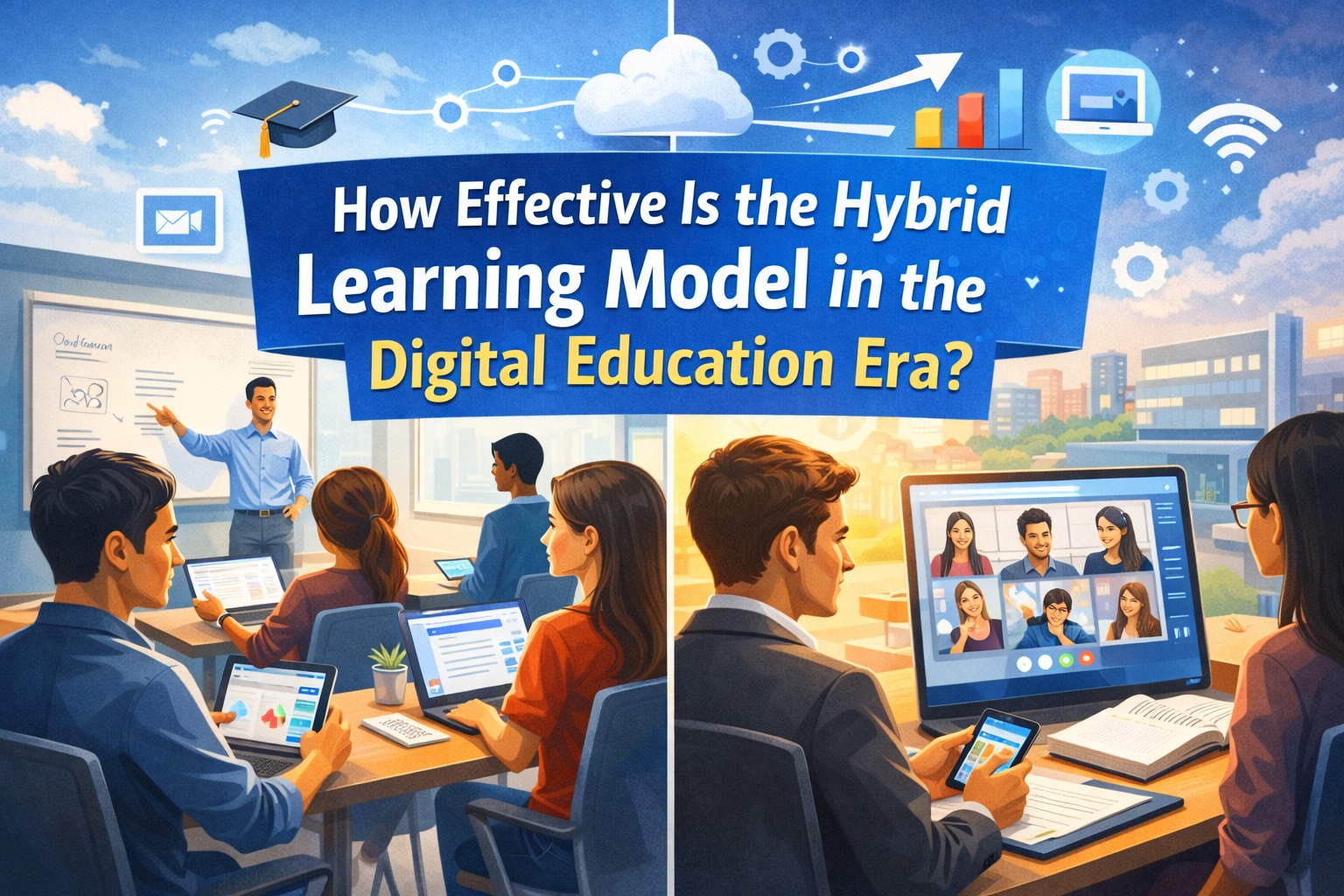
The development of digital technology has brought significant changes to the world of education. One innovation that has emerged and is widely implemented is the **hybrid learning model**—a combination of face-to-face learning and online learning.
This method is considered a flexible solution to address educational challenges in the digital era. However, an important question arises: how effective is the hybrid learning model in improving the quality and learning outcomes of students in today’s modern education system?
WHAT IS HYBRID LEARNING?
Hybrid learning is a learning model that combines conventional face-to-face instruction with online, technology-based learning methods.
In this system, some learning activities are conducted online using platforms such as Google Classroom, Zoom, or Learning Management Systems (LMS), while others are still carried out in physical classrooms.
This model aims to create a more flexible, interactive, and efficient learning experience by leveraging the strengths of both approaches.
ADVANTAGES OF THE HYBRID LEARNING MODEL
1. Flexibility of Time and Place
One of the greatest advantages of hybrid learning is flexibility. Students can access learning materials anytime and anywhere, without being restricted to specific times or locations.
2. More Personalized Learning
Teachers can tailor materials and teaching methods to suit the needs and abilities of each student, making the learning process more effective and engaging.
3. Utilization of Digital Technology
With the support of technology such as learning videos, online discussion forums, and interactive quizzes, students become more active and motivated to learn.
4. Cost and Time Efficiency
Schools can reduce operational costs such as electricity and stationery, while students can save travel time to and from school.
CHALLENGES IN IMPLEMENTING HYBRID LEARNING
1. Technology Access Gap
Not all students have adequate devices or stable internet connections, which can lead to inequality in access to education.
2. Readiness of Teachers and Students
Many teachers and students are still not fully accustomed to using digital technology in learning. Training and adaptation are needed to ensure effective learning processes.
3. Lack of Social Interaction
Physical presence in the classroom allows for more natural social interaction. In hybrid learning, some interactions take place online, which can reduce emotional closeness.
4. Discipline and Time Management
Online learning requires high levels of independence and responsibility. Without direct supervision, some students may struggle to manage their study time effectively.
EFFECTIVENESS OF HYBRID LEARNING BASED ON RESEARCH
Several studies show that the hybrid learning model is effective in improving student learning outcomes. According to the UNESCO Education Report (2023), students who participate in hybrid learning experience a 20–30% increase in knowledge retention compared to those who learn solely through conventional methods.
Additionally, a study from the Harvard Education Review revealed that combining online and face-to-face learning significantly increases student engagement, especially when teachers design interactive and adaptive learning experiences.
However, this effectiveness largely depends on infrastructure readiness, teaching quality, and support from schools and parents.
STRATEGIES TO IMPROVE THE EFFECTIVENESS OF HYBRID LEARNING
To maximize the effectiveness of hybrid learning, the following strategies can be implemented:
- Digital training for teachers and students to improve technological literacy
- Strengthening educational infrastructure, such as stable internet connections and digital learning devices
- Adaptive curriculum design that balances online and offline learning
- Regular evaluation to assess effectiveness and address weaknesses
CONCLUSION
The hybrid learning model is an innovative solution in the digital education era. By combining face-to-face and online learning, this method offers flexibility, efficiency, and a more interactive learning experience.
However, its effectiveness will only be fully realized with adequate technological readiness, teacher competence, and student motivation. When implemented properly, hybrid learning is not merely a trend but represents the future of education—one that is more adaptive, inclusive, and sustainable.
**Keywords:**
Tentang Penulis
Gusti Ayu Tita
Penulis — Universitas STEKOM
Penulis aktif yang berfokus pada isu-isu akademik, teknologi pendidikan, dan pengembangan sumber daya manusia di lingkungan kampus.