
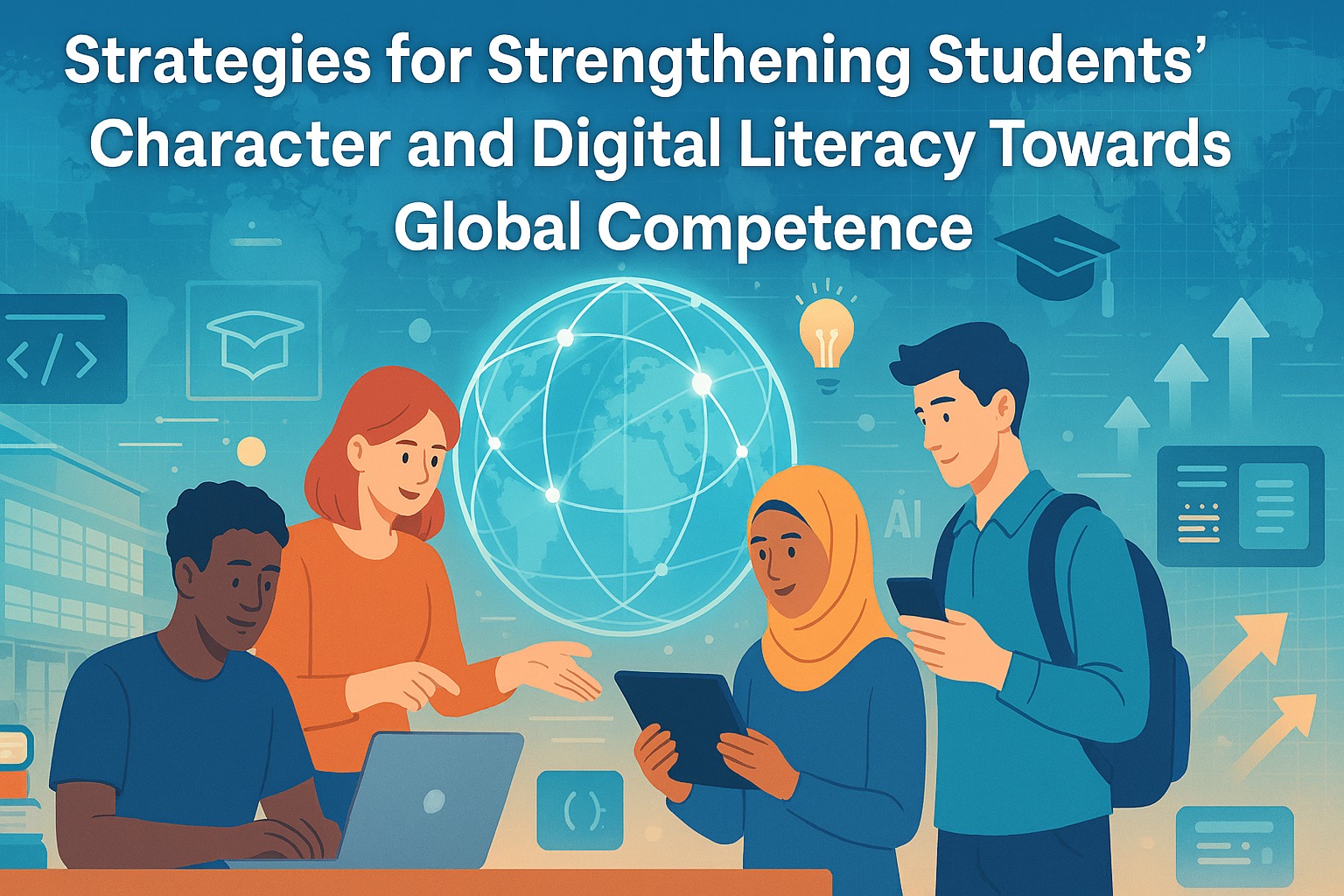
In the era of rapid technological advancement, higher education is no longer limited to transferring academic knowledge. Universities are increasingly expected to prepare students to become individuals who possess strong character, critical thinking abilities, and digital competence. The globalization of information and technology has created a highly competitive environment where students must be able to adapt, collaborate, and innovate across cultural and geographical boundaries.
Character and digital literacy are two essential pillars that shape students into globally competent individuals. Character provides the ethical foundation needed to navigate complex social and professional environments, while digital literacy equips students with the skills to access, analyze, and utilize information effectively. When these two aspects are developed simultaneously, students are better prepared to face the dynamic demands of the global workforce.
However, strengthening students' character and digital literacy requires intentional strategies within the educational system. Universities must design learning environments that encourage responsibility, integrity, collaboration, and digital awareness. This integration ensures that technological mastery does not occur without ethical awareness and social responsibility.
Therefore, educational institutions need comprehensive approaches that combine character education, digital skills development, and global perspectives. By implementing effective strategies, universities can nurture students who are not only academically capable but also ethically grounded and globally competitive.
THE IMPORTANCE OF CHARACTER EDUCATION IN MODERN HIGHER EDUCATION
Character education plays a vital role in shaping students into responsible individuals who can contribute positively to society. In a world that is increasingly driven by technology, ethical awareness and personal integrity become even more important. Without strong character values, technological skills alone may lead to misuse or irresponsible behavior.
Universities serve as environments where students develop not only intellectual capabilities but also moral awareness. Through academic experiences, organizational involvement, and social interaction, students learn to practice values such as honesty, discipline, empathy, and accountability. These values are essential in preparing students to work within diverse global communities.
Furthermore, character education helps students develop resilience when facing challenges and uncertainties. The ability to remain principled and maintain ethical judgment is crucial when navigating complex professional and social situations. Students who possess strong character are more likely to demonstrate leadership and responsible decision-making.
As global competition continues to intensify, institutions that prioritize character development will produce graduates who are not only competent but also trustworthy and socially responsible. This balance between competence and integrity forms the foundation of long-term professional success.
DIGITAL LITERACY AS A CORE SKILL FOR GLOBAL COMPETENCE
Digital literacy has become one of the most critical competencies in the twenty-first century. It involves more than just the ability to use technological devices; it includes understanding how to search, evaluate, interpret, and create information within digital environments.
Students who possess strong digital literacy skills can navigate the vast amount of information available online with critical awareness. They are able to distinguish credible sources from misinformation and utilize digital tools effectively for academic and professional purposes. This capability is essential in an era where information spreads rapidly across digital platforms.
In addition, digital literacy supports creativity and innovation. With access to various digital resources, students can collaborate across borders, share ideas, and develop solutions to global problems. The digital environment enables knowledge exchange on a scale that was previously unimaginable.
Therefore, strengthening digital literacy among students is not simply about technology adoption but about cultivating responsible, critical, and creative digital citizens who can thrive in global knowledge networks.
INTEGRATING CHARACTER AND DIGITAL LITERACY IN THE LEARNING PROCESS
One of the most effective ways to strengthen students' character and digital literacy is by integrating both aspects within the learning process. Education should not treat character education and technological competence as separate components but as interconnected elements that support holistic development.
In the classroom, lecturers can design assignments that require students to utilize digital tools while practicing ethical values such as honesty and responsibility. For example, research projects that involve digital data collection can also emphasize academic integrity and proper citation practices.
Collaborative digital learning environments also provide opportunities for students to practice communication, respect for diverse perspectives, and teamwork. When students engage in online discussions or group projects, they learn how to interact constructively within digital communities.
By integrating character values into technology-based learning, universities can cultivate students who are not only digitally skilled but also ethically aware and socially responsible in their use of technology.
THE ROLE OF EDUCATORS IN BUILDING RESPONSIBLE DIGITAL CITIZENS
Educators play a crucial role in shaping how students perceive and utilize digital technology. Lecturers are not only knowledge transmitters but also mentors who guide students in developing responsible attitudes toward information and technology.
Through teaching practices, educators can encourage critical thinking and ethical awareness when students interact with digital content. Discussions about digital ethics, online behavior, and information reliability help students understand the broader impact of technology on society.
Moreover, educators can model responsible digital behavior by demonstrating proper information sourcing, respectful online communication, and responsible use of digital platforms. Students often learn values through observation, making educators important role models in digital environments.
When educators actively guide students in navigating the digital world responsibly, they contribute to the formation of digital citizens who are capable of using technology for positive and meaningful purposes.
DEVELOPING CRITICAL THINKING IN THE DIGITAL INFORMATION ERA
The abundance of information available in digital spaces presents both opportunities and challenges. While access to knowledge has become easier, the presence of misinformation and biased content requires students to develop strong critical thinking skills.
Critical thinking enables students to analyze information carefully before accepting it as truth. This skill helps them evaluate sources, understand context, and identify potential biases in digital content. Without such abilities, students may become vulnerable to misinformation or manipulation.
Universities can foster critical thinking by encouraging inquiry-based learning and reflective discussions. When students are challenged to question assumptions and analyze complex issues, they develop intellectual independence and analytical capabilities.
These skills are particularly important in a global context where students must engage with diverse perspectives and complex global challenges. Critical thinkers are better equipped to contribute meaningful ideas and solutions in international environments.
BUILDING GLOBAL AWARENESS THROUGH DIGITAL CONNECTIVITY
Digital technology has significantly expanded opportunities for global interaction. Students today can communicate, collaborate, and learn with individuals from different countries through digital platforms. This connectivity creates valuable opportunities to develop global awareness.
Through virtual collaborations, international webinars, and online learning communities, students gain exposure to diverse cultural perspectives and global issues. These experiences help them develop empathy, cultural sensitivity, and cross-cultural communication skills.
Global awareness also encourages students to think beyond local perspectives and understand the interconnected nature of modern societies. Issues such as climate change, technological development, and economic inequality require collaborative global solutions.
By utilizing digital platforms to foster international engagement, universities can prepare students to become globally minded individuals who are capable of contributing to international cooperation and innovation.
CREATING A SUSTAINABLE EDUCATIONAL ECOSYSTEM FOR FUTURE COMPETENCE
Sustainable educational development requires long-term commitment from educational institutions, policymakers, and educators. Strengthening students' character and digital literacy should be integrated into institutional strategies rather than treated as temporary initiatives.
Universities can develop supportive ecosystems by providing digital learning infrastructure, character-based curricula, and opportunities for interdisciplinary collaboration. These efforts ensure that students receive balanced education that nurtures both competence and integrity.
In addition, partnerships with industries, communities, and international institutions can enhance students' exposure to real-world challenges. Such collaborations allow students to apply their character values and digital skills in practical contexts.
Ultimately, educational systems that successfully combine character development with digital literacy will produce graduates who are not only technologically capable but also ethically responsible and globally competitive.
Tentang Penulis
Gusti Ayu Tita
Penulis — Universitas STEKOM
Penulis aktif yang berfokus pada isu-isu akademik, teknologi pendidikan, dan pengembangan sumber daya manusia di lingkungan kampus.



