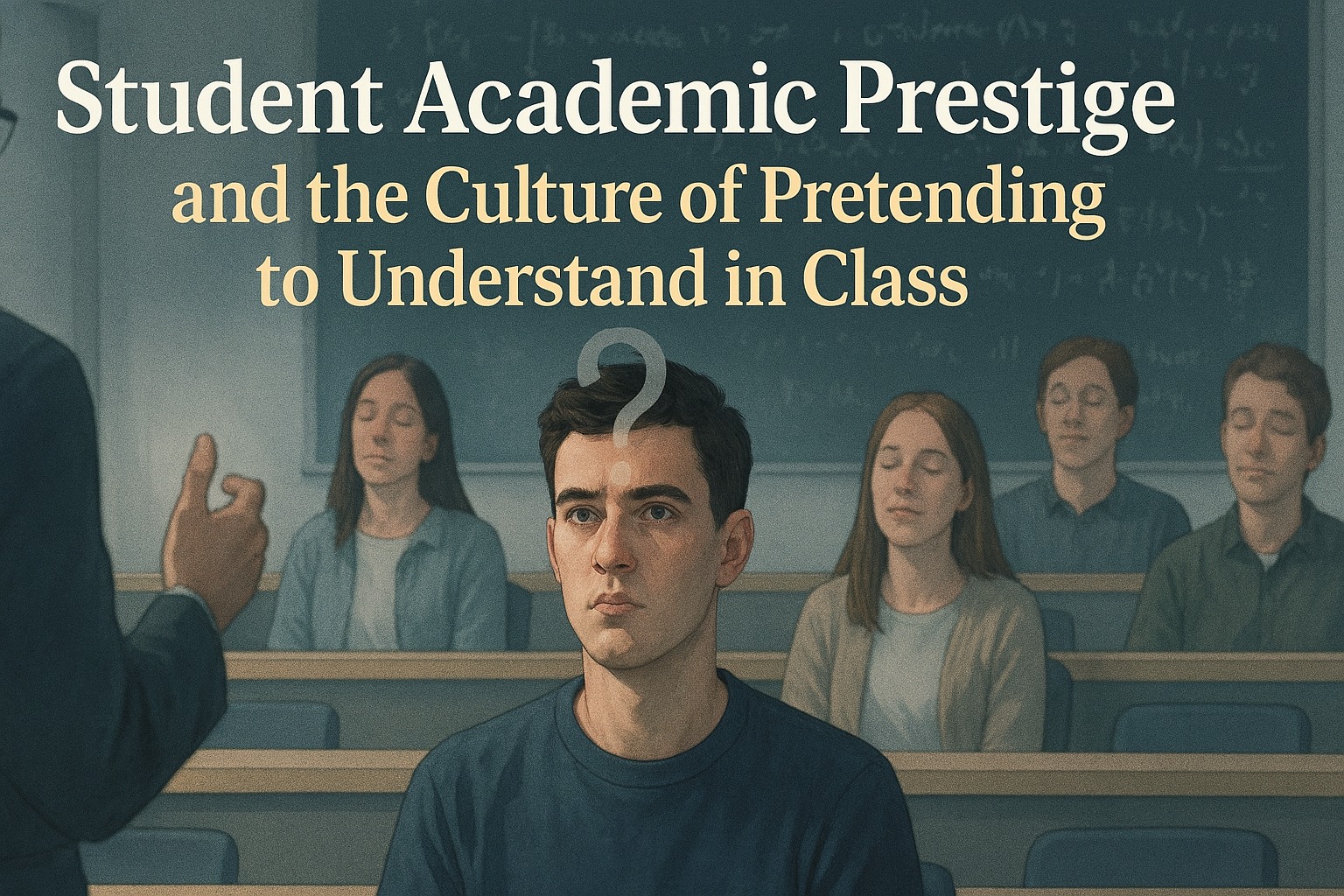
In many universities, intelligence is not only measured by grades but also by how confidently students present themselves in class. Academic environments often reward quick responses, articulate opinions, and visible participation. Over time, this creates an unspoken hierarchy of who appears smart and who does not. Within this climate, academic prestige becomes a silent currency.
For some students, maintaining that prestige feels more important than actually understanding the material. Instead of asking questions, they nod along. Instead of admitting confusion, they remain silent. The classroom slowly transforms into a stage where performance sometimes replaces genuine learning.
The culture of pretending to understand rarely begins with bad intentions. Most students simply want to protect their image. However, when this behavior becomes normalized, it affects not only individual growth but also the collective learning atmosphere.
Understanding why this culture exists is the first step toward addressing it. Beneath the surface, there are psychological pressures, social dynamics, and institutional expectations that push students toward silence rather than curiosity.
THE INVISIBLE PRESSURE TO APPEAR INTELLIGENT
University classrooms can feel like competitive arenas. Students compare GPAs, internships, scholarships, and academic achievements. In such an environment, appearing competent becomes essential for social validation. The fear of being judged as “less capable” often outweighs the desire to truly understand.
This pressure intensifies in selective programs where students are surrounded by high achievers. When everyone seems confident, admitting confusion feels risky. A simple question can feel like a public confession of weakness. As a result, many students choose quiet agreement over visible vulnerability.
Social media also amplifies this pressure. Academic accomplishments are frequently displayed online, reinforcing the idea that successful students rarely struggle. The curated image of constant productivity makes real confusion seem abnormal, even though it is part of learning.
Over time, the need to appear intelligent creates a habit of silence. Students train themselves to listen passively, hoping to catch up later on their own. Unfortunately, this habit often leads to deeper misunderstandings.
WHY STUDENTS PRETEND TO UNDERSTAND
Pretending to understand is often a defense mechanism. It protects self-esteem in environments where mistakes feel costly. Rather than risk embarrassment, students choose the safer path of blending in. A nod, a short comment, or even silence can mask uncertainty effectively.
Another reason is the fast pace of lectures. When concepts move quickly, students may not have time to process information fully. Instead of interrupting the flow, they decide to review the material later. However, “later” does not always come, especially with multiple assignments competing for attention.
Peer dynamics also play a significant role. If no one else asks questions, students assume they are the only ones confused. This false consensus effect strengthens the illusion that everyone else understands perfectly. The classroom becomes collectively silent, even though many are struggling internally.
Cultural background can further influence this behavior. In some educational traditions, questioning instructors may feel disrespectful. Students from such backgrounds might hesitate to speak up, reinforcing the culture of pretending to understand.
THE LONG TERM CONSEQUENCES OF SILENT CONFUSION
While pretending may protect short-term image, it can harm long-term competence. Concepts that are not fully understood often become foundational gaps. As courses advance, these gaps widen and make future material even harder to grasp.
Academic performance may also suffer. Exams test understanding, not appearance. Students who rely on self-study to compensate for classroom silence may find themselves overwhelmed before major assessments. Stress levels increase, and confidence decreases.
Beyond grades, this culture affects critical thinking skills. University education is meant to encourage dialogue, debate, and inquiry. When students avoid asking questions, they miss opportunities to refine their reasoning and deepen their insights.
Emotionally, constant pretense can be exhausting. Maintaining an image requires energy. Over time, students may feel disconnected from authentic learning, turning education into a performance rather than a process of growth.
THE ROLE OF CLASSROOM CULTURE AND INSTRUCTORS
Classroom dynamics are not shaped by students alone. Instructors play a crucial role in determining whether questions are welcomed or subtly discouraged. A dismissive response to one question can silence an entire room.
On the other hand, educators who normalize confusion create safer spaces for dialogue. When lecturers openly acknowledge that complex topics require time and questions, students feel less isolated in their struggles. This shift can gradually dismantle the prestige-driven atmosphere.
Assessment methods also matter. If participation is graded purely on frequency rather than quality, students may prioritize sounding confident over seeking clarity. A balanced approach that values thoughtful engagement can encourage more honest interactions.
Institutional culture contributes as well. Universities that celebrate curiosity and collaborative learning, rather than only ranking and competition, foster healthier academic environments. Prestige becomes less about image and more about intellectual growth.
REDEFINING WHAT IT MEANS TO BE SMART
True academic strength lies not in flawless performance but in the willingness to learn. Asking questions demonstrates engagement, not incompetence. Students who seek clarification are actively building understanding, even if it momentarily challenges their pride.
Redefining intelligence requires a cultural shift. Instead of praising only quick answers, classrooms can value thoughtful pauses and reflective questions. Slowing down discussions allows deeper comprehension to replace surface-level agreement.
Peer support also plays a powerful role. Study groups and open discussions outside class can encourage honesty about confusion. When students realize that uncertainty is common, the stigma around asking questions weakens.
Ultimately, academic prestige should be grounded in integrity. Understanding, growth, and resilience form a stronger foundation than silent agreement. By choosing authenticity over appearance, students not only improve their knowledge but also reshape the culture of learning itself.
BREAKING THE CYCLE OF PRETENSE
Changing this culture begins with small actions. One brave question can open space for others to speak. Often, when one student admits confusion, several others feel immediate relief.
Students can practice reframing their mindset. Instead of viewing questions as evidence of weakness, they can see them as investments in mastery. Over time, this shift reduces anxiety around participation.
Universities can further support this transformation by offering workshops on communication skills and academic confidence. These initiatives help students understand that struggling is not a sign of failure but a natural stage of intellectual development.
Breaking the cycle of pretending to understand is not about lowering standards. It is about aligning performance with genuine comprehension. When students feel safe to admit uncertainty, classrooms become spaces of real learning rather than silent competition.
Tentang Penulis
Gusti Ayu Tita
Penulis — Universitas STEKOM
Penulis aktif yang berfokus pada isu-isu akademik, teknologi pendidikan, dan pengembangan sumber daya manusia di lingkungan kampus.