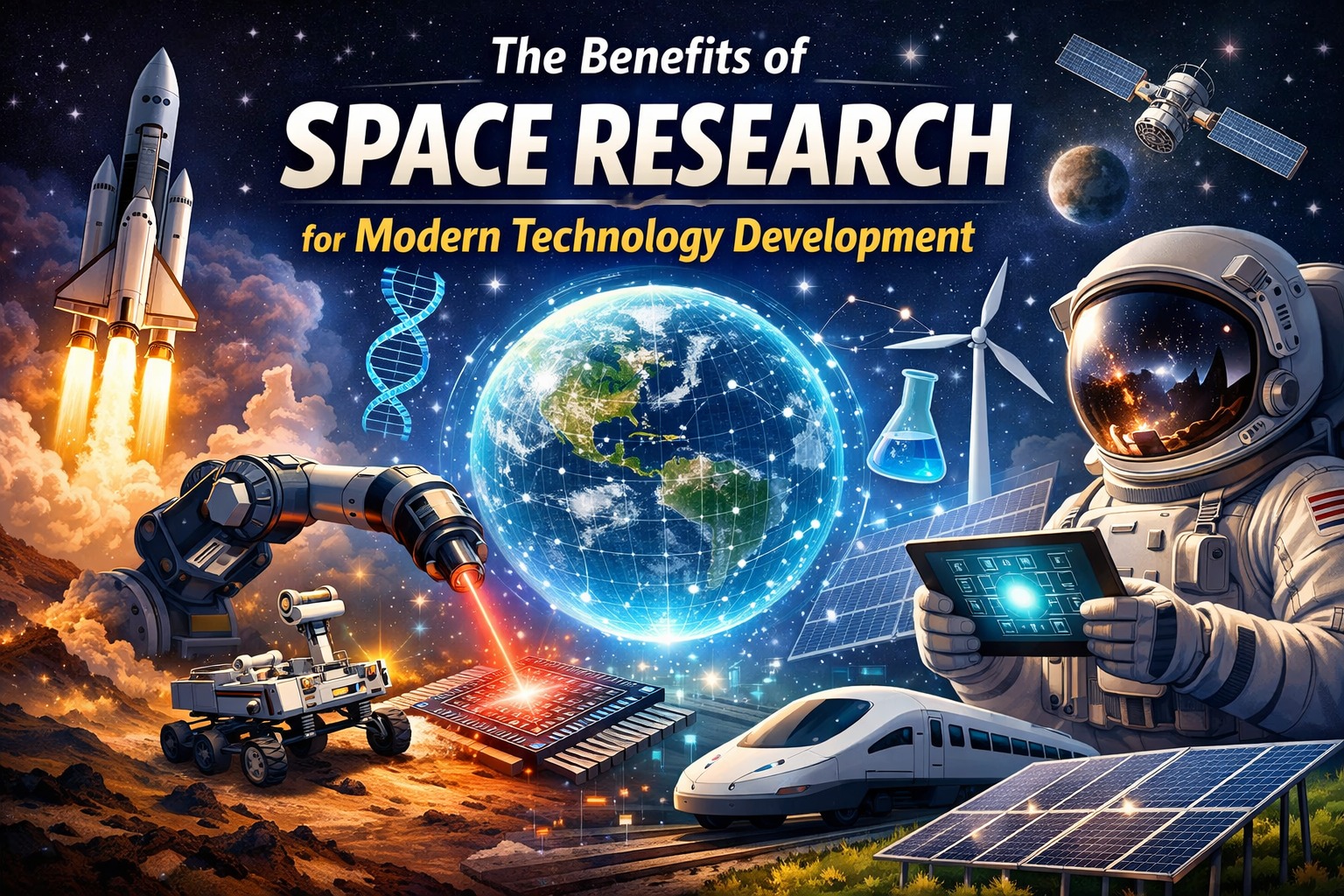
Space exploration is often seen as a pursuit of discovering distant planets, stars, and galaxies. However, beyond its scientific curiosity, space research plays a crucial role in shaping and advancing modern technology on Earth. Many of the innovations we use in daily life today are direct or indirect results of discoveries made through space programs. From communication systems to medical devices, the influence of space research continues to grow and transform the world we live in.
INTRODUCTION TO SPACE RESEARCH AND TECHNOLOGY
Space research refers to the scientific study and exploration of outer space using satellites, telescopes, probes, and manned missions. Organizations such as NASA, ESA, and other global space agencies invest heavily in understanding the universe. While the primary goal is to explore space, the technological breakthroughs developed during these missions often find practical applications on Earth.
The demand for reliable systems in extreme space conditions has pushed scientists and engineers to create highly advanced technologies. These innovations later become useful in various industries such as healthcare, transportation, communication, and environmental monitoring.
IMPACT ON COMMUNICATION TECHNOLOGY
One of the most visible benefits of space research is the advancement of communication systems. Satellite technology, originally developed for space exploration, is now essential for global communication networks.
Satellites enable television broadcasting, internet connectivity, GPS navigation, and real-time weather updates. Without space research, modern communication would not be as fast, accurate, and globally connected as it is today. This has revolutionized how people interact, conduct business, and access information across the world.
ADVANCEMENTS IN MEDICAL TECHNOLOGY
Space research has also contributed significantly to the medical field. Technologies designed for astronauts have been adapted to improve healthcare on Earth. For example, imaging systems developed for space missions are now used in medical diagnostics such as MRI and CT scans.
Additionally, research on bone density loss in space has helped scientists better understand osteoporosis, leading to improved treatments. Portable medical devices, originally designed for space missions, are now widely used in emergency care and remote areas.
INNOVATION IN MATERIALS AND ENGINEERING
The extreme environment of space requires materials that are lightweight, durable, and resistant to harsh conditions. As a result, space research has led to the development of advanced materials such as heat-resistant alloys, insulation materials, and carbon composites.
These materials are now widely used in industries like aviation, automotive manufacturing, construction, and sports equipment. For example, stronger and lighter aircraft components improve fuel efficiency and safety in modern aviation.
ENVIRONMENTAL MONITORING AND EARTH OBSERVATION
Space technology plays a vital role in monitoring Earth's environment. Satellites provide critical data about climate change, natural disasters, deforestation, and ocean behavior. This information helps scientists predict weather patterns, track environmental changes, and respond to disasters more effectively.
Governments and environmental organizations rely heavily on satellite data to make informed decisions about sustainability and environmental protection.
CONCLUSION
The benefits of space research extend far beyond exploring the universe. It has become a driving force behind modern technological development, improving communication, healthcare, engineering, and environmental monitoring. As space exploration continues to evolve, its contributions to everyday life on Earth will only become more significant, making it one of the most valuable scientific investments for the future.
Tentang Penulis
Gusti Ayu Tita
Penulis — Universitas STEKOM
Penulis aktif yang berfokus pada isu-isu akademik, teknologi pendidikan, dan pengembangan sumber daya manusia di lingkungan kampus.