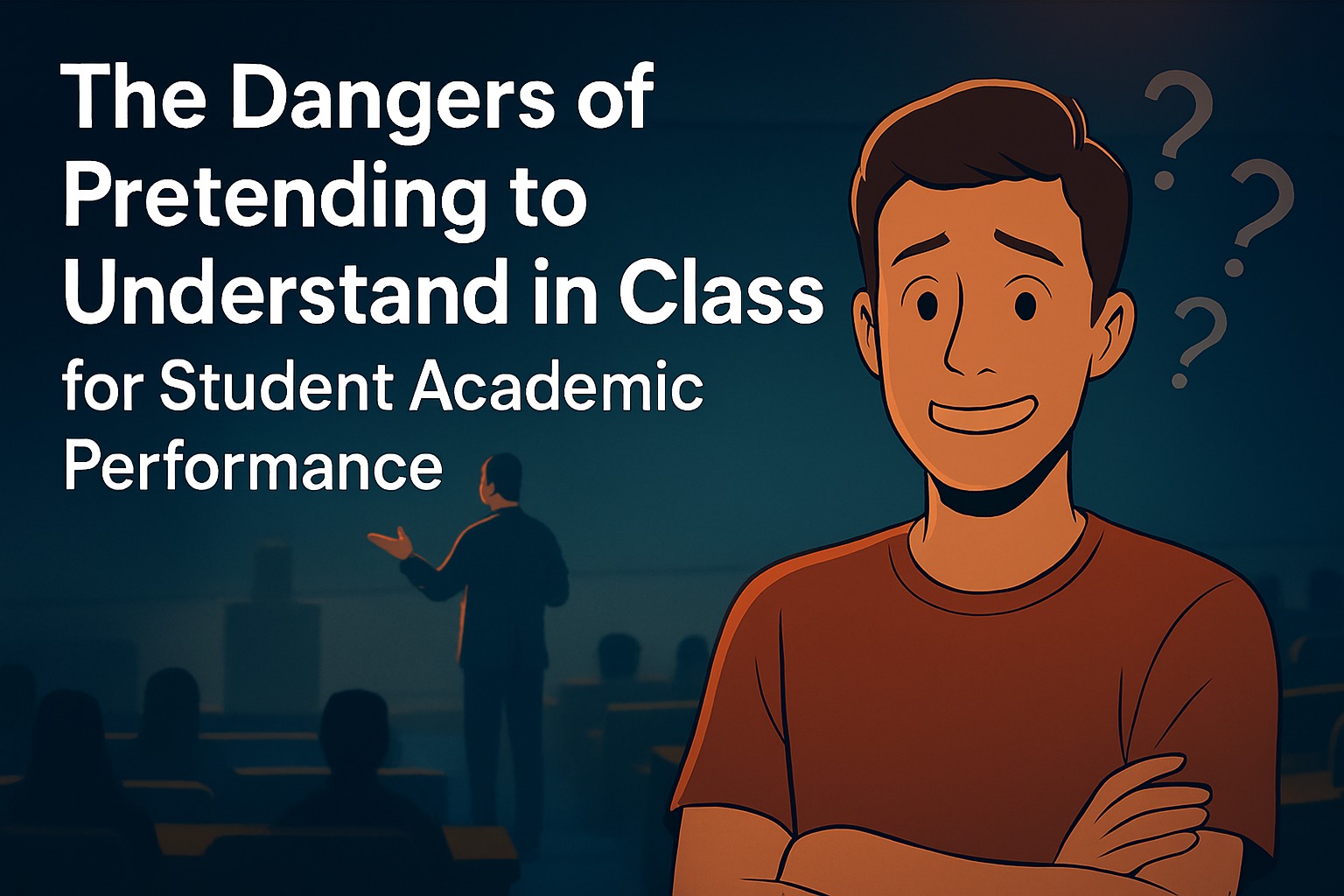
In modern classrooms, active participation and open communication are widely encouraged as essential elements of effective learning. However, many students still fall into a subtle but harmful habit: pretending to understand lessons they do not fully grasp. While this behavior may seem harmless in the moment, it can have serious long-term consequences for student academic performance. Pretending to understand in class often stems from fear, embarrassment, or the desire to maintain a positive academic image. Students may nod along, avoid asking questions, or give superficial responses to appear competent. Over time, this pattern creates learning gaps that become increasingly difficult to close. Understanding the dangers of pretending to understand is crucial for improving both academic success and overall educational development.
HIDDEN LEARNING GAPS THAT CONTINUE TO GROW
One of the most significant dangers of pretending to understand in class is the creation of hidden learning gaps. When students do not seek clarification, misunderstandings remain unresolved. Each new topic often builds upon previous material, meaning that small gaps can quickly expand into major obstacles.
For example, in subjects like mathematics, science, or language learning, foundational concepts are essential for mastering more advanced material. If a student pretends to understand an early lesson, they may struggle silently as lessons become more complex. Over time, confusion accumulates and academic performance declines.
These hidden gaps are particularly dangerous because they are not immediately visible. Teachers may assume comprehension based on silence or minimal participation, while students internally struggle to keep up.
NEGATIVE IMPACT ON ACADEMIC PERFORMANCE
Pretending to understand directly affects academic performance. When students fail to grasp core concepts, their ability to perform well on exams, assignments, and projects decreases. Poor comprehension leads to lower grades, which can affect overall academic standing.
Additionally, students who repeatedly experience academic difficulties may begin to doubt their abilities. This self-doubt can reduce motivation and increase anxiety, further harming performance. What started as a simple act of pretending becomes a cycle of confusion and underachievement.
Academic success requires active engagement and clarification of misunderstandings. Without these elements, consistent improvement becomes difficult.
REDUCED CRITICAL THINKING AND ANALYTICAL SKILLS
Classroom discussions and interactive learning are designed to strengthen critical thinking and analytical skills. When students pretend to understand, they miss opportunities to engage deeply with the material. They may avoid asking probing questions or participating in debates that challenge their thinking.
This avoidance limits intellectual growth. Critical thinking develops when students question assumptions, explore different perspectives, and reflect on their understanding. By pretending to understand, students bypass these cognitive processes.
Over time, this can result in surface-level learning. Students may memorize information temporarily but struggle to apply knowledge in new or complex situations.
INCREASED ACADEMIC ANXIETY AND STRESS
Although pretending to understand may provide temporary relief from embarrassment, it often increases long-term stress. Students who do not fully understand lessons may feel anxious before exams or presentations. They may fear being exposed when deeper knowledge is required.
This constant pressure can negatively impact mental well-being. Academic anxiety may lead to sleep problems, reduced concentration, and emotional exhaustion. The effort to maintain an appearance of competence becomes mentally draining.
Ironically, the attempt to avoid short-term discomfort often results in greater long-term distress.
DAMAGE TO SELF-CONFIDENCE
True confidence is built through mastery and understanding. When students pretend to understand, they deny themselves the opportunity to genuinely improve. As academic challenges grow more complex, the gap between perceived understanding and actual knowledge becomes evident.
This realization can damage self-confidence. Students may begin to believe they are incapable, even though the real issue was the lack of clarification earlier on. Authentic confidence develops from confronting difficulties, asking questions, and gradually mastering concepts.
By avoiding vulnerability, students limit their personal and academic growth.
WEAKENED TEACHER-STUDENT COMMUNICATION
Effective education depends on open communication between teachers and students. When students pretend to understand, teachers lose valuable feedback about the clarity of their instruction. This communication gap prevents necessary adjustments in teaching methods.
Teachers rely on student questions and responses to assess comprehension. Silence can be misinterpreted as understanding. As a result, the classroom environment becomes less responsive to student needs.
Open dialogue benefits both parties. Without it, the overall learning process becomes less effective.
LONG-TERM CONSEQUENCES FOR FUTURE SUCCESS
The habit of pretending to understand can extend beyond the classroom. In higher education and professional settings, individuals are often expected to demonstrate real competence. Gaps in foundational knowledge can limit career opportunities and professional confidence.
Furthermore, workplaces value problem-solving skills and continuous learning. Individuals who avoid asking questions may struggle to adapt in dynamic environments. Developing the courage to seek clarification during academic years is essential for long-term success.
Addressing this behavior early helps students build habits that support lifelong learning.
CONCLUSION
The dangers of pretending to understand in class for student academic performance are significant and far-reaching. Hidden learning gaps, declining grades, reduced critical thinking, increased anxiety, weakened confidence, and poor communication all stem from this seemingly minor behavior.
While the desire to appear competent is understandable, genuine academic growth requires honesty and active participation. Students who ask questions, seek clarification, and engage openly with material are more likely to achieve lasting success.
Educational environments should encourage curiosity and normalize mistakes as part of the learning journey. When students feel safe to admit confusion, they transform classrooms into spaces of real understanding and meaningful academic development.
Tentang Penulis
Gusti Ayu Tita
Penulis — Universitas STEKOM
Penulis aktif yang berfokus pada isu-isu akademik, teknologi pendidikan, dan pengembangan sumber daya manusia di lingkungan kampus.