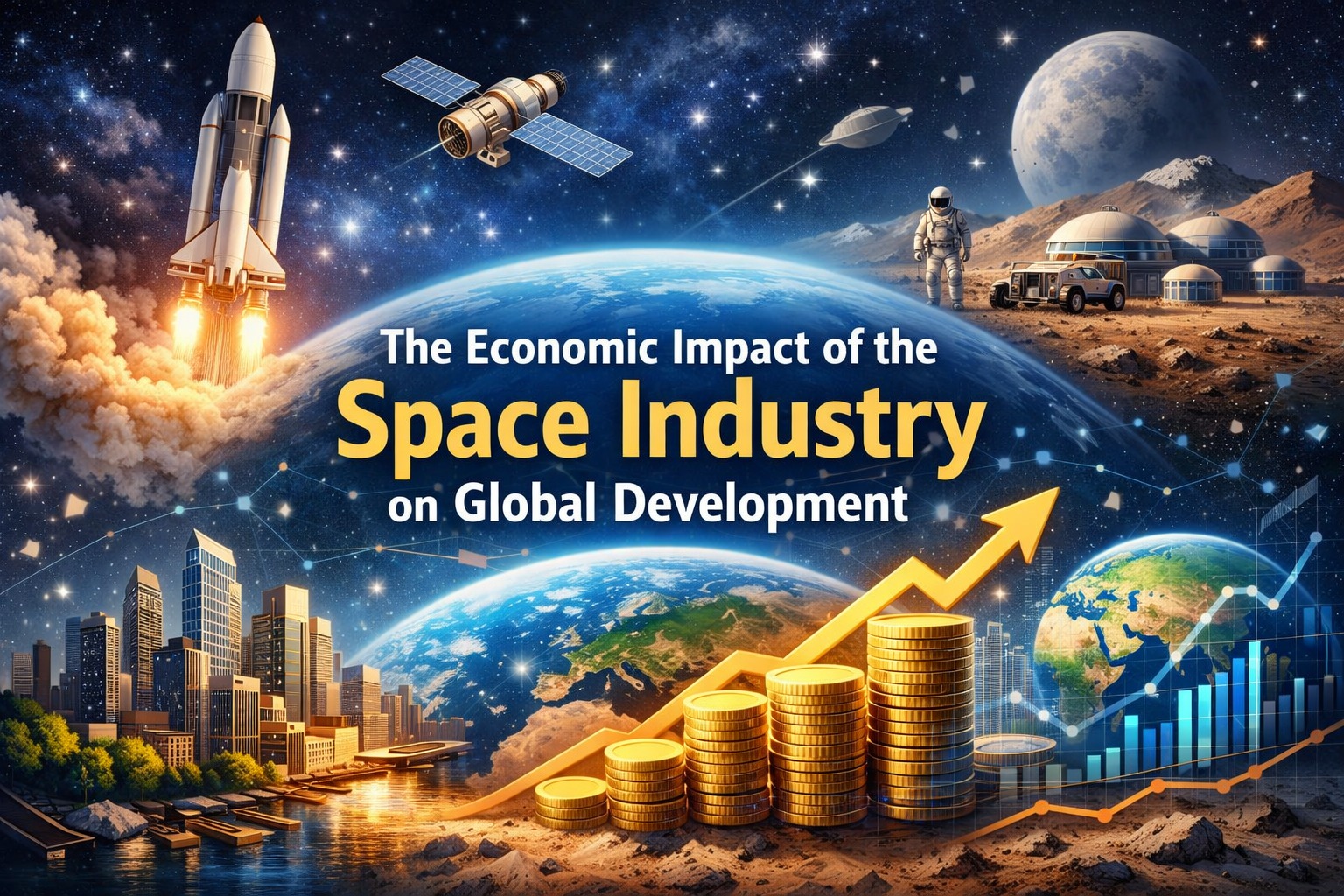
The space industry has transformed from a government-driven scientific ambition into a powerful global economic engine. Today, it influences innovation, job creation, international trade, and technological advancement. As private companies and national agencies continue to expand their presence in space, the economic impact of this industry is becoming increasingly significant for global development.
INTRODUCTION TO THE SPACE ECONOMY
The space economy refers to all economic activities related to the exploration, understanding, management, and utilization of space. This includes satellite manufacturing, rocket launches, space exploration missions, and downstream services such as telecommunications, navigation, and Earth observation.
Over the past two decades, the space industry has shifted from being dominated by a few government agencies to a more diversified ecosystem involving private enterprises. Companies like SpaceX, Blue Origin, and OneWeb have accelerated innovation and reduced the cost of access to space, making the industry more commercially viable.
JOB CREATION AND INDUSTRY EXPANSION
One of the most direct economic impacts of the space industry is job creation. The sector supports millions of jobs worldwide, ranging from highly specialized aerospace engineers to data analysts and manufacturing workers.
In addition to direct employment, the industry generates indirect job opportunities in supply chains, research institutions, and technology startups. This ripple effect strengthens local economies and contributes to long-term workforce development in science, technology, engineering, and mathematics (STEM) fields.
TECHNOLOGICAL INNOVATION AND SPILLOVER EFFECTS
The space industry is a major driver of technological innovation. Many technologies originally developed for space missions have found practical applications on Earth. Examples include GPS navigation, weather forecasting systems, satellite communications, and advanced medical imaging technologies.
These innovations create spillover effects that benefit multiple sectors such as agriculture, transportation, defense, and healthcare. As a result, investment in space exploration often yields high returns for broader economic development.
GLOBAL CONNECTIVITY AND DIGITAL TRANSFORMATION
Satellites play a crucial role in enhancing global connectivity. They enable internet access in remote areas, support global communication networks, and facilitate real-time data exchange across continents.
This improved connectivity helps bridge the digital divide between developed and developing countries. It also empowers businesses to operate globally, supports e-commerce growth, and strengthens international collaboration.
INVESTMENT AND COMMERCIAL OPPORTUNITIES
The commercialization of space has opened new investment opportunities. Private investors and venture capital firms are increasingly funding space startups focused on satellite technology, space tourism, asteroid mining, and orbital infrastructure.
Governments are also partnering with private companies to reduce costs and increase efficiency in space missions. This public-private collaboration is reshaping the global economy and positioning space as a key sector for future economic growth.
CHALLENGES AND ECONOMIC RISKS
Despite its benefits, the space industry also faces challenges. High development costs, regulatory uncertainties, space debris management, and geopolitical tensions can hinder growth.
Additionally, unequal access to space technology may widen the gap between developed and developing nations if not properly addressed. International cooperation and sustainable policies are essential to ensure balanced global development.
CONCLUSION
The space industry is no longer just about exploration—it is a major contributor to global economic development. Through job creation, technological innovation, global connectivity, and investment opportunities, it continues to reshape the modern economy.
As humanity expands its presence beyond Earth, the economic impact of space activities will likely grow even further, making it a cornerstone of future global progress.
Tentang Penulis
Gusti Ayu Tita
Penulis — Universitas STEKOM
Penulis aktif yang berfokus pada isu-isu akademik, teknologi pendidikan, dan pengembangan sumber daya manusia di lingkungan kampus.