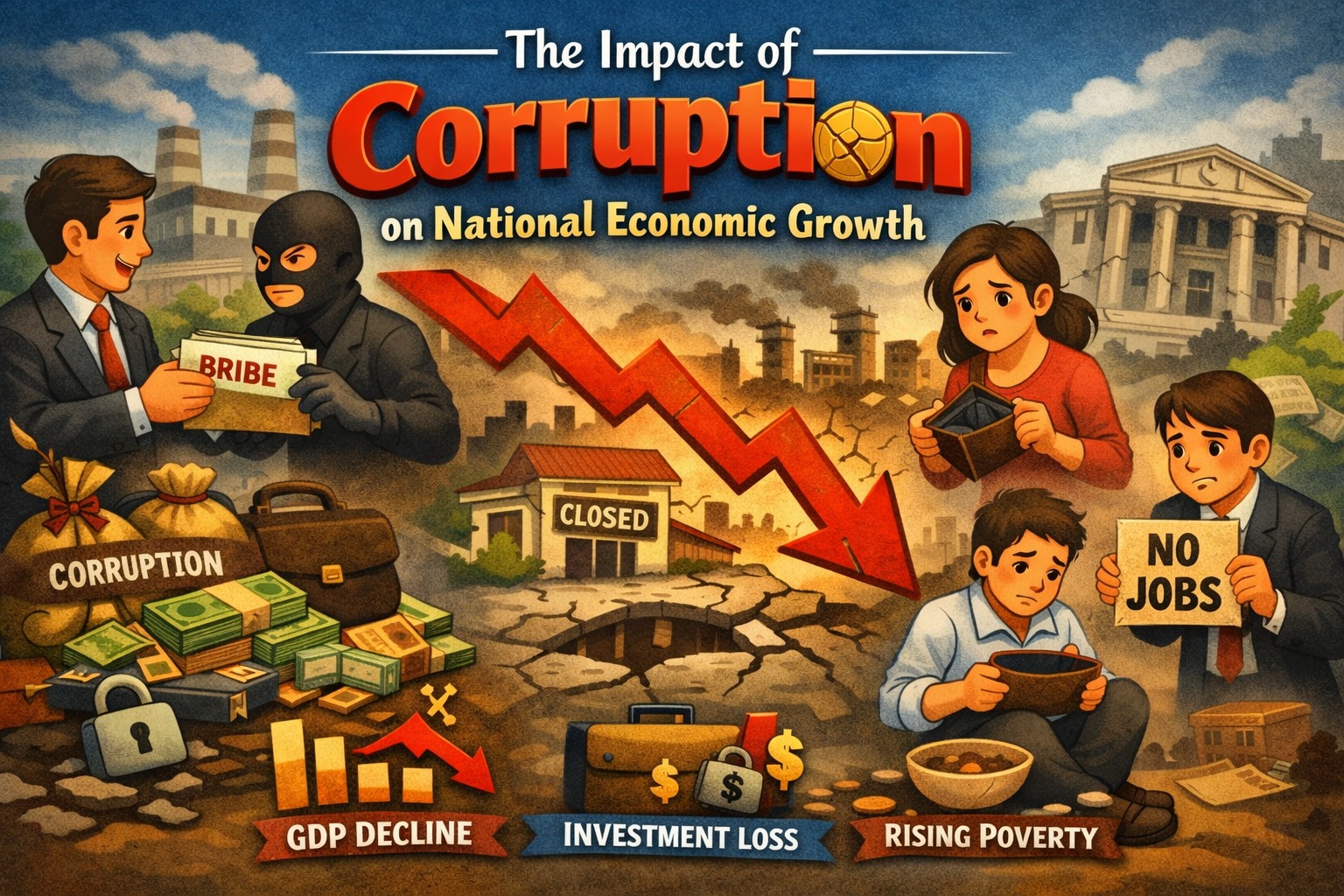
Corruption remains one of the biggest challenges faced by many countries around the world. It affects not only political stability but also economic development and social welfare. When corruption becomes widespread, public trust decreases, investments decline, and economic growth slows down. Understanding the impact of corruption on national economic growth is important to encourage transparency, accountability, and sustainable development.
UNDERSTANDING CORRUPTION
Corruption refers to the abuse of power for personal gain. It can occur in various forms, such as bribery, embezzlement, fraud, nepotism, and misuse of public funds. Corruption may happen in government institutions, private companies, or public services.
In many developing countries, corruption creates barriers to fair competition and weakens the effectiveness of economic policies. As a result, national resources are often used inefficiently, limiting opportunities for growth and prosperity.
HOW CORRUPTION SLOWS ECONOMIC GROWTH
Corruption directly affects the economy in several negative ways. One of the most serious impacts is the reduction of public investment quality. Funds that should be used for infrastructure, healthcare, and education are often misused for personal interests.
When government officials demand bribes or manipulate budgets, important development projects may become delayed or poorly managed. Roads, schools, and hospitals may be built with low-quality materials because of dishonest practices. This reduces productivity and weakens economic progress.
Corruption also discourages foreign investors. Investors prefer countries with transparent legal systems and fair business environments. High levels of corruption increase business risks, making investors hesitant to invest their money. Lower investment means fewer jobs, lower income, and slower economic expansion.
THE EFFECT ON BUSINESS AND EMPLOYMENT
Businesses suffer greatly in corrupt environments. Companies may need to pay illegal fees or bribes to obtain permits and licenses. This increases operational costs and reduces profits, especially for small and medium-sized enterprises.
Corruption also creates unfair competition. Companies with political connections may receive special treatment, while honest businesses struggle to compete. As a result, innovation and productivity decline because success depends more on connections than performance.
High corruption levels can also increase unemployment. When economic growth slows and investments decrease, companies may reduce hiring or even close operations. This negatively affects workers and increases poverty rates.
IMPACT ON PUBLIC SERVICES
Economic growth depends heavily on strong public services. However, corruption weakens the quality of healthcare, education, transportation, and public administration.
For example, corruption in the education sector may reduce the quality of schools and limit access to learning opportunities. In healthcare, medical supplies and funding may be stolen or mismanaged, harming public health. Poor public services reduce human capital development, which is essential for long-term economic growth.
Citizens who lose trust in public institutions may also become less willing to pay taxes. Lower tax revenue reduces the government's ability to finance national development programs.
SOCIAL INEQUALITY AND POVERTY
Corruption often increases social inequality. Wealth and opportunities become concentrated among individuals with political influence or financial power. Meanwhile, ordinary citizens face limited access to quality education, healthcare, and employment opportunities.
This inequality can create social tension and political instability, which further harms economic growth. Countries with high corruption rates often experience higher poverty levels because public resources fail to reach those who need them most.
Reducing corruption can help create a fairer economic system where resources are distributed more equally and development benefits all citizens.
STRATEGIES TO REDUCE CORRUPTION
Governments and societies must work together to fight corruption. Strong laws, transparent institutions, and effective law enforcement are essential for preventing dishonest practices.
Digital technology can also reduce corruption by improving transparency in public services and financial management. Online systems for taxation, licensing, and government procurement can minimize opportunities for bribery and fraud.
Education plays an important role as well. Teaching ethical values and promoting anti-corruption awareness from an early age can help build a culture of honesty and responsibility.
In addition, independent media and active civil society organizations are important for monitoring government activities and exposing corruption cases.
CONCLUSION
Corruption has a serious impact on national economic growth. It reduces investment, weakens public services, increases unemployment, and worsens social inequality. Countries with high corruption levels often struggle to achieve sustainable economic development.
Fighting corruption requires commitment from governments, businesses, and citizens. By promoting transparency, accountability, and ethical behavior, nations can create stronger economies and improve the quality of life for their people.
Tentang Penulis
Gusti Ayu Tita
Penulis — Universitas STEKOM
Penulis aktif yang berfokus pada isu-isu akademik, teknologi pendidikan, dan pengembangan sumber daya manusia di lingkungan kampus.