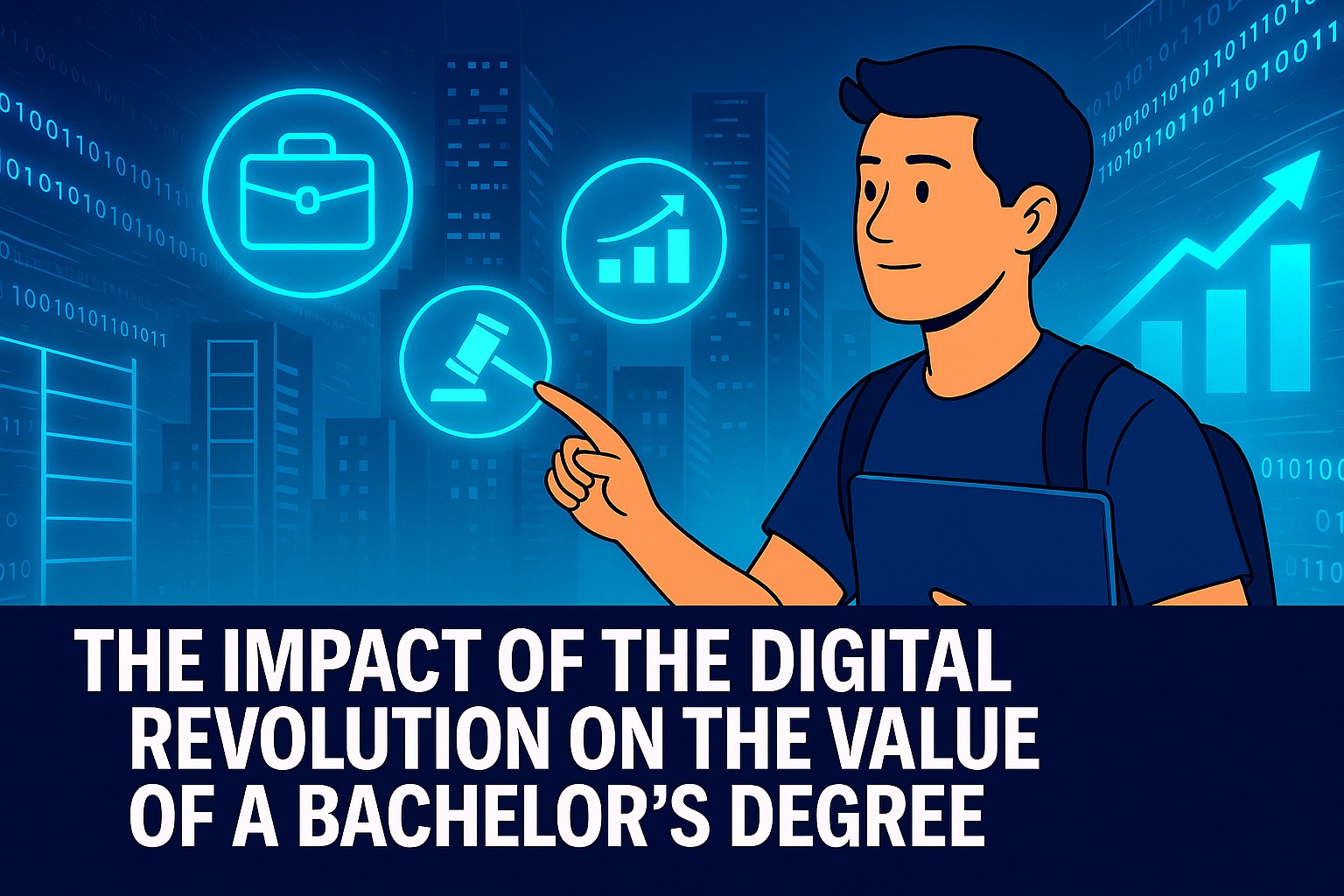
The digital revolution has transformed nearly every aspect of modern life, from communication and commerce to education and employment. Rapid advancements in artificial intelligence, automation, big data, cloud computing, and digital platforms have redefined how organizations operate and how professionals build their careers. In this context, many people question whether a bachelor’s degree still holds the same value it once did. As alternative learning platforms, online certifications, and skill-based hiring practices gain popularity, the traditional higher education model faces new challenges. However, rather than eliminating the value of a bachelor’s degree, the digital revolution is reshaping its meaning and redefining its role in professional development.
THE DIGITAL TRANSFORMATION OF THE JOB MARKET
The digital revolution has accelerated the shift toward a knowledge-based economy. Many traditional roles have been automated, while new professions have emerged in fields such as data analytics, cybersecurity, digital marketing, software engineering, and technology management. Employers increasingly prioritize digital literacy, adaptability, and problem-solving abilities.
This shift has encouraged companies to reconsider hiring criteria. In some industries, practical skills and demonstrated competence can outweigh formal educational credentials. Online portfolios, project experience, and technical certifications sometimes serve as evidence of expertise.
However, while hiring practices may evolve, the complexity of modern workplaces has also increased. Organizations now operate in interconnected, data-driven environments that require strategic thinking, cross-disciplinary collaboration, and continuous learning. These demands highlight the continued relevance of structured higher education.
THE RISE OF ALTERNATIVE LEARNING PATHWAYS
One of the most significant impacts of the digital revolution is the expansion of accessible learning resources. Massive open online courses (MOOCs), professional certifications, coding bootcamps, and micro-credentials allow individuals to gain targeted skills quickly and affordably.
These flexible learning models challenge the exclusivity of bachelor’s degrees as the primary route to professional competence. Individuals can now acquire technical knowledge without enrolling in a traditional four-year program.
Despite this accessibility, alternative pathways often focus narrowly on specific technical skills. They may not provide comprehensive theoretical foundations, interdisciplinary exposure, or long-term intellectual development. While they are effective for rapid upskilling, they do not always replace the broader academic experience offered by a bachelor’s program.
THE ENDURING FOUNDATION OF A BACHELOR’S DEGREE
Although the digital revolution changes how knowledge is delivered, it does not diminish the importance of foundational education. A bachelor’s degree provides structured academic training that builds analytical reasoning, research capability, communication skills, and intellectual discipline.
In an era where information is abundant, the ability to evaluate sources critically and synthesize complex data becomes essential. Undergraduate education trains students to question assumptions, construct logical arguments, and apply theoretical frameworks to real-world challenges.
Moreover, digital technologies evolve rapidly. Specific software tools or programming languages may become outdated within a few years. A strong academic foundation enables graduates to adapt to technological change rather than depend solely on short-term technical training.
EMPLOYABILITY, CREDIBILITY, AND CAREER MOBILITY
The value of a bachelor’s degree in the digital era extends beyond technical knowledge. It also serves as a widely recognized credential that signals commitment, perseverance, and competence. Many organizations still require a degree as a baseline qualification for professional roles.
Furthermore, career advancement often depends on more than technical execution. Leadership positions demand strategic thinking, ethical judgment, interpersonal communication, and organizational understanding. Undergraduate education frequently fosters these competencies through collaborative projects, presentations, and academic research.
In addition, a bachelor’s degree provides access to postgraduate education, professional certifications, and global career mobility. As competition intensifies in digital industries, having a formal qualification can strengthen professional credibility.
THE EVOLUTION OF UNIVERSITY EDUCATION
The digital revolution has not left universities unchanged. Higher education institutions are integrating digital tools into teaching methodologies, adopting blended learning models, and incorporating industry partnerships into curricula. Many programs now emphasize digital skills, entrepreneurship, and innovation.
Project-based learning, internships, and research collaborations with technology companies allow students to gain practical experience alongside academic study. This integration enhances the real-world relevance of bachelor’s programs.
By adapting to technological advancements, universities reinforce the value of undergraduate education rather than diminish it. The combination of theoretical depth and practical application positions graduates to navigate complex digital environments effectively.
CONCLUSION
The digital revolution has undoubtedly transformed the landscape of education and employment. While alternative learning pathways and skill-based hiring practices challenge traditional models, they do not eliminate the importance of a bachelor’s degree.
Instead, the digital era reshapes its significance. A bachelor’s degree continues to provide foundational knowledge, critical thinking skills, professional credibility, and long-term career mobility. When combined with continuous digital skill development, it becomes a powerful asset in navigating modern professional environments.
Rather than losing its value, the bachelor’s degree is evolving alongside technological change. In a world defined by rapid innovation, structured higher education remains a cornerstone of sustainable professional growth.
Tentang Penulis
Gusti Ayu Tita
Penulis — Universitas STEKOM
Penulis aktif yang berfokus pada isu-isu akademik, teknologi pendidikan, dan pengembangan sumber daya manusia di lingkungan kampus.