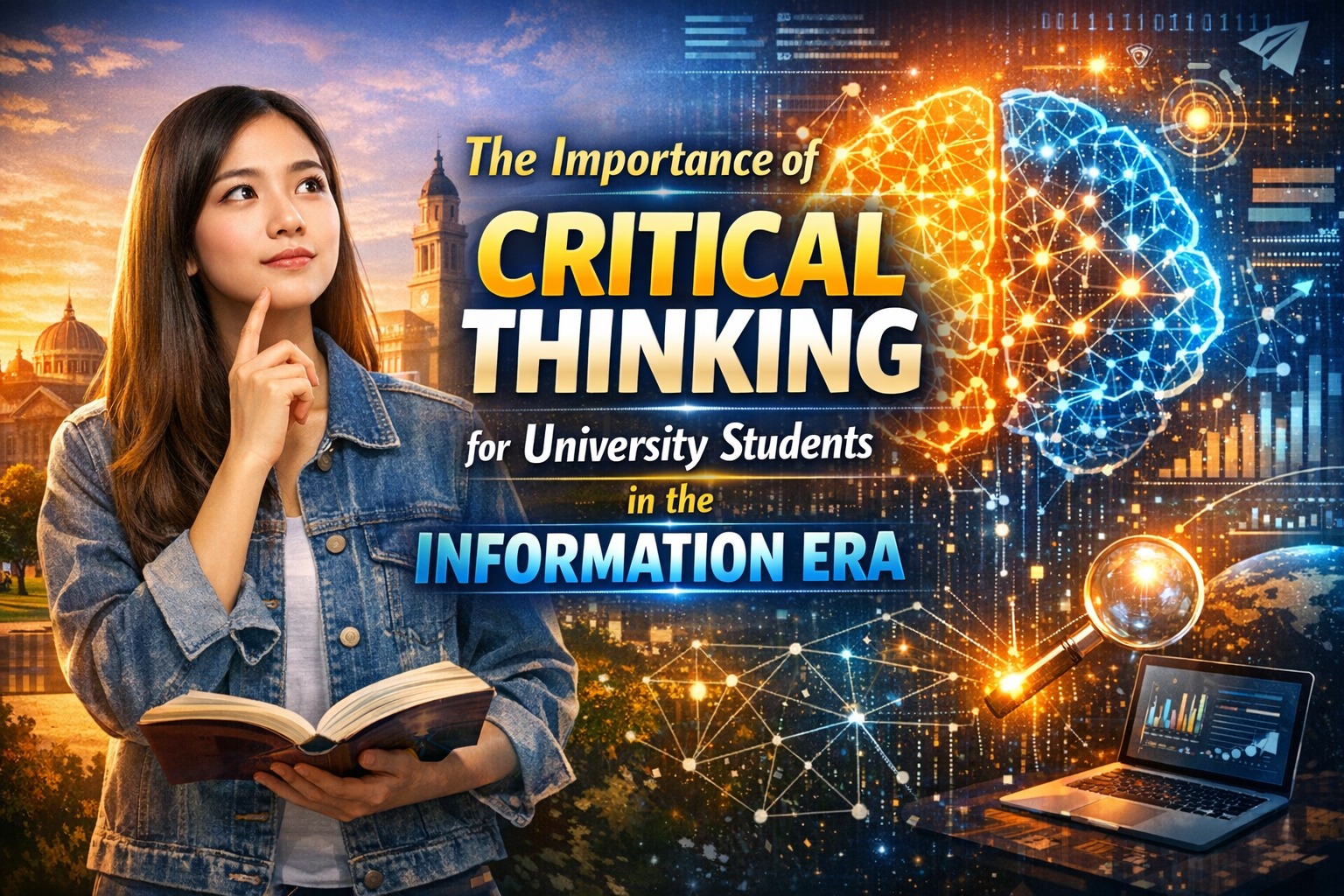
In the modern information era, university students are surrounded by an enormous amount of knowledge and data that can be accessed instantly through digital technology. The internet, academic journals, social media, and various online platforms have made it easier than ever for students to obtain information about almost any topic. While this accessibility provides significant advantages for learning, it also creates new challenges. Not all information available online is accurate, reliable, or supported by credible sources. Because of this, university students need the ability to analyze and evaluate information carefully. One of the most essential skills that helps students deal with this challenge is critical thinking. Critical thinking refers to the ability to analyze information logically, evaluate different perspectives, and draw conclusions based on evidence and rational reasoning. Instead of accepting information at face value, students who think critically question assumptions, examine sources, and consider the broader context of the information they encounter. This skill is particularly important in higher education because universities are not only places for gaining knowledge but also environments where students develop intellectual independence and analytical abilities.
THE ROLE OF CRITICAL THINKING IN ACADEMIC LEARNING
Critical thinking plays a significant role in the academic success of university students. In higher education, students are expected to move beyond memorizing theories or repeating information provided by lecturers. Instead, they must understand concepts deeply, analyze ideas, and connect knowledge from different disciplines. This process requires the ability to evaluate arguments, identify patterns, and form logical conclusions.
When students apply critical thinking in their studies, they become more engaged in the learning process. They are more likely to ask meaningful questions, participate actively in discussions, and explore ideas beyond the classroom materials. This approach encourages deeper understanding because students are not simply receiving knowledge but actively interpreting and evaluating it.
Critical thinking also plays an important role in academic writing and research. When students write essays, research papers, or dissertations, they must analyze multiple sources, compare different viewpoints, and support their arguments with credible evidence. These tasks require careful reasoning and structured thinking. Students who develop strong critical thinking skills are able to present clearer arguments and produce more insightful academic work.
CHALLENGES OF INFORMATION OVERLOAD IN THE DIGITAL AGE
Although technology has made information widely accessible, it has also created the challenge of information overload. University students often encounter large volumes of data from various digital sources, including news websites, blogs, social networks, and online forums. Some of this information may be incomplete, biased, or inaccurate.
In this environment, critical thinking becomes an essential tool for evaluating the reliability of information. Students must learn to question where information comes from, who created it, and whether the evidence supporting it is credible. By examining sources carefully, students can avoid spreading misinformation and develop a more accurate understanding of complex issues.
Another challenge in the digital age is the tendency to consume information quickly without deep analysis. Social media platforms often encourage rapid reading and immediate reactions rather than thoughtful reflection. As a result, students may become accustomed to processing information superficially. Developing critical thinking helps counter this tendency by encouraging students to slow down, examine evidence carefully, and think more deeply about the content they encounter.
CRITICAL THINKING AS A SKILL FOR FUTURE CAREERS
Critical thinking is not only important for academic success but also for future professional life. Employers increasingly seek individuals who can analyze problems, evaluate information, and make well-reasoned decisions. In many professions, employees must deal with complex situations that require careful analysis and strategic thinking.
Students who develop strong critical thinking skills during their university years are better prepared to face these challenges. They are able to assess situations objectively, consider multiple solutions, and choose the most effective course of action. These abilities are valuable in fields such as business, education, technology, and public policy.
Furthermore, critical thinking helps individuals become more independent and responsible decision-makers. Rather than relying solely on the opinions of others, critically minded individuals evaluate evidence and form their own conclusions. This intellectual independence is essential in a rapidly changing world where new information and challenges constantly emerge.
CONCLUSION
Critical thinking is a vital skill for university students living in the information era. With the vast amount of information available through digital technology, students must be able to analyze, evaluate, and interpret data responsibly. This ability not only enhances academic learning but also prepares students to navigate complex issues in society and the professional world.
By developing critical thinking skills, university students can become more thoughtful learners, better problem solvers, and more informed members of society. In an age defined by rapid information exchange, the ability to think critically remains one of the most valuable competencies a student can possess.
Tentang Penulis
Gusti Ayu Tita
Penulis — Universitas STEKOM
Penulis aktif yang berfokus pada isu-isu akademik, teknologi pendidikan, dan pengembangan sumber daya manusia di lingkungan kampus.