
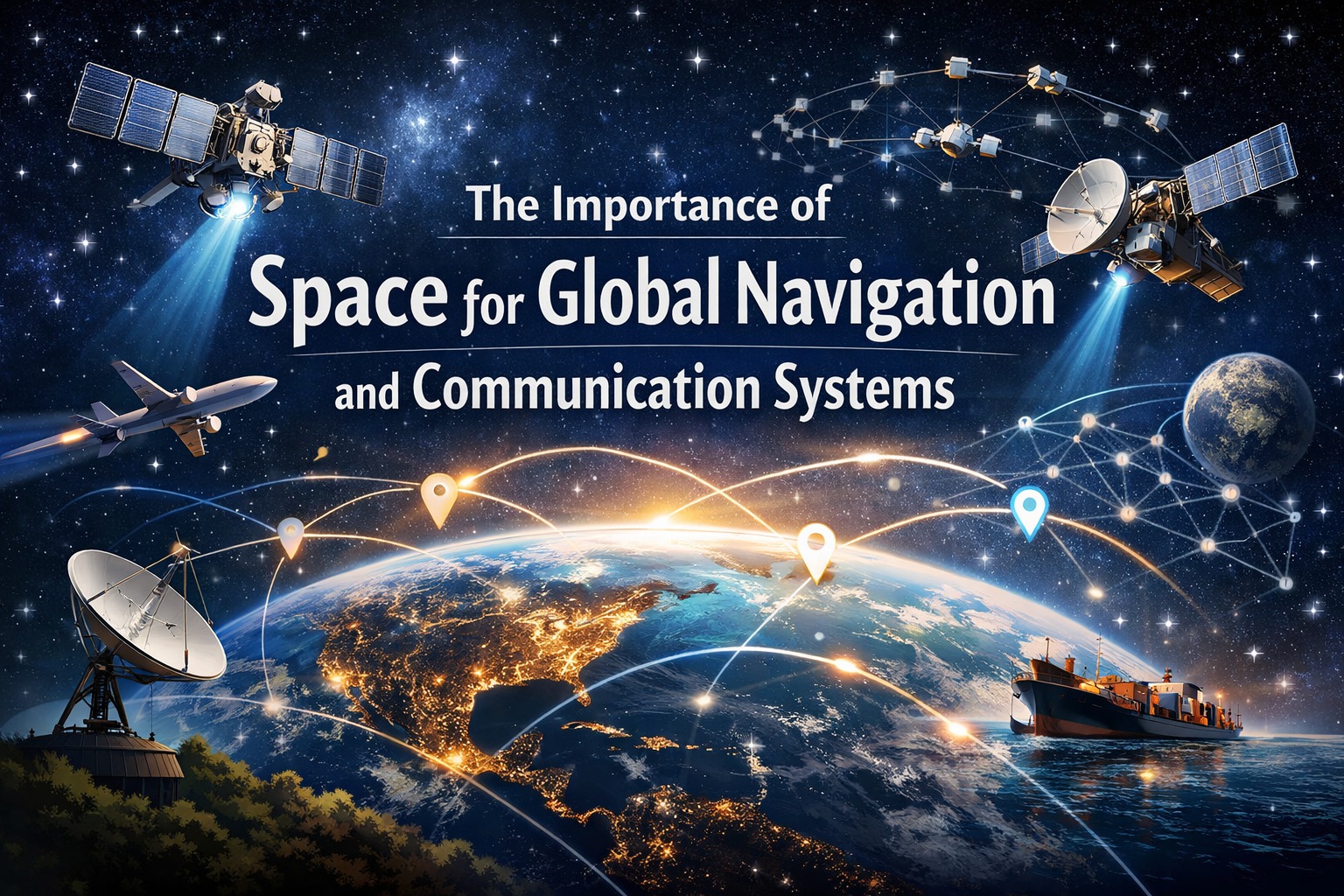
Space has become an essential foundation for modern civilization, especially in supporting global navigation and communication systems. From GPS-enabled smartphones to international broadcasting and internet connectivity, space-based technology plays a silent yet powerful role in connecting the world. Without satellites orbiting the Earth, many of the conveniences and safety systems we rely on daily would not exist.
SPACE NAVIGATION SYSTEMS
One of the most significant contributions of space technology is global navigation. Systems such as GPS (Global Positioning System), GLONASS, Galileo, and BeiDou rely on satellites to determine precise locations anywhere on Earth. These systems are widely used in transportation, aviation, maritime navigation, agriculture, and even emergency response.
Navigation satellites transmit signals to receivers on Earth, allowing users to calculate accurate positions, speed, and time. This capability has transformed how people travel, conduct business, and manage logistics. Even everyday applications like ride-hailing apps and food delivery services depend heavily on satellite navigation.
GLOBAL COMMUNICATION NETWORKS
Space also plays a crucial role in global communication. Communication satellites enable long-distance data transmission, including television broadcasting, internet services, phone calls, and military communications. These satellites act as relay stations in orbit, allowing signals to travel across continents in seconds.
In remote and rural areas where ground infrastructure is limited, satellite communication often becomes the only reliable connection to the outside world. This helps bridge the digital divide and supports education, healthcare, and economic development in underserved regions.
SATELLITE INFRASTRUCTURE AND TECHNOLOGY
The backbone of navigation and communication systems is a complex network of artificial satellites placed in different orbits around Earth. Low Earth Orbit (LEO), Medium Earth Orbit (MEO), and Geostationary Orbit (GEO) satellites each serve specific functions.
LEO satellites are commonly used for internet services due to their lower latency, while GEO satellites are ideal for broadcasting because they remain fixed relative to one point on Earth. Continuous advancements in satellite technology, including miniaturization and reusable launch systems, have made space more accessible and efficient than ever before.
MODERN IMPACT ON DAILY LIFE
The influence of space-based systems is deeply embedded in modern life. Financial transactions rely on precise timing provided by satellites. Disaster management agencies use satellite imagery and communication to coordinate rescue operations. Even weather forecasting depends on space technology to monitor atmospheric conditions globally.
Moreover, industries such as aviation, shipping, and agriculture have become more efficient and safer thanks to satellite-based systems. This integration of space technology has significantly improved productivity and global connectivity.
FUTURE OUTLOOK OF SPACE SYSTEMS
The future of global navigation and communication systems is moving toward greater innovation and expansion. Mega-constellations of satellites are being developed to provide global high-speed internet coverage. Artificial intelligence is also being integrated to improve satellite data processing and accuracy.
As space exploration continues to grow, the dependency on satellite systems will increase even further. New technologies will likely make navigation more precise and communication faster, supporting a more connected and technologically advanced world.
Tentang Penulis
Gusti Ayu Tita
Penulis — Universitas STEKOM
Penulis aktif yang berfokus pada isu-isu akademik, teknologi pendidikan, dan pengembangan sumber daya manusia di lingkungan kampus.



