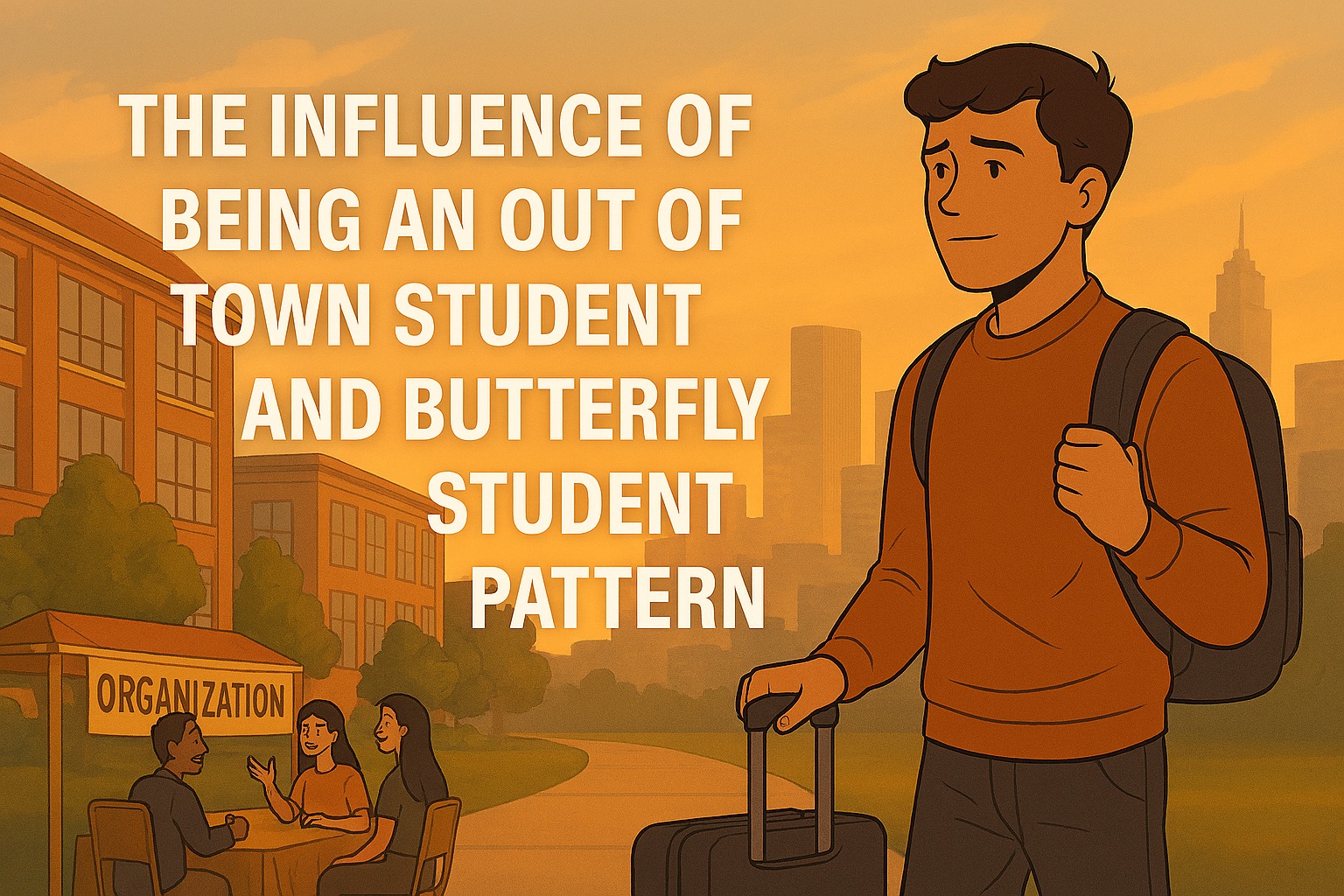
Entering university is a transformative phase, especially for students who leave their hometowns to pursue higher education. Being an out of town student brings new academic challenges, social adjustments, financial responsibilities, and emotional transitions. At the same time, many universities observe the emergence of the “butterfly student” pattern — a lifestyle where students attend classes and return directly to their residence without actively engaging in campus organizations or extracurricular activities. The influence of being an out of town student on the butterfly student pattern is significant and multidimensional. Distance from family, adaptation stress, financial considerations, housing environments, and social comfort levels all shape how students participate in campus life. Understanding this connection provides valuable insight into student engagement, personal development, and institutional support strategies.
ADAPTATION STRESS AND SOCIAL ADJUSTMENT
One of the most powerful influences on out of town students is the adjustment process. Moving to a new city requires adaptation to unfamiliar environments, cultural norms, transportation systems, and social expectations. This adjustment period can be mentally exhausting.
For many students, attending lectures already consumes substantial emotional energy. After navigating a new academic system and unfamiliar peers, they may prefer returning to their dormitory or rented room to rest rather than participating in campus organizations. Over time, this routine solidifies into the butterfly student pattern.
Social anxiety may also intensify during the early stages of relocation. Without established friendships or family support nearby, students may feel hesitant to join new groups. Instead of actively seeking involvement, they may limit their campus presence to mandatory academic activities.
FINANCIAL RESPONSIBILITIES AND SURVIVAL PRIORITIES
Being an out of town student often comes with increased financial demands. Tuition fees, accommodation costs, daily meals, transportation, and living expenses create financial pressure. Some students take part-time jobs to sustain themselves, reducing their available time and energy for extracurricular engagement.
Economic survival becomes a priority. When financial stability is uncertain, joining organizations or attending campus events may appear secondary or even impractical. The butterfly student pattern, in this context, becomes a strategic time-management choice rather than a lack of interest.
Additionally, commuting distance between housing and campus can influence behavior. Students who live far from campus may choose to minimize non-essential trips, reinforcing the habit of attending classes only.
HOUSING ENVIRONMENT AND SOCIAL CIRCLES
The type of accommodation significantly affects campus engagement. Students living in dormitories with active communities may be more exposed to social invitations and organizational information. However, those living in private rentals or isolated housing areas may experience limited social interaction.
Out of town students who share housing with individuals from different backgrounds may initially struggle to find common ground. Without strong peer encouragement, involvement in campus life may decrease. The comfort of a private room often becomes a safe space, encouraging a routine centered on academic attendance and immediate return home.
Environmental comfort strongly influences behavioral patterns. If students feel more secure and productive in their living spaces, they may unconsciously prioritize that environment over campus-based social activities.
EMOTIONAL INDEPENDENCE AND SELF-RELIANCE
Relocating to another city fosters independence. Out of town students learn to manage finances, cooking, laundry, schedules, and personal decisions without direct family supervision. This self-reliance can enhance maturity and discipline.
However, independence may also encourage a highly structured routine focused on essential responsibilities only. Students may develop a mindset centered on efficiency: attend class, complete assignments, manage personal needs, and return home. This efficiency-oriented lifestyle aligns closely with the butterfly student pattern.
Emotional self-protection may also play a role. Being far from family can trigger homesickness. To cope, some students reduce social exposure and focus strictly on academic responsibilities, maintaining stability through routine.
CULTURAL TRANSITION AND IDENTITY ADAPTATION
Out of town students sometimes encounter cultural differences between their hometown and university location. Variations in communication styles, language accents, social norms, or campus culture can influence confidence levels.
If students feel culturally different or socially disconnected, they may hesitate to join organizations. The fear of misunderstanding or social rejection can gradually reduce participation. In such cases, the butterfly student pattern becomes a protective response to perceived social barriers.
Over time, cultural adaptation may increase confidence and encourage broader engagement. However, during early university years, this transition phase often shapes participation habits significantly.
LONG-TERM IMPACT ON PERSONAL AND PROFESSIONAL DEVELOPMENT
The influence of being an out of town student on the butterfly student pattern does not necessarily produce negative outcomes. Many out of town butterfly students develop resilience, independence, financial responsibility, and strong self-discipline. These qualities are valuable in professional environments.
However, limited organizational involvement may reduce exposure to leadership training, teamwork practice, and networking opportunities. Since out of town students are already building independence, combining that strength with selective campus engagement can create a balanced developmental path.
Institutions can also play an important role by providing mentorship programs, inclusive communities, and support systems tailored for relocated students. When out of town students feel welcomed and supported, they are more likely to expand their participation beyond academic requirements.
CONCLUSION
The influence of being an out of town student on the butterfly student pattern is shaped by adaptation stress, financial responsibility, housing conditions, emotional independence, and cultural transition. For many students, this pattern is a rational response to relocation challenges rather than a sign of disengagement.
While the butterfly lifestyle may limit certain social experiences, it also strengthens independence and structured discipline. The key lies in balance. Out of town students who gradually integrate academic focus with meaningful campus involvement can maximize both personal growth and professional readiness.
Understanding this dynamic allows universities, educators, and students to create supportive environments where relocation challenges do not restrict engagement but instead foster holistic development.
Tentang Penulis
Gusti Ayu Tita
Penulis — Universitas STEKOM
Penulis aktif yang berfokus pada isu-isu akademik, teknologi pendidikan, dan pengembangan sumber daya manusia di lingkungan kampus.