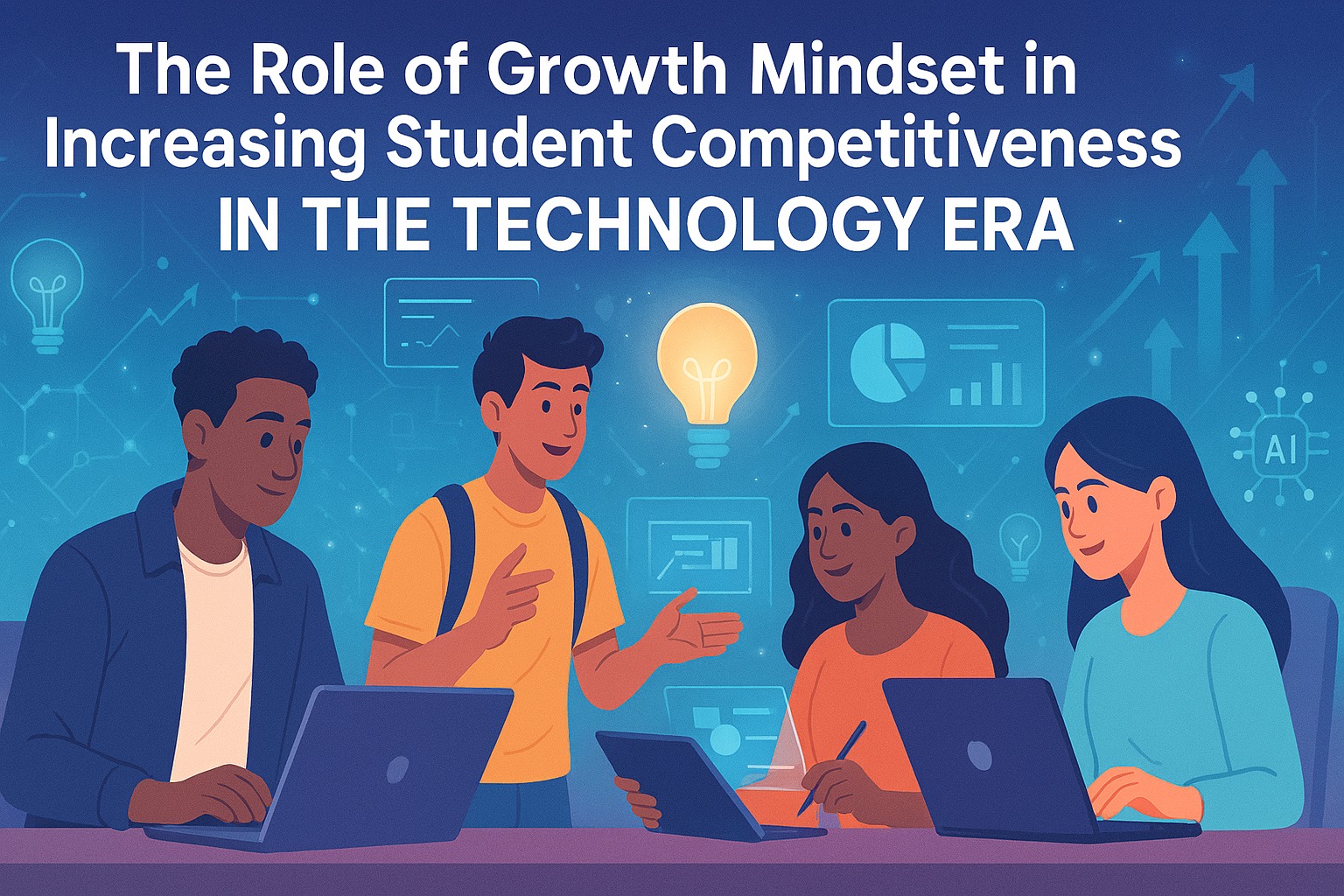
The rapid development of digital technology has transformed almost every aspect of human life, including education. Students today are required not only to master academic knowledge but also to adapt quickly to technological changes that continue to evolve. In this dynamic environment, competitiveness is no longer determined solely by grades or academic achievements, but also by the ability to learn, adapt, and innovate.
One of the most important psychological foundations that supports student success in this era is the growth mindset. This concept refers to the belief that intelligence, skills, and abilities can be developed through effort, persistence, and continuous learning. Students who possess this mindset tend to view challenges as opportunities for growth rather than obstacles.
In the technology era, where new information and skills emerge rapidly, students with a growth mindset are more likely to remain relevant and competitive. They are willing to explore new tools, learn emerging technologies, and improve their abilities even after experiencing failure.
Therefore, developing a growth mindset is not only beneficial for academic success but also essential for preparing students to compete in an increasingly competitive global landscape. This article explores how a growth mindset contributes to strengthening student competitiveness in the modern technological world.
UNDERSTANDING THE CONCEPT OF GROWTH MINDSET
Growth mindset is a concept that emphasizes the belief that intelligence and abilities are not fixed traits but can be developed through dedication and effort. Students who adopt this mindset understand that learning is a continuous process that requires persistence and resilience.
In contrast to a fixed mindset, which assumes that intelligence is static and unchangeable, a growth mindset encourages individuals to embrace challenges. Students with this perspective are more likely to experiment, ask questions, and seek solutions when facing difficulties.
The concept of growth mindset also promotes the idea that mistakes and failures are part of the learning process. Instead of feeling discouraged, students who adopt this mindset analyze their mistakes and use them as opportunities to improve their skills and knowledge.
As a result, the growth mindset becomes a crucial psychological foundation that supports long-term intellectual development and helps students remain adaptable in an era characterized by constant technological change.
THE TECHNOLOGY ERA AND THE DEMAND FOR ADAPTIVE STUDENTS
The technology era has created a highly dynamic environment in which knowledge evolves rapidly and new skills are constantly required. Digital transformation, artificial intelligence, and automation have reshaped the workforce and the competencies needed for future careers.
Students must therefore develop adaptive abilities that enable them to learn new technologies quickly and respond effectively to change. Traditional learning approaches that focus solely on memorization are no longer sufficient to prepare students for modern challenges.
A growth mindset plays an essential role in helping students adapt to this environment. Students who believe that their abilities can improve through effort are more willing to explore digital tools, online learning platforms, and innovative technologies.
By continuously updating their knowledge and skills, students become more flexible and capable of responding to emerging opportunities in the global digital economy.
HOW GROWTH MINDSET ENCOURAGES CONTINUOUS LEARNING
Continuous learning is one of the most important characteristics of successful individuals in the technology era. Because technology evolves rapidly, knowledge acquired today may become outdated within a short period.
Students with a growth mindset understand that learning does not stop in the classroom. They actively seek new information through online courses, digital resources, and collaborative learning environments.
This mindset also encourages curiosity and intellectual exploration. Instead of feeling satisfied with existing knowledge, students become motivated to deepen their understanding and develop new competencies.
Through continuous learning, students are able to stay relevant in a rapidly changing technological landscape and maintain their competitiveness in academic and professional environments.
DEVELOPING RESILIENCE THROUGH A GROWTH MINDSET
Resilience is another critical factor that influences student competitiveness. In the process of learning and innovation, students often encounter challenges, failures, and setbacks.
Students who possess a growth mindset tend to view these difficulties as temporary obstacles rather than permanent limitations. This perspective helps them maintain motivation and continue working toward improvement.
Resilience also strengthens students' ability to manage pressure and uncertainty. In the technology era, where change is constant, the ability to remain optimistic and persistent becomes a valuable asset.
As students develop resilience, they become more confident in facing complex problems and are better prepared to navigate academic and professional challenges.
THE ROLE OF EDUCATION IN CULTIVATING A GROWTH MINDSET
Educational institutions play a significant role in fostering a growth mindset among students. Teachers and learning environments that encourage exploration, creativity, and critical thinking can help students develop this perspective.
Learning systems that emphasize the learning process rather than merely final results are particularly effective in promoting a growth mindset. When students are encouraged to experiment and learn from mistakes, they become more confident in their abilities to improve.
Digital learning platforms also provide opportunities for students to practice independent learning. Access to global knowledge allows students to explore diverse topics and develop skills that support their academic and professional growth.
Through supportive educational environments, students can develop the attitudes and habits necessary to thrive in the rapidly evolving technological world.
CONCLUSION
In the technology era, competitiveness among students is determined not only by academic achievement but also by adaptability, resilience, and the willingness to continuously learn. These qualities are closely related to the development of a growth mindset.
Students who adopt a growth mindset tend to embrace challenges, learn from failures, and continuously improve their abilities. This mindset enables them to navigate technological changes with confidence and creativity.
Educational institutions, teachers, and learning environments play a vital role in cultivating this mindset. By encouraging exploration, critical thinking, and persistence, they help students develop the attitudes necessary for long-term success.
Ultimately, the growth mindset becomes a key factor in strengthening student competitiveness in the modern technological era, enabling them to contribute meaningfully to society and the global knowledge economy.
Tentang Penulis
Gusti Ayu Tita
Penulis — Universitas STEKOM
Penulis aktif yang berfokus pada isu-isu akademik, teknologi pendidikan, dan pengembangan sumber daya manusia di lingkungan kampus.