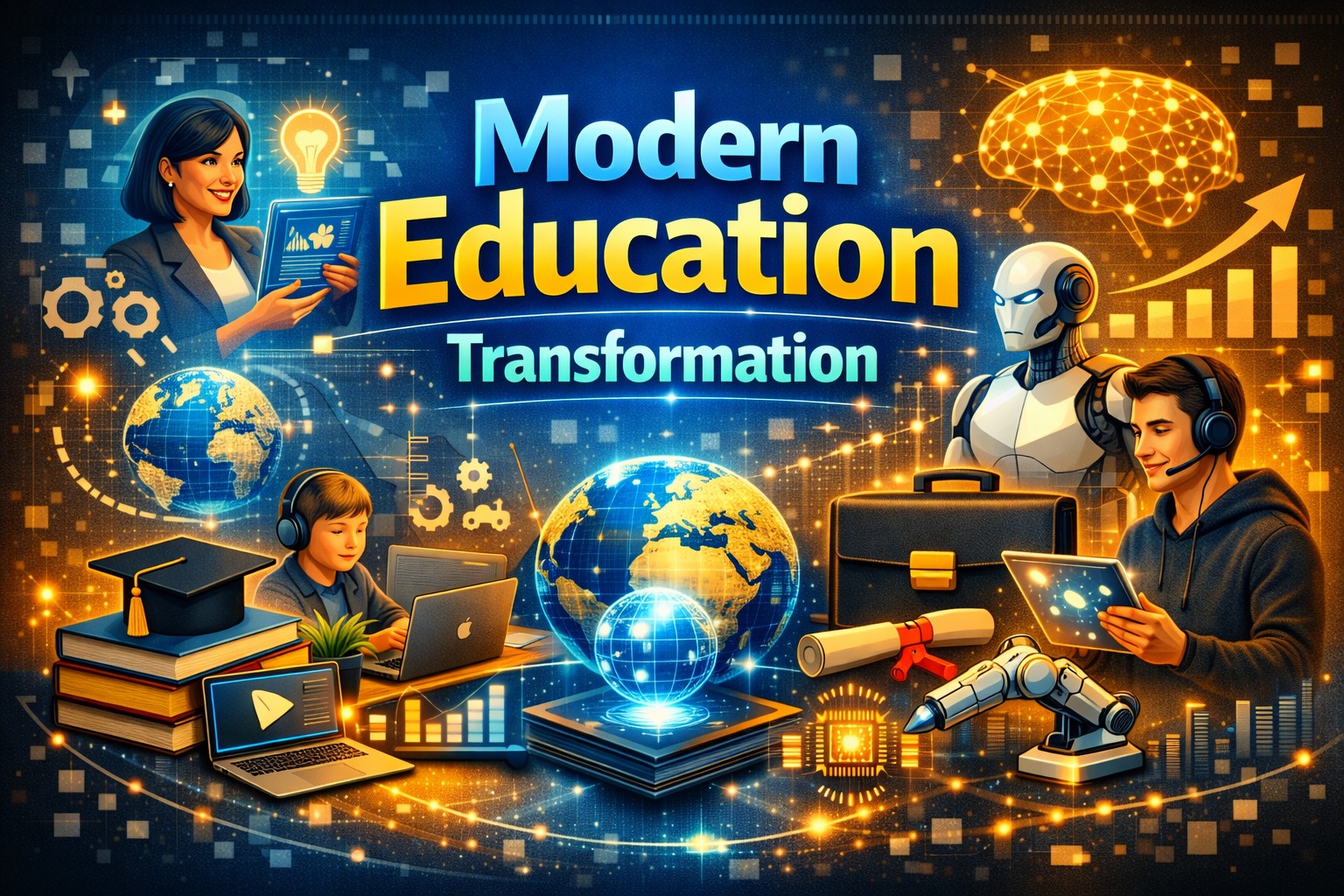
Education has always been the foundation of human progress, but in today’s fast‑paced technological era, it is undergoing a profound transformation. The integration of digital tools, artificial intelligence, and global connectivity has reshaped how people learn, teach, and interact. Modern education is no longer confined to classrooms—it is a dynamic, evolving system that prepares individuals for a future defined by innovation and adaptability.
THE IMPACT OF TECHNOLOGY ON EDUCATION
Technology has revolutionized the learning process. Online platforms, virtual classrooms, and interactive applications have made education accessible to millions worldwide. Students can now learn at their own pace, collaborate globally, and explore subjects beyond traditional boundaries. This digital shift encourages creativity, critical thinking, and problem‑solving—skills essential for success in the modern world.
THE ROLE OF EDUCATORS IN THE DIGITAL AGE
Teachers are no longer just sources of information—they are facilitators of learning. In the technological era, educators guide students to navigate information critically, use digital tools effectively, and develop emotional intelligence. The teacher’s role has evolved to include mentoring, coaching, and inspiring lifelong learning.
CHALLENGES AND OPPORTUNITIES IN MODERN EDUCATION
While technology offers countless benefits, it also presents challenges such as digital inequality, data privacy, and overreliance on automation. Educational institutions must balance innovation with inclusivity, ensuring that every learner has equal access to resources. The opportunity lies in creating systems that combine technological efficiency with human empathy.
PREPARING STUDENTS FOR THE FUTURE
Modern education focuses on equipping students with future‑ready skills—communication, collaboration, adaptability, and digital literacy. As industries evolve, education must prepare learners to embrace change and contribute meaningfully to society. Lifelong learning becomes the key to staying relevant in a world that never stops changing.
Conclusion
The transformation of education in a rapidly changing technological era is not just about adopting new tools—it’s about redefining how we learn and grow. By embracing innovation while preserving human values, education can empower future generations to lead with wisdom, creativity, and purpose.
Tentang Penulis
Gusti Ayu Tita
Penulis — Universitas STEKOM
Penulis aktif yang berfokus pada isu-isu akademik, teknologi pendidikan, dan pengembangan sumber daya manusia di lingkungan kampus.