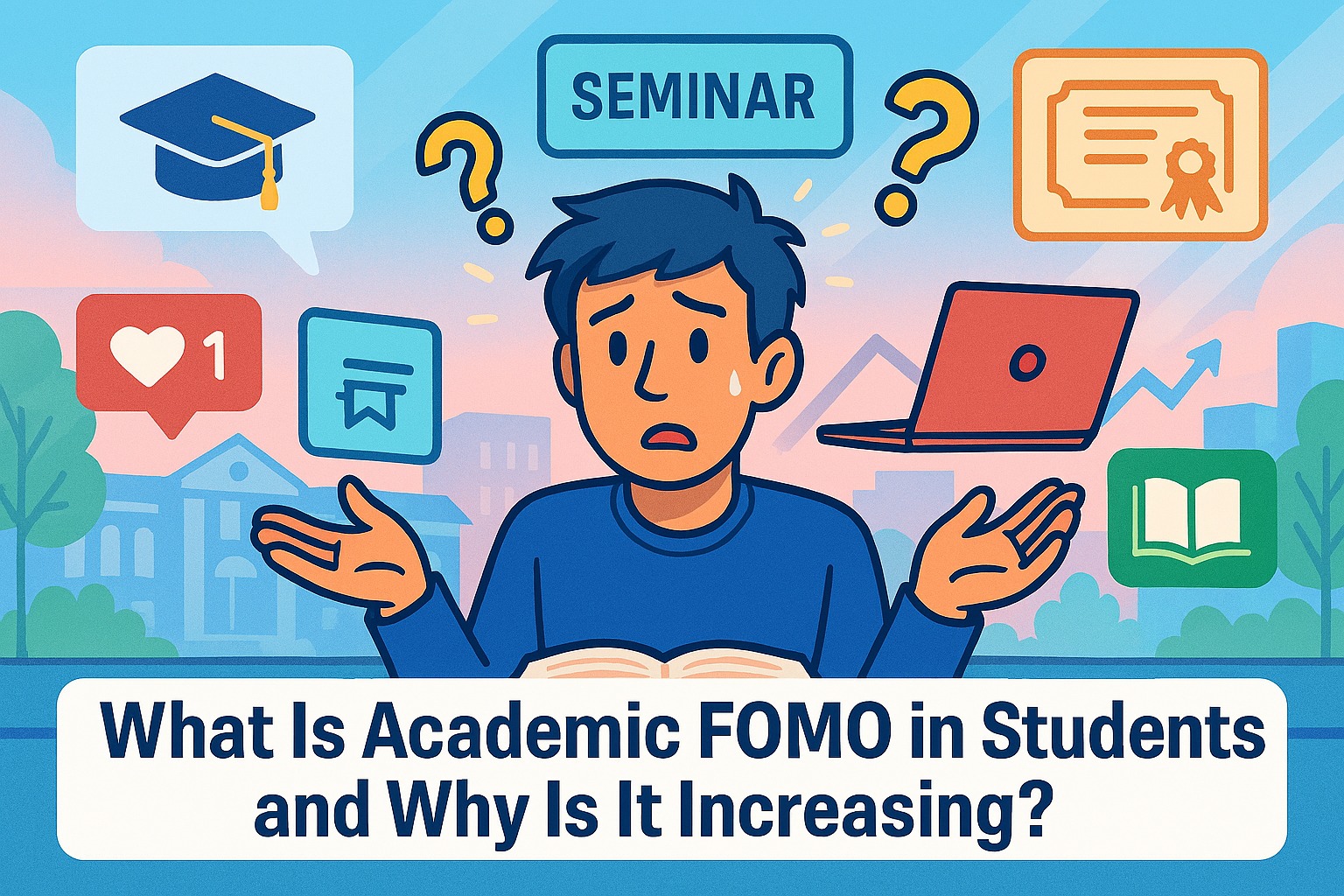
Academic life has never been more connected, competitive, or opportunity-driven than it is today. Students are surrounded by announcements of scholarships, internships, research programs, certifications, and peer achievements. While this abundance can inspire growth, it has also given rise to a modern psychological pattern known as academic FOMO — the fear of missing out within an educational context. Students begin to feel anxious that skipping an opportunity could mean falling behind academically or professionally. Academic FOMO is not simply about ambition or curiosity. It reflects deeper psychological and social dynamics shaped by digital exposure, performance culture, and evolving expectations of success. As this phenomenon grows more visible, its influence on learning behavior, emotional health, and decision-making becomes increasingly significant. Understanding what academic FOMO is — and why it is intensifying — helps students navigate modern education with greater clarity and balance.
DEFINING ACADEMIC FOMO IN THE STUDENT EXPERIENCE
Academic FOMO occurs when students feel compelled to pursue every available opportunity out of fear that missing one could harm their future. It is characterized by persistent comparison, urgency, and self-doubt. Students may feel that participation equals progress, leading them to equate busyness with achievement.
Unlike healthy motivation, academic FOMO is driven by anxiety. Decisions are made reactively rather than intentionally. Students often overcommit, believing that saying no is equivalent to losing ground. This mindset shifts attention away from meaningful engagement toward constant activity.
At its core, academic FOMO reflects the human tendency to avoid perceived loss. When opportunities are framed as scarce or competitive, fear becomes a powerful motivator. Students respond by trying to stay everywhere at once, which fragments focus and energy.
THE ROLE OF DIGITAL CULTURE IN AMPLIFYING FOMO
Digital technology plays a central role in the rise of academic FOMO. Online platforms allow achievements to be shared instantly and widely. Students regularly encounter curated highlights of peers’ success — awards, internships, conference participation, and academic milestones.
This constant visibility accelerates social comparison. Because digital content often emphasizes outcomes rather than effort, students may underestimate the complexity behind achievements. The result is a distorted perception of progress, where others appear consistently ahead.
Information overload compounds the effect. Notifications about deadlines, programs, and opportunities arrive continuously. Students feel pressure to respond immediately to avoid missing out. The brain remains in a state of alertness, which heightens anxiety and reduces reflective decision-making.
PERFORMANCE EXPECTATIONS AND ACADEMIC PRESSURE
Modern education increasingly emphasizes measurable achievement. Grades, certifications, extracurricular involvement, and portfolio development are often viewed as indicators of readiness for future careers. While these standards encourage ambition, they can also intensify fear-based thinking.
Students internalize the belief that success requires constant accumulation of credentials. This expectation creates pressure to participate in multiple activities simultaneously. Over time, academic engagement becomes less about curiosity and more about maintaining competitive visibility.
Institutional culture can unintentionally reinforce this pattern. When achievement is celebrated publicly without equal attention to well-being, students may interpret productivity as a requirement rather than a choice.
PSYCHOLOGICAL MECHANISMS BEHIND THE INCREASE
Several psychological factors explain why academic FOMO is becoming more common. Humans are naturally sensitive to social comparison and perceived scarcity. In high-achievement environments, these tendencies are magnified.
Fear of regret is another contributor. Students imagine future scenarios where missed opportunities lead to failure. This anticipation fuels urgency, even when opportunities are not essential. Cognitive biases, such as overestimating the importance of single events, reinforce the cycle.
Identity formation also plays a role. Many students define themselves through academic success. When identity is tied to productivity, missing an opportunity feels like a personal setback rather than a neutral choice.
CONSEQUENCES OF RISING ACADEMIC FOMO
As academic FOMO increases, its effects ripple through student life. Anxiety becomes more frequent, reducing emotional resilience. Overcommitment leads to fatigue, making it difficult to sustain attention and motivation.
Learning quality may decline when students prioritize quantity over depth. Engagement becomes fragmented, and creativity suffers. The pressure to remain active leaves little room for reflection or recovery.
Social relationships can also be affected. Students consumed by comparison may withdraw or feel isolated, believing they are falling behind. This emotional strain undermines both academic performance and personal well-being.
WHY THE TREND CONTINUES TO GROW
Academic FOMO continues to rise because modern education is deeply interconnected. Opportunities are more visible, competition is global, and expectations evolve rapidly. Students are encouraged to prepare for uncertain futures, which heightens sensitivity to perceived advantage.
Cultural narratives around success emphasize constant growth and hustle. While these messages aim to inspire, they can unintentionally normalize overextension. Without clear boundaries, students internalize the idea that rest equals stagnation.
The accessibility of information ensures that opportunities never stop appearing. This abundance, paradoxically, increases fear — not because options are scarce, but because choosing one means declining another.
BUILDING AWARENESS AND BALANCE
Recognizing academic FOMO is the first step toward managing it. Awareness allows students to separate genuine interest from fear-driven impulses. Intentional decision-making restores control and promotes sustainable engagement.
Balanced academic life requires prioritization. Students benefit from aligning opportunities with long-term goals rather than reacting to external pressure. Reflection helps evaluate whether commitments support growth or merely satisfy comparison.
Digital boundaries reduce overstimulation. Limiting exposure to achievement highlights fosters healthier self-assessment. Rest and recovery become essential components of productivity, strengthening cognitive and emotional resilience.
Supportive academic communities also counter isolation. Open conversations about pressure normalize shared experiences and encourage collaborative growth.
CONCLUSION
Academic FOMO is a growing phenomenon shaped by digital culture, performance expectations, and psychological tendencies. While opportunity abundance can motivate students, fear-driven engagement undermines focus, well-being, and meaningful learning. As visibility and competition increase, so does the urgency students feel to remain constantly active.
Understanding the roots of academic FOMO empowers students to make intentional choices. By prioritizing depth over accumulation, managing comparison, and valuing recovery, learners can navigate modern education with confidence. When success is defined by sustainable growth rather than constant activity, academic life becomes both productive and fulfilling.
Tentang Penulis
Gusti Ayu Tita
Penulis — Universitas STEKOM
Penulis aktif yang berfokus pada isu-isu akademik, teknologi pendidikan, dan pengembangan sumber daya manusia di lingkungan kampus.