
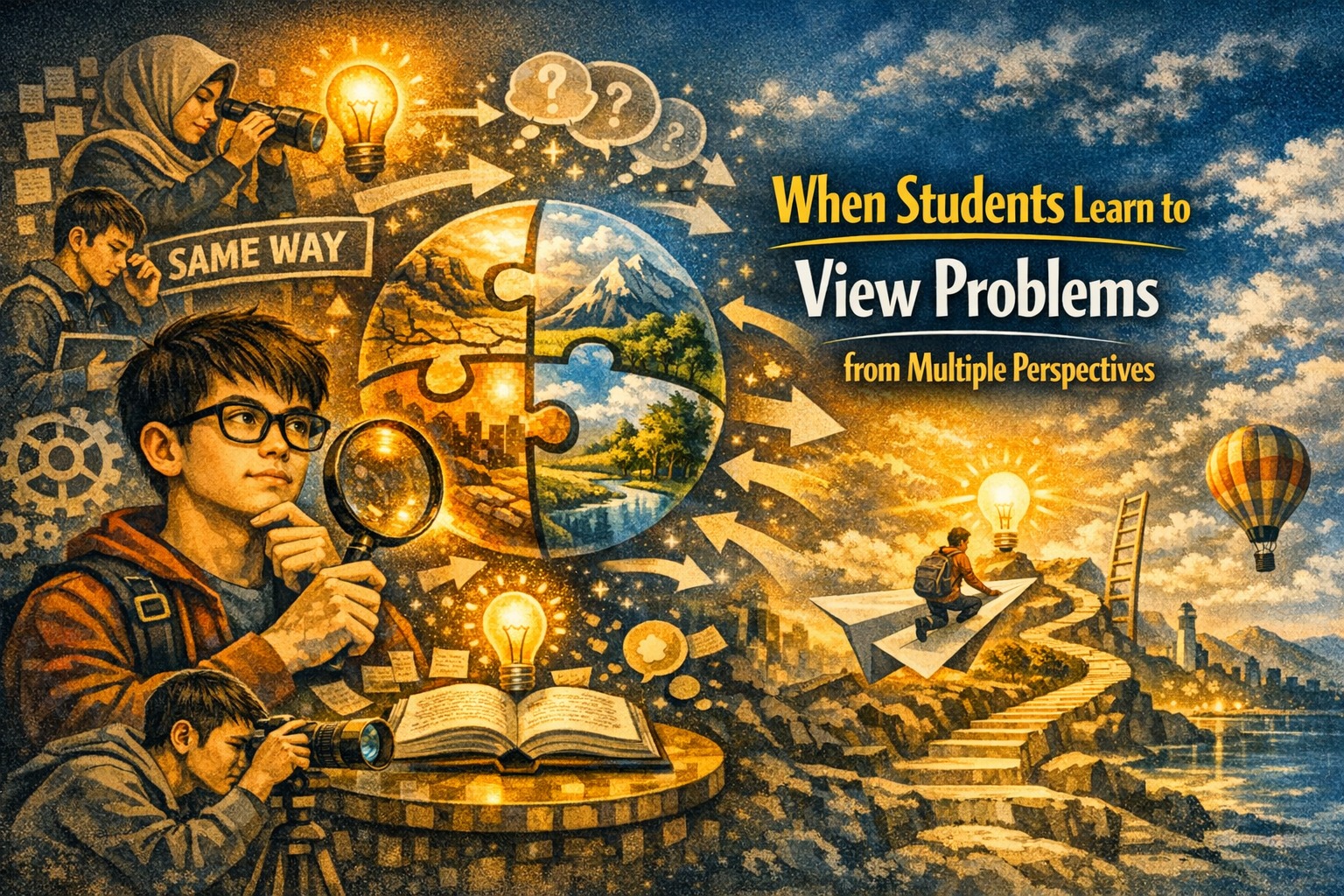
In today’s complex and interconnected world, many issues cannot be solved by looking at them from a single point of view. Social, technological, economic, and environmental challenges often involve multiple factors and diverse interests. Because of this, students need to develop the ability to view problems from multiple perspectives.
Learning to analyze a problem from different angles helps students understand situations more deeply and develop more thoughtful solutions. Instead of relying on simple conclusions, they learn to explore various viewpoints, evaluate evidence carefully, and build balanced arguments. This skill has become increasingly important in modern education and professional life.
THE IMPORTANCE OF MULTI-PERSPECTIVE THINKING
Multi-perspective thinking refers to the ability to examine an issue from different viewpoints. When students develop this skill, they move beyond narrow interpretations and begin to understand the complexity of real-world situations.
For example, a social issue might be influenced by cultural values, economic conditions, and political policies. By exploring these different dimensions, students gain a more complete understanding of the problem.
This broader perspective encourages students to think critically and prevents them from forming conclusions based on limited information.
HOW DIVERSE PERSPECTIVES ENRICH LEARNING
Educational environments often bring together students from diverse backgrounds, cultures, and experiences. This diversity naturally introduces a variety of perspectives into classroom discussions.
When students listen to different viewpoints, they gain insights that they might not have considered before. Each perspective contributes new ideas that help deepen collective understanding.
This process makes learning more dynamic and encourages intellectual curiosity. Students begin to realize that complex problems rarely have only one correct answer.
THE ROLE OF CRITICAL THINKING IN ANALYZING PROBLEMS
Critical thinking plays a central role in helping students evaluate different perspectives effectively. It allows them to assess the strengths and weaknesses of various arguments and determine which ideas are supported by reliable evidence.
Students who practice critical thinking do not simply accept opinions at face value. Instead, they analyze the reasoning behind each viewpoint and consider how different factors influence the situation.
Through this process, students develop the ability to make balanced judgments and form well-reasoned conclusions.
DEVELOPING EMPATHY AND OPEN-MINDEDNESS
Viewing problems from multiple perspectives also encourages empathy and open-mindedness. When students explore how others think and experience the world, they develop a deeper appreciation for diverse viewpoints.
This understanding helps students communicate more effectively and collaborate with people from different backgrounds. In academic discussions, it promotes respectful dialogue and constructive debate.
These qualities are essential in a global society where cooperation and mutual understanding play an important role in solving complex challenges.
PREPARING STUDENTS FOR REAL-WORLD CHALLENGES
Many real-world problems require individuals who can analyze situations from several angles before making decisions. Business leaders, researchers, policymakers, and professionals in many fields must consider multiple perspectives when addressing complex issues.
Students who develop this ability during their academic journey are better prepared for these responsibilities. They can approach problems with flexibility, evaluate competing ideas, and identify solutions that consider various interests.
This skill not only enhances academic success but also strengthens professional competence.
THE ROLE OF EDUCATION IN CULTIVATING BROAD THINKING
Educational institutions have a responsibility to encourage students to explore multiple perspectives. Through discussions, collaborative projects, and research activities, students can examine topics from different viewpoints.
Teachers can also promote open inquiry by encouraging students to question assumptions and consider alternative explanations. This approach helps students become more thoughtful and independent thinkers.
When educational environments value intellectual diversity, students gain the confidence to analyze complex issues more comprehensively.
CONCLUSION
Learning to view problems from multiple perspectives is an essential skill for students in the modern world. It allows them to understand complex issues more deeply, evaluate different viewpoints objectively, and develop balanced solutions.
By encouraging critical thinking, empathy, and open-mindedness, education helps students build the intellectual tools necessary to face real-world challenges. Ultimately, students who learn to analyze problems from many perspectives become more capable thinkers, effective collaborators, and responsible global citizens.
Tentang Penulis
Gusti Ayu Tita
Penulis — Universitas STEKOM
Penulis aktif yang berfokus pada isu-isu akademik, teknologi pendidikan, dan pengembangan sumber daya manusia di lingkungan kampus.



