
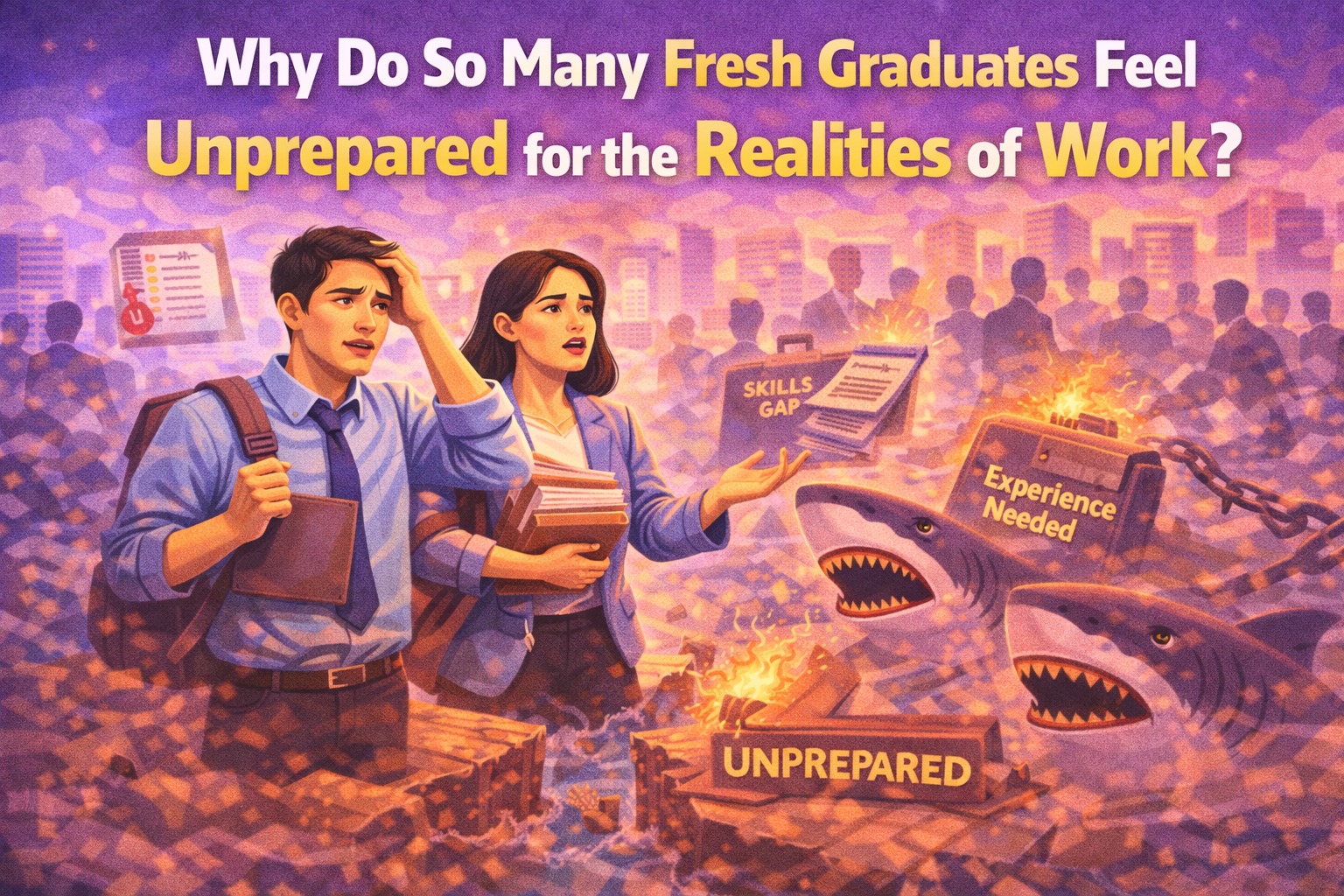
Graduating from college is often seen as a gateway to a promising professional career. However, real-life experiences frequently tell a different story. Many fresh graduates feel nervous, uncertain, and even overwhelmed when they first enter the professional world. This sense of being “unprepared” can arise even among those with strong academic backgrounds.
So, what exactly causes many new graduates to feel unready to face the realities of work?
THE DIFFERENCE BETWEEN CAMPUS LIFE AND THE WORKING WORLD
One of the main reasons behind this feeling is the significant difference between college life and the workplace. In college, students are accustomed to a structured system with clear schedules, measurable academic tasks, and room for making mistakes.
In contrast, the working world demands independence, speed, and accountability—where actions directly affect team performance or company outcomes. This shift in pace often leaves fresh graduates feeling shocked and lacking confidence.
LACK OF PRACTICAL EXPERIENCE
Many new graduates possess solid theoretical knowledge but have limited practical experience. When confronted with real workplace challenges, they often feel unsure where to begin. This issue becomes more apparent for those who had little exposure to internships, field projects, or organizational activities during college.
Without hands-on experience, adapting to the workplace becomes slower and more demanding.
THE PRESSURE OF OVERLY HIGH EXPECTATIONS
Fresh graduates often carry high expectations—from themselves, their families, and their social environment. The pressure to succeed quickly, adapt immediately, and perform perfectly can become a mental burden.
As a result, many new graduates become afraid of making mistakes, leading them to feel unprepared to face workplace challenges that are actually part of the learning process.
THE GAP IN NON-ACADEMIC SKILLS
The workplace evaluates not only technical abilities but also soft skills such as communication, teamwork, time management, and conflict resolution. Unfortunately, these skills often receive limited emphasis in academic settings.
Consequently, fresh graduates may feel less confident when interacting with supervisors, colleagues, or clients.
LIMITED UNDERSTANDING OF WORKPLACE CULTURE
Every organization has its own unwritten rules and workplace culture, including communication styles, professional ethics, and decision-making norms. Fresh graduates who are unfamiliar with professional environments often feel awkward and afraid of making missteps.
Adjusting to workplace culture requires time and strong mental readiness.
THE ROLE OF UNIVERSITIES AND PERSONAL INITIATIVE
Feeling unprepared for the workplace is not entirely an individual’s fault. Limited career preparation and exposure at universities also contribute to graduates’ lack of readiness. Nevertheless, students themselves play a crucial role in preparing early—through internships, organizational involvement, and personal skill development beyond the classroom.
The earlier the preparation begins, the smaller the shock when entering the professional world.
CONCLUSION
Many fresh graduates feel unprepared for the realities of work due to environmental differences, limited practical experience, high expectations, and gaps in soft skills. However, these feelings are normal and part of the transition into professional life. With an open mindset, a willingness to learn, and adaptability, fresh graduates can gradually build confidence and find their own rhythm in the workplace.
Tentang Penulis
Gusti Ayu Tita
Penulis — Universitas STEKOM
Penulis aktif yang berfokus pada isu-isu akademik, teknologi pendidikan, dan pengembangan sumber daya manusia di lingkungan kampus.



