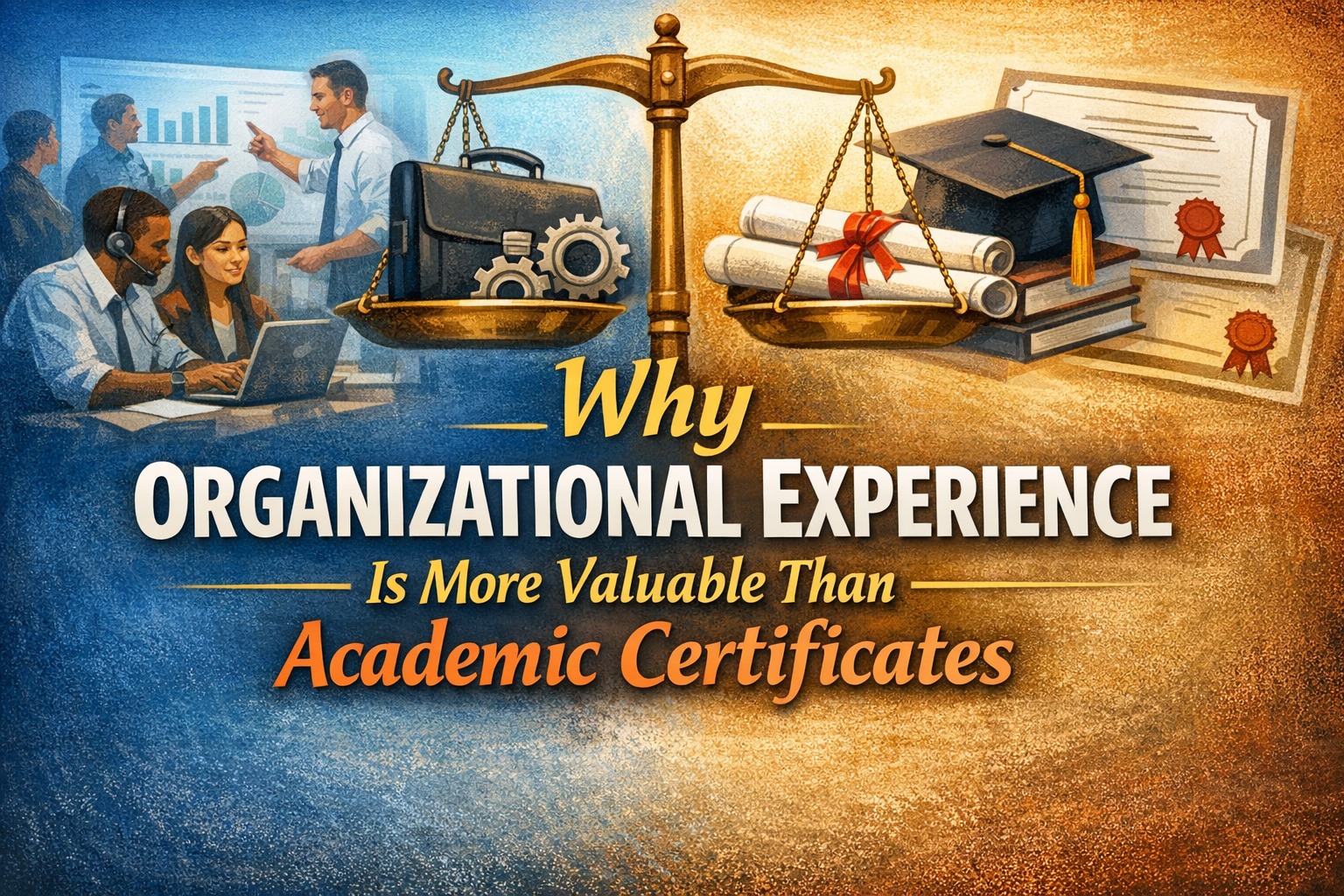
In today’s competitive world, academic certificates are often seen as the primary measure of success. Diplomas, transcripts, and titles frequently become the main focus for students and job seekers. However, as workplaces and societies evolve, organizational experience is increasingly recognized as a deeper and more lasting investment. While certificates show what someone has studied, organizational experience reveals how someone thinks, acts, and grows in real situations.
This article explores why organizational experience often provides greater long-term value than academic certificates alone.
THE LIMITATIONS OF ACADEMIC CERTIFICATES
Academic certificates represent formal achievement. They show that a person has completed a curriculum and met certain standards. This is important, but certificates have limits. They mainly reflect cognitive ability and individual performance in structured environments.
In many cases, certificates cannot fully describe how someone handles pressure, communicates with others, or adapts to unexpected challenges. Employers and institutions increasingly realize that high grades do not always translate into strong performance in real-world settings.
ORGANIZATIONAL EXPERIENCE BUILDS REAL-WORLD SKILLS
Organizational involvement places individuals in dynamic and often unpredictable situations. Through committees, student organizations, community groups, or professional associations, people learn by doing.
Organizational experience develops practical skills such as leadership, teamwork, problem-solving, time management, and conflict resolution. These skills are difficult to gain from lectures alone. When someone is responsible for a project, an event, or a team, learning becomes personal and deeply embedded.
Unlike certificates, these skills grow through repeated action and reflection, making them more durable over time.
CHARACTER FORMATION THROUGH RESPONSIBILITY
One of the strongest values of organizational experience lies in character development. Being part of an organization means dealing with differences in opinion, facing failure, and making decisions that affect others.
Responsibility teaches accountability. Collaboration teaches empathy. Leadership teaches humility and courage. These qualities shape personal character in ways that academic assessments rarely measure.
Certificates may expire in relevance as knowledge changes, but character traits formed through experience often last a lifetime.
NETWORKING AND SOCIAL CAPITAL
Organizations connect individuals with people from diverse backgrounds. These connections create social capital that can open doors to opportunities, mentorship, and collaboration.
Through organizational activities, individuals learn how to communicate professionally, build trust, and maintain long-term relationships. These networks often become more influential in career development than grades or formal credentials.
Academic certificates may help someone enter a field, but relationships often help them grow within it.
ADAPTABILITY IN A CHANGING WORLD
The modern world changes rapidly. New technologies, work models, and social challenges require adaptability. Organizational experience trains individuals to respond to change, manage uncertainty, and learn continuously.
In organizations, plans rarely run perfectly. Adjusting strategies, managing limited resources, and responding to unexpected problems become part of daily life. This adaptability is highly valued in professional environments where flexibility matters more than rigid knowledge.
ORGANIZATIONAL EXPERIENCE COMPLEMENTS, NOT REPLACES, EDUCATION
It is important to note that organizational experience does not make academic education irrelevant. Instead, it complements it. Academic learning provides theoretical foundations, while organizational experience transforms theory into action.
When combined, these two elements create individuals who are not only knowledgeable but also capable, ethical, and resilient. However, when forced to choose which has longer-lasting impact on personal growth, organizational experience often proves more transformative.
LONG-TERM VALUE BEYOND THE CV
Certificates look impressive on a resume, but organizational experience tells a story. It shows growth, initiative, and commitment. It reflects how someone contributes, not just what they have completed.
In the long term, people are remembered for how they work with others, how they lead, and how they respond to challenges. These qualities are shaped far more by experience than by documentation.
CONCLUSION
Academic certificates are important milestones, but they are not the final measure of success. Organizational experience offers something deeper: real skills, strong character, meaningful relationships, and adaptability for an uncertain future.
In a world that values action, collaboration, and integrity, organizational experience becomes an investment that continues to pay off long after certificates are earned. It is not just about being qualified on paper, but about being prepared in life.
Tentang Penulis
Gusti Ayu Tita
Penulis — Universitas STEKOM
Penulis aktif yang berfokus pada isu-isu akademik, teknologi pendidikan, dan pengembangan sumber daya manusia di lingkungan kampus.