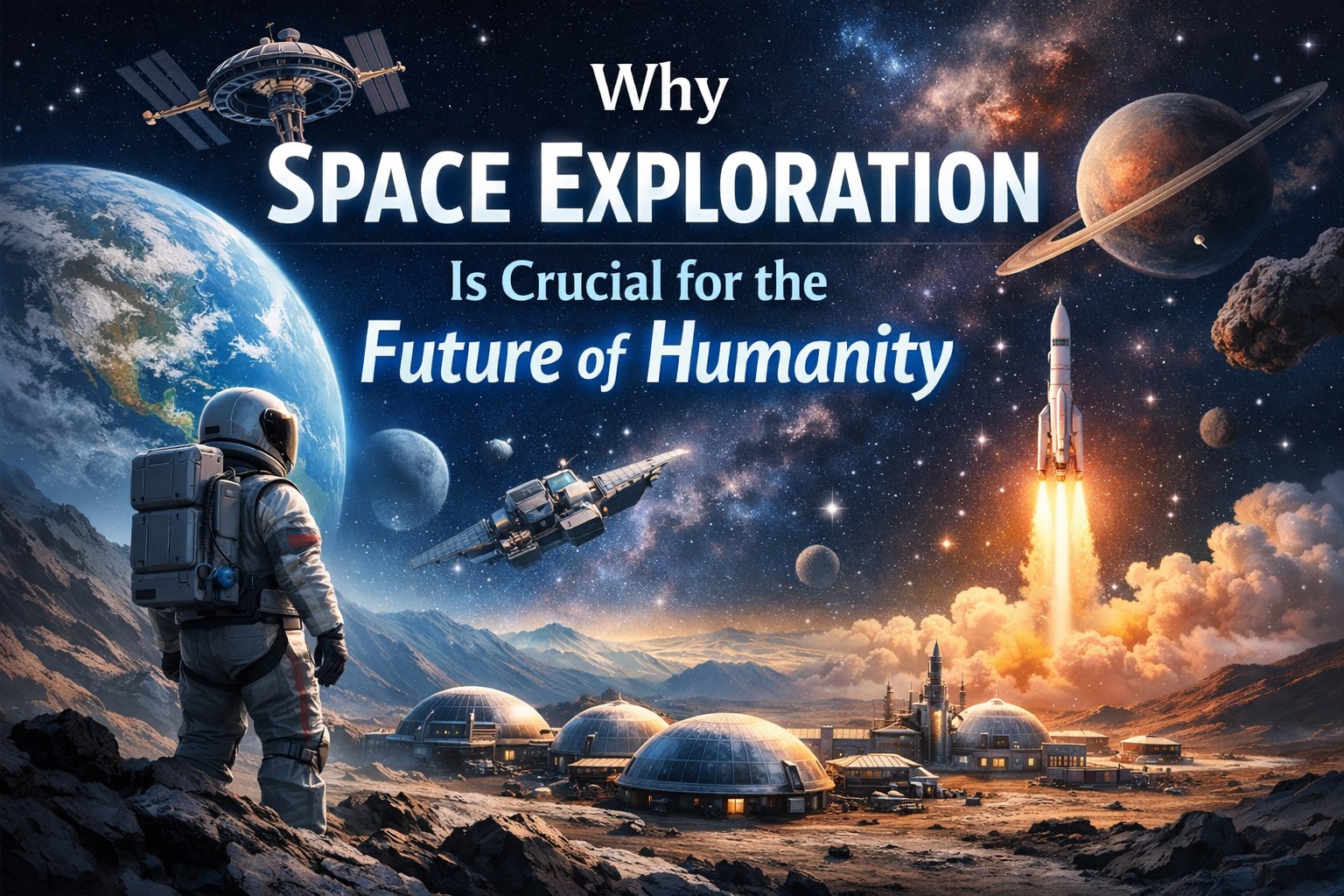
Space exploration is no longer just a symbol of scientific curiosity or national pride. It has become a critical pillar for the survival, progress, and long-term future of humanity. As Earth faces growing challenges such as climate change, overpopulation, and resource depletion, exploring outer space offers solutions that may determine the next chapter of human civilization.
UNDERSTANDING OUR PLACE IN THE UNIVERSE
One of the most important reasons for space exploration is to better understand our place in the universe. By studying planets, stars, and galaxies, scientists gain insight into how Earth was formed and how life itself may have begun. Missions to Mars, the Moon, and deep space provide valuable data that helps answer fundamental questions about existence.
This knowledge not only expands scientific understanding but also encourages humanity to think beyond planetary boundaries. It shifts our perspective from a planet-centered mindset to a more universal awareness of life and existence.
ADVANCING TECHNOLOGY AND INNOVATION
Space exploration has always been a driving force behind technological advancement. Many technologies we use in daily life today—such as satellite navigation, weather forecasting, and advanced medical imaging—originated from space research.
Developing spacecraft, rockets, and space stations requires cutting-edge innovation in engineering, robotics, artificial intelligence, and materials science. These innovations often find applications on Earth, improving industries such as transportation, communication, healthcare, and environmental monitoring.
ENSURING THE SURVIVAL OF HUMANITY
Earth is our home, but it is not immune to threats. Natural disasters, asteroid impacts, and long-term environmental changes pose risks to human survival. Space exploration provides a form of planetary insurance by exploring the possibility of human life beyond Earth.
Colonizing other planets, such as Mars, is no longer just science fiction but a serious scientific goal. Establishing human settlements in space could ensure that humanity continues even if Earth becomes uninhabitable in the distant future.
RESOURCE EXPLORATION AND SUSTAINABILITY
As Earth's natural resources become increasingly limited, space may offer alternative sources of materials and energy. Asteroids, for example, contain valuable metals and minerals that could support future industries.
In addition, space-based solar power systems have been proposed as a way to generate clean and unlimited energy. These innovations could reduce pressure on Earth's ecosystems and contribute to a more sustainable future.
GLOBAL COOPERATION AND PEACEFUL PROGRESS
Space exploration encourages international collaboration. Large-scale missions often involve cooperation between multiple countries and space agencies, such as NASA, ESA, and others. This shared effort promotes peaceful relations and scientific diplomacy.
By working together in space, nations can build trust and focus on common goals that benefit all of humanity, rather than competing solely on Earth-based conflicts.
CONCLUSION
Space exploration is not just about reaching distant planets—it is about securing the future of humanity. From technological innovation to survival strategies and global cooperation, the benefits are vast and essential. As we continue to explore the universe, we are also investing in the long-term resilience and progress of human civilization.
The future of humanity may very well depend on how far we are willing to go beyond Earth.
Tentang Penulis
Gusti Ayu Tita
Penulis — Universitas STEKOM
Penulis aktif yang berfokus pada isu-isu akademik, teknologi pendidikan, dan pengembangan sumber daya manusia di lingkungan kampus.