
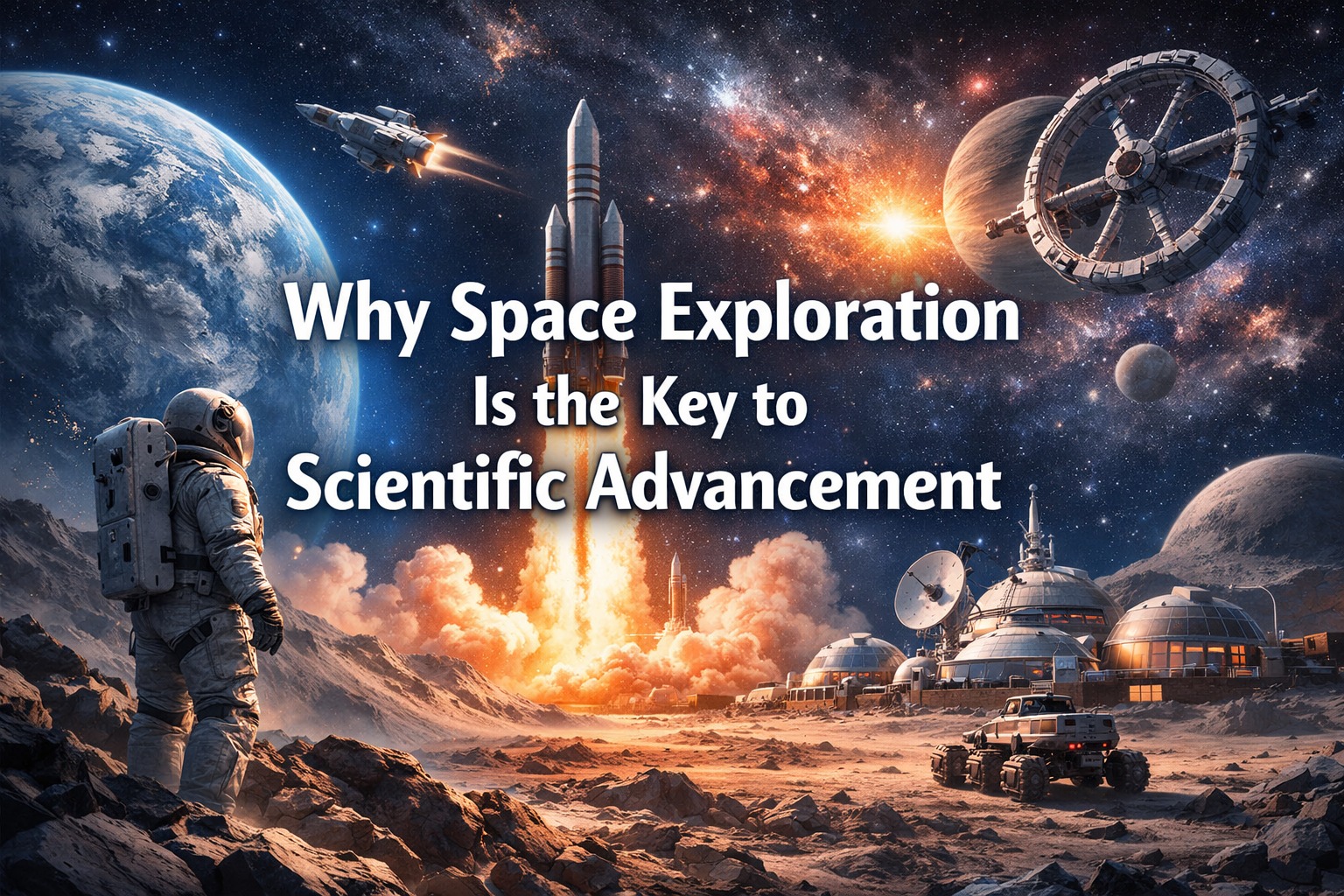
Space exploration has long been seen as one of humanity’s greatest achievements. Beyond the fascination of stars and planets, it plays a crucial role in driving scientific progress on Earth. From technological innovation to medical breakthroughs, the study of outer space continues to expand human knowledge and reshape modern life.
THE FOUNDATION OF MODERN SCIENCE
Space exploration serves as a foundation for many branches of modern science. By studying celestial bodies, scientists gain insights into physics, chemistry, and cosmology that cannot be replicated on Earth. Observing extreme environments such as black holes or distant galaxies helps researchers test theories and refine scientific models.
This continuous process of discovery strengthens our understanding of natural laws and pushes science beyond its current limits.
TECHNOLOGICAL INNOVATION DRIVEN BY SPACE RESEARCH
Many technologies we use today were originally developed for space missions. Satellite communication, GPS systems, and advanced imaging technologies are direct results of space exploration efforts.
Materials designed for spacecraft have also influenced industries on Earth, including construction, transportation, and consumer electronics. The need to solve complex challenges in space encourages engineers and scientists to create innovative solutions that benefit everyday life.
SPACE EXPLORATION AND MEDICAL ADVANCEMENTS
Medical science has also greatly benefited from space research. Experiments conducted in microgravity environments help scientists understand human biology in new ways. For example, studies on bone density loss in space have contributed to better treatments for osteoporosis on Earth.
Additionally, imaging technologies developed for space missions have improved diagnostic tools such as MRI and CT scans, enhancing healthcare quality worldwide.
EXPANDING HUMAN KNOWLEDGE AND PERSPECTIVE
Exploring space also expands humanity’s perspective about its place in the universe. It encourages curiosity and inspires future generations to pursue careers in science, technology, engineering, and mathematics.
By understanding other planets and galaxies, scientists can also gain insights into Earth’s origins and future, including climate patterns and planetary sustainability.
THE FUTURE OF SCIENTIFIC DISCOVERY
As technology continues to evolve, space exploration will play an even greater role in shaping scientific advancement. Missions to Mars, asteroid exploration, and deep-space telescopes are expected to reveal new information about the universe.
International collaboration in space programs will further accelerate discoveries, making science more interconnected and globally impactful.
CONCLUSION
Space exploration is not just about reaching distant worlds; it is about advancing human knowledge and improving life on Earth. Its contributions to science, technology, and medicine prove that investing in space is an investment in the future of humanity.
Tentang Penulis
Gusti Ayu Tita
Penulis — Universitas STEKOM
Penulis aktif yang berfokus pada isu-isu akademik, teknologi pendidikan, dan pengembangan sumber daya manusia di lingkungan kampus.



