
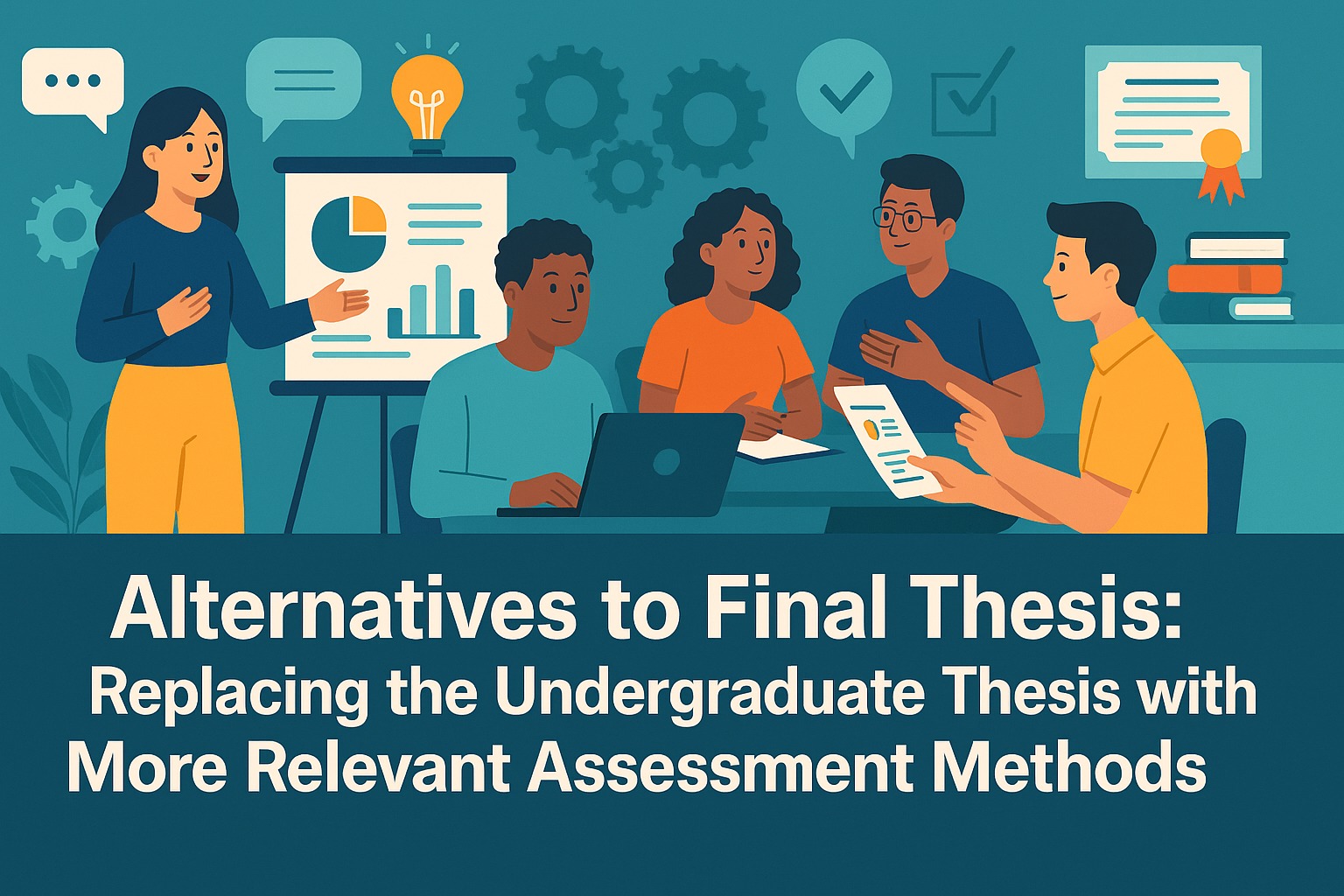
Alternatives to Final Thesis: Replacing the Undergraduate Thesis with More Relevant Assessment Methods
Introduction
As the world of education evolves alongside the dynamic demands of industry, the discourse around replacing the traditional undergraduate thesis with more practical final assessments is gaining momentum. The core objective is to align academic processes with real-world competencies while offering students broader opportunities to demonstrate their skills in practical and applicable ways.
Table of Contents
- Alternatives to Final Thesis Assessments
1.1. Team-Based Collaborative Projects
1.2. Academic Portfolios
1.3. Oral Exams and Open Presentations
1.4. Case Study Analysis and Solutions
1.5. Integrated Internships or Field Practice
1.6. Industry Simulation Projects
1.7. Structured Problem-Solving Exams
1.8. Academic and Professional Competitions - Conclusion
1. Alternatives to Final Thesis Assessments
Below are several assessment methods that can serve as alternatives to a thesis, offering more measurable learning outcomes and greater alignment with professional needs:
1.1. Team-Based Collaborative Projects
Involving students in group-based projects encourages teamwork, critical problem-solving, and team dynamics management—reflecting the reality of modern work environments.
1.2. Academic Portfolios
Student portfolios may include their best academic work such as essays, digital designs, practice reports, and project documentation. These reflect holistic skill development over time.
1.3. Oral Exams and Open Presentations
This format evaluates conceptual understanding while enhancing critical thinking, logical argumentation, and public speaking—skills that are vital in the professional world.
1.4. Case Study Analysis and Solutions
By working on real-world case studies, students apply theories to practical situations and develop contextual understanding of business or social challenges.
1.5. Integrated Internships or Field Practice
Replacing a thesis with reflective reports from internships gives students firsthand exposure to professional ethics, responsibility, and business processes.
1.6. Industry Simulation Projects
Simulations based on real industry scenarios provide students with practical experiences—challenging them to design strategies, manage projects, and solve problems like professionals.
1.7. Structured Problem-Solving Exams
These exams assess a student’s ability to analyze data, develop solutions, and apply scientific methods in technical or social contexts.
1.8. Academic and Professional Competitions
Participation in research contests, business proposal competitions, product design challenges, or hackathons tests students’ real-world skills while offering networking and external validation opportunities.
2. Conclusion
Replacing the thesis with more flexible and application-oriented final assessments is a strategic step toward modernizing higher education. This approach not only enhances learning relevance but also better prepares students for the workforce.
By implementing diverse assessment systems—from collaborative projects to portfolios and internships—universities can cultivate graduates who are adaptive, skilled, and ready to compete in a global landscape.
About the Author
Gusti Ayu Tita
Author — STEKOM University
An active author focused on academic issues, educational technology, and human resource development in the campus environment.



