
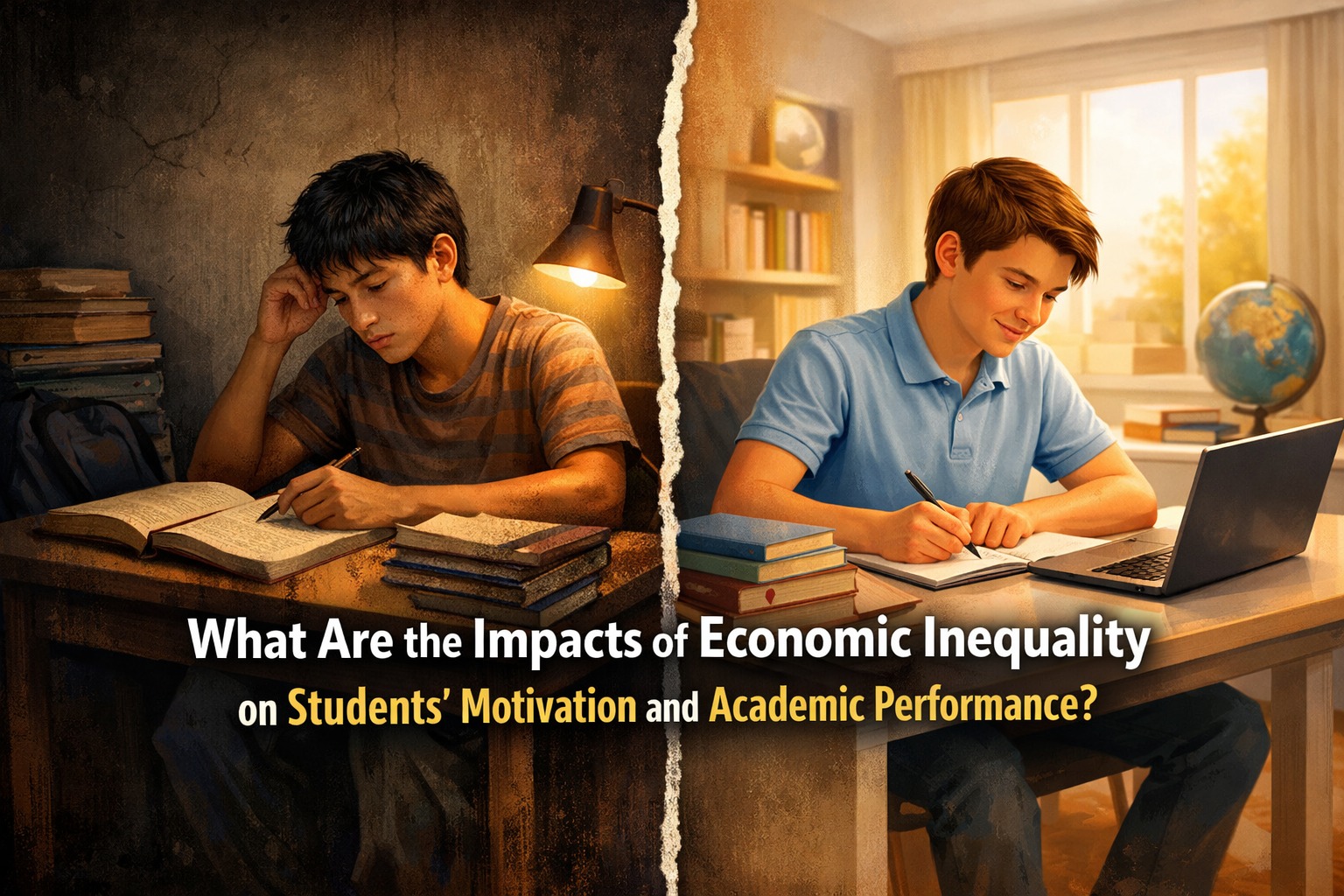
Economic inequality remains one of the greatest challenges in the field of education. Differences in family financial conditions often create a significant gap between students who have full access to learning facilities and those who must struggle with limitations. So, what are the impacts of economic inequality on students’ motivation and academic performance? This article discusses the issue in detail.
1. Economic Inequality and Access to Learning Facilities
Family economic conditions greatly influence the quality of learning facilities accessible to students.
Students from high-income families usually have:
- Laptops or adequate learning devices
- Comfortable study spaces
- Stable internet access
- Private tutoring or additional courses
In contrast, students from low-income families often have to share devices, study in less conducive environments, or lack internet access altogether. This inequality directly affects their ability to understand academic material.
2. Impact on Learning Motivation
Motivation is a crucial factor in determining academic success. Economic inequality can influence students’ motivation in several ways:
a. Feelings of Inferiority and Low Self-Confidence
Students with financial limitations tend to feel inferior when they see their peers with better learning facilities. This can reduce self-confidence and make them feel less capable of competing academically.
b. Stress and Emotional Pressure
Family economic problems often become a psychological burden. Many students must help their parents work, which reduces their study time. This condition lowers motivation due to divided focus.
c. Lack of External Support
Parents who are busy earning a living often lack the time or resources to optimally support their children’s learning processes.
3. Impact on Academic Performance
Economic inequality affects not only motivation but also academic performance directly. Some of the key impacts include:
a. Suboptimal Learning Outcomes
Limited learning resources make it difficult for students to understand material deeply. This results in lower academic scores compared to students with complete facilities.
b. Differences in Learning Speed
Access to books, the internet, and additional tutoring allows students from affluent families to learn more quickly. Meanwhile, students from disadvantaged backgrounds often lag behind in understanding lessons.
c. Achievement Gap
The academic performance of students from low-economic groups tends to fall below the national average, creating an achievement gap that continues to widen over time.
4. Long-Term Impacts on Students’ Futures
Economic inequality does not stop at academic achievement; it also affects students’ long-term futures:
- Reduced opportunities to continue education at the tertiary level
- Limited access to scholarships or high-quality educational programs
- Higher risk of being trapped in intergenerational poverty cycles
- Lower self-confidence in pursuing better career opportunities
These consequences make economic inequality a critical issue that must be addressed seriously.
5. Efforts to Reduce the Impact of Economic Inequality
Several measures can be taken to minimize the impact of economic inequality on education:
- Equal distribution of school facilities in underdeveloped areas
- Scholarship programs and educational financial assistance
- Increased access to affordable internet for students
- Teacher training to support students with special needs
- Collaboration among parents, schools, and governments to support learning processes
Through collective efforts, gaps in academic achievement can be reduced.
Conclusion
Economic inequality has a significant impact on students’ motivation and academic performance. From limited learning facilities and declining motivation to lower academic outcomes, these factors are interconnected and influence students’ futures. Awareness of this issue is essential so that governments, schools, and communities can work together to create a more equitable and inclusive education system.
About the Author
Gusti Ayu Tita
Author — STEKOM University
An active author focused on academic issues, educational technology, and human resource development in the campus environment.



