
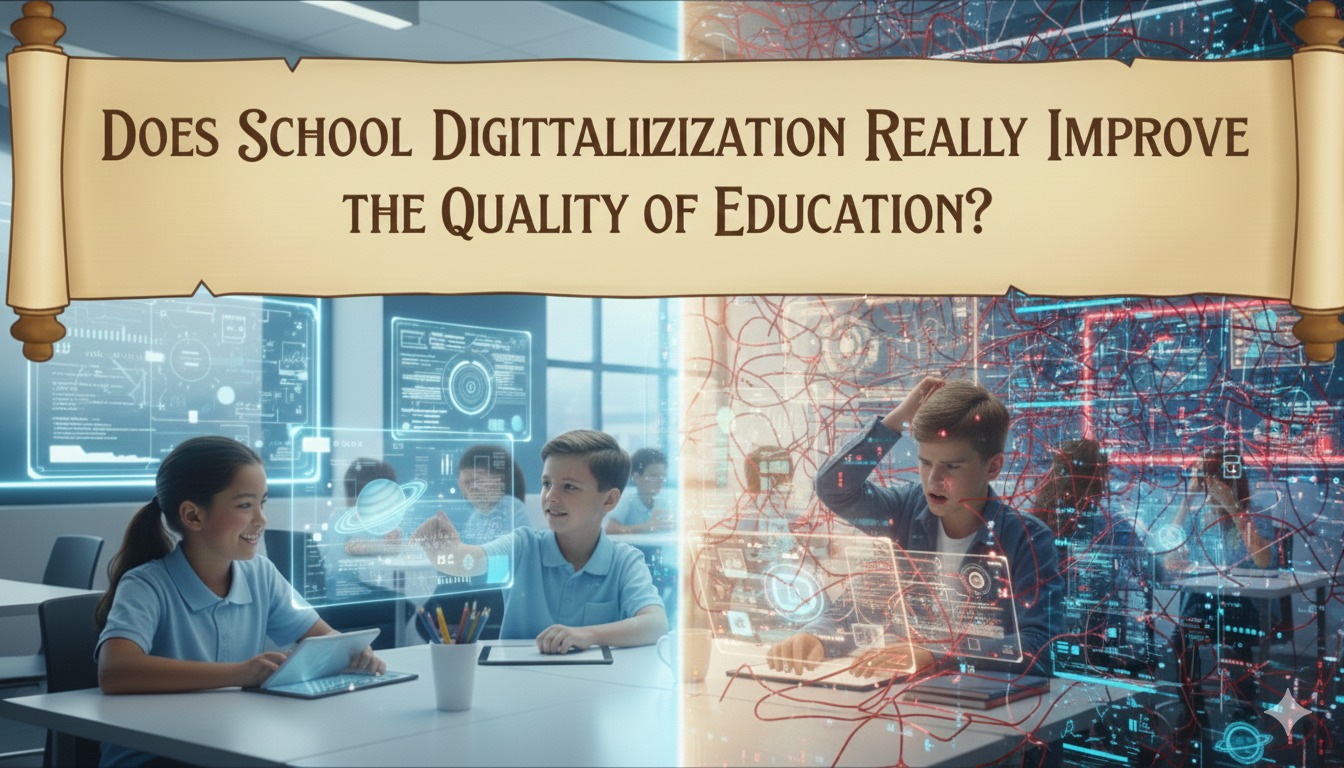
In today’s highly digital era, schools across Indonesia are beginning to transform through the use of technology. From app-based learning and online examinations to digital school management systems, all of these efforts are directed toward the digitalization of education. However, an important question arises: does school digitalization truly improve the quality of education, or is it merely a trend of modernization?
EDUCATIONAL TRANSFORMATION IN THE DIGITAL ERA
School digitalization does not simply mean using laptops or the internet in classrooms. More broadly, it involves how teachers teach, how students learn, and how academic data is managed.
With online learning platforms, students can study anytime and anywhere. Teachers can also use technology to make lessons more interactive and engaging through videos, online quizzes, and digital simulations.
For example, the implementation of Learning Management Systems (LMS) helps schools organize schedules, grades, and attendance efficiently. As a result, administrative processes become faster and more transparent.
REAL BENEFITS OF SCHOOL DIGITALIZATION
Digitalization brings several positive impacts on education quality, including:
Broader Access to Learning
Students in remote areas can now access the same learning materials as those in major cities through the internet.
More Engaging Learning Experiences
Digital media makes lessons more dynamic and interactive, helping students understand materials more easily.
Improved Teacher Efficiency
Teachers can manage assignments, grades, and student reports automatically through digital platforms.
Accurate Monitoring of Learning Progress
Digital data allows teachers and parents to track student progress in real time.
CHALLENGES THAT STILL EXIST
Despite its promise, school digitalization has not been fully smooth. Several obstacles remain, such as:
The digital divide in internet access between urban and rural areas.
Limited digital skills among teachers and students.
Dependence on devices and internet connectivity.
Lack of supervision in online learning environments.
Without serious attention, digitalization may actually create new inequalities in education.
STEPS TO IMPROVE THE EFFECTIVENESS OF SCHOOL DIGITALIZATION
To ensure that digitalization truly enhances education quality, strategic steps are needed, including:
Regular teacher training to improve digital literacy.
Improving internet infrastructure and learning devices.
Developing hybrid learning systems that combine online and face-to-face learning.
Strengthening collaboration between the government, schools, and technology industries.
CONCLUSION
School digitalization has great potential to improve education quality, but its success depends on proper implementation and strong infrastructure support. When managed effectively, digitalization becomes not just a symbol of modernity, but a real tool for transforming education toward a more equitable, efficient, and high-quality system.
About the Author
Gusti Ayu Tita
Author — STEKOM University
An active author focused on academic issues, educational technology, and human resource development in the campus environment.



