
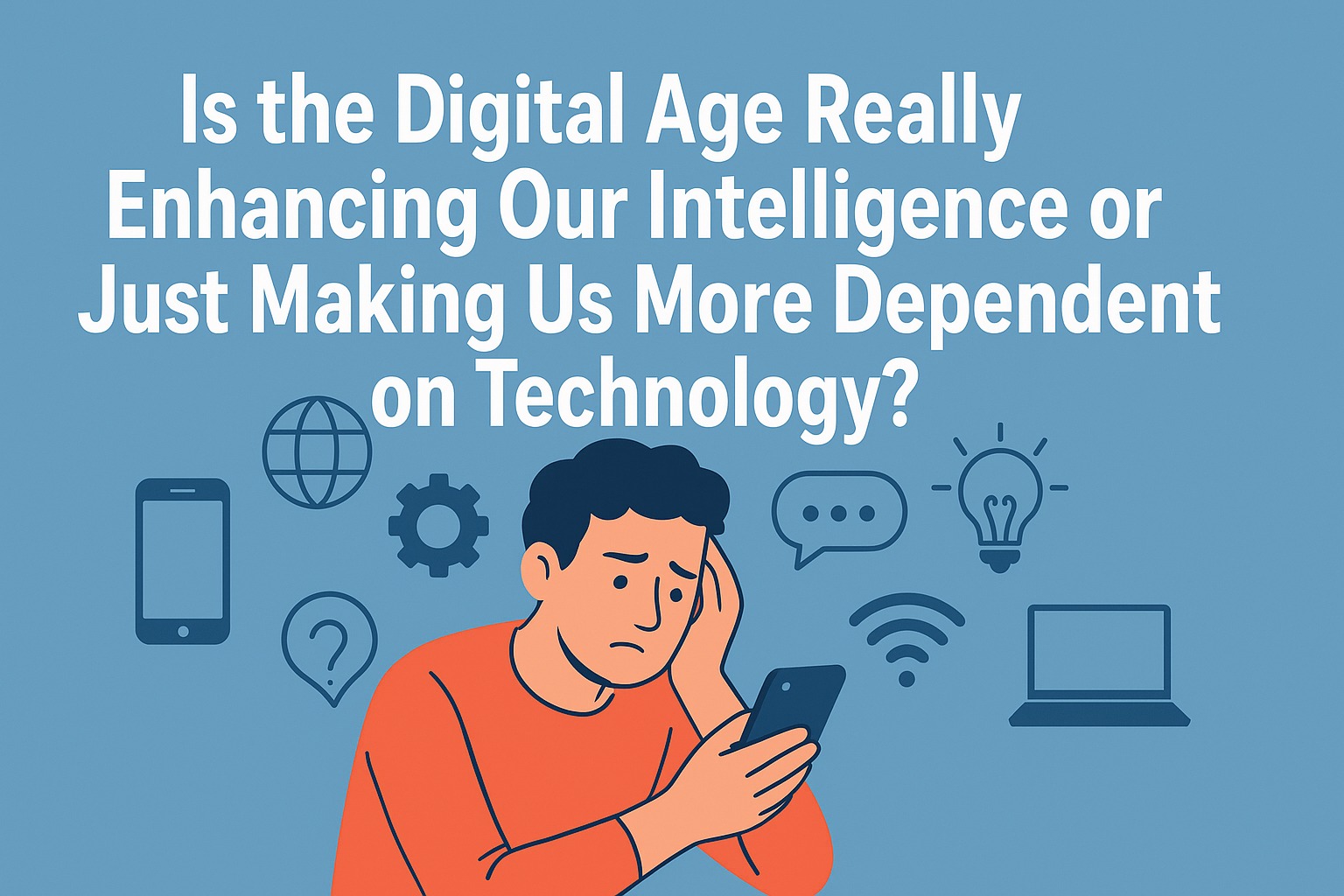
The development of digital technology has brought significant changes to the way we learn, work, and interact. The presence of the internet, smartphones, and various smart applications offers conveniences that were once unimaginable. However, an important question arises: do these conveniences truly make us smarter, or are they creating an unhealthy dependence on technology?
This article explores both sides of the digital era—its potential to enhance intelligence and its tendency to foster dependency—to provide readers with a more comprehensive understanding.
THE DIGITAL ERA AND INCREASED ACCESS TO KNOWLEDGE
It is undeniable that the digital era has opened the doors to vast amounts of information. Within seconds, one can access scientific journals, educational videos, or online courses from universities around the world. This makes the learning process faster and more flexible.
We can understand complex topics through visualizations, simulations, and interactive explanations. For students and professionals, technology accelerates comprehension and enhances analytical skills.
Even artificial intelligence (AI) provides additional support—from summarizing material to functioning as a personal learning assistant. All of this shows that technology holds great potential to boost intelligence when used wisely.
IMPROVED MULTITASKING AND ADAPTABILITY
Generations growing up in the digital era tend to be more accustomed to multitasking. They quickly adapt to rapid information changes and use various digital tools to simplify tasks.
This adaptability is one of the indicators of modern intelligence. A person today is not only expected to memorize facts but also to search for, evaluate, and apply information effectively—abilities that digital technology strongly supports.
CRITICAL ANALYSIS: ARE WE ACTUALLY GETTING SMARTER?
Despite the growing accessibility of information, experts debate whether our intelligence is truly increasing. Many argue that the quantity of information does not necessarily equate to improved quality of thinking.
Some emerging challenges include:
- Information overload often leads to passive consumption rather than deep analysis.
- Focus easily breaks due to constant notifications from various apps.
- Fast-reading habits can prevent deeper understanding of concepts.
This shows that intelligence is not determined only by how much information we have but by how effectively we process and evaluate it.
INCREASING DEPENDENCE ON TECHNOLOGY
On the other hand, studies show that people are becoming more reliant on technology even for simple tasks. Many now depend heavily on search engines to answer basic questions that were once easy to remember.
Some signs of technology dependence include:
- Relying on GPS even for familiar or short routes.
- Using calculators for simple calculations.
- Difficulty focusing without checking the phone.
- toring all information digitally to the point of forgetting it mentally.
This dependence can reduce the brain’s capacity for memory and independent thinking, as many decisions are influenced by algorithms and automation.
PSYCHOLOGICAL IMPACTS: INTELLIGENCE OR DISTRACTION?
Technology is undeniably helpful, yet it also carries a high risk of distraction. Social media, digital games, and short-form content train the brain to seek quick stimulation. As a result, long-term concentration skills may decline.
On one side, we have more tools than ever to learn. On the other, our ability to maintain focus and delay gratification is weakening.
This means the digital era is not only increasing intelligence—it is also reshaping how the brain works.
HOW TO USE THE DIGITAL ERA BALANCEFULLY
To ensure technology enhances intelligence rather than creating dependency, here are some simple steps:
1. Limit phone use during study or work hours.
2. Use technology to deepen understanding, not just for quick consumption.
3. Train the brain with offline activities, such as reading books or writing by hand.
4. Use digital tools productively, such as note-taking apps, calendars, or educational platforms.
5. Manage notifications to reduce distractions.
With the right balance, technology can be an extremely powerful tool for enhancing thinking and intellectual abilities.
CONCLUSION: THE CHOICE IS IN THE HANDS OF THE USERS
The digital era has two sides. It can accelerate intelligence, or it can foster dependence. The outcome depends greatly on how we use technology every day.
When used for learning, exploration, and self-improvement, technology can elevate intelligence to a higher level. But when used excessively and without control, it can weaken independent thinking skills.
Ultimately, intelligence in the digital age is not just about accessing information but about processing it critically and wisely.
About the Author
Gusti Ayu Tita
Author — STEKOM University
An active author focused on academic issues, educational technology, and human resource development in the campus environment.



