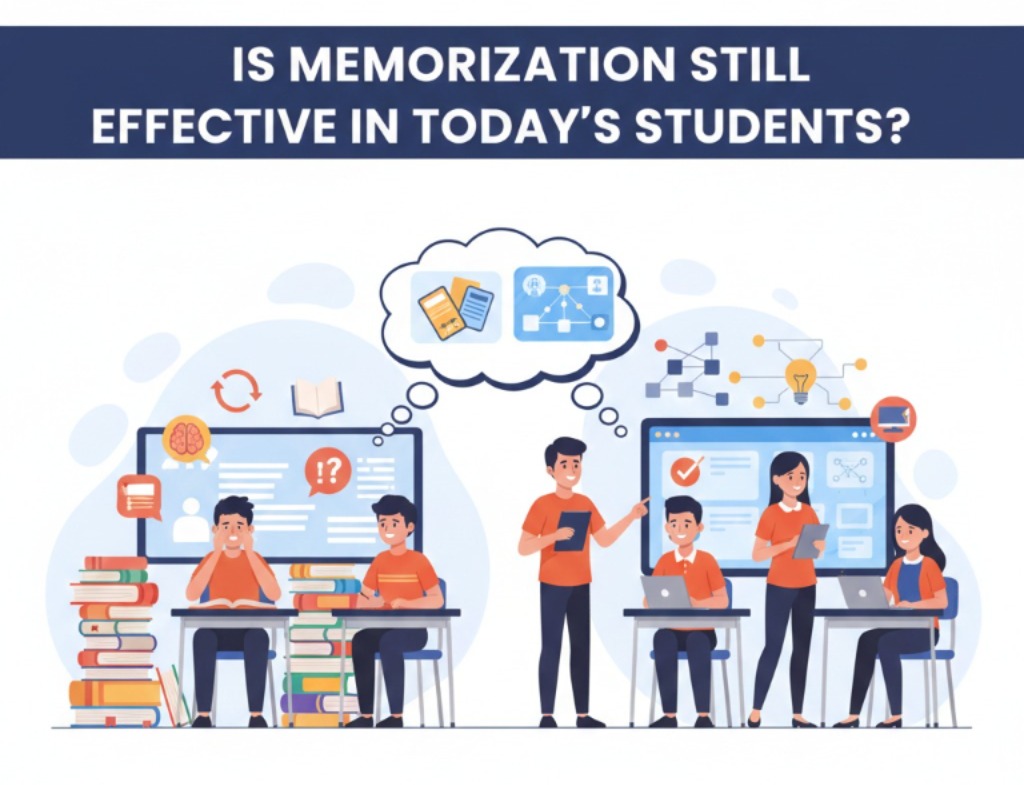
In the world of education, memorization has long been an integral part of learning. From elementary school to university, students are trained to recall facts, formulas, and definitions to answer exam questions. However, the world has changed. Information is now at our fingertips, technology is rapidly advancing, and critical thinking is increasingly required. This raises an important question: is memorization still effective for students today?
Memorization: An Old Method That Once Reigned
In the past, memorization was considered the easiest and most efficient way to measure learning success. Students who could accurately repeat lessons were seen as smart and high-achieving. In certain contexts, memorization still has benefits:
* Helps retain basic information such as formulas, terms, or vocabulary
* Trains memory and discipline
* Serves as a foundation before understanding more complex concepts
However, when memorization becomes the main goal rather than a step toward understanding, learning becomes shallow. Students may be able to answer questions but struggle to explain the meaning behind their answers.
Educational Challenges in the Digital Era
Students today live in an era flooded with information. Anything can be searched online in seconds. In this context, the ability to memorize is no longer a major advantage.
What matters more is the ability to understand, interpret, and apply information. The modern world requires a generation capable of critical thinking, adaptability, and problem-solving—not merely repeating data. Furthermore, future jobs will not demand memorization of facts but the ability to learn continuously, innovate, and collaborate across disciplines.
Limitations of Memorization Today
* Easily forgotten: Information memorized without understanding is often lost after exams.
* Inhibits creativity: Students who rely too much on memorization tend to fear mistakes and rarely think outside the box.
* Does not develop higher-order thinking: Memorization only involves recall, not analysis, evaluation, or creation.
* Not relevant to future needs: Modern workplaces value critical thinking and collaboration more than rote memory.
When Memorization and Understanding Work Together
Although memorization has limitations, it does not need to be eliminated entirely. In fact, it can serve as a foundation for understanding when used appropriately.
For example, in learning a language, students need to memorize vocabulary before understanding complex texts. Similarly, in mathematics or science, memorizing basic formulas is necessary before applying them to real-world problems.
In other words, memorization remains effective when combined with learning strategies that foster understanding.
Toward a More Effective Learning Approach
To make learning meaningful in the modern era, a shift in approach is needed:
* Teacher as facilitator, not information center: Teachers should encourage students to think critically and find meaning in the material.
* Use active learning methods: Discussions, experiments, and project-based learning help students deeply understand concepts.
* Assessment based on understanding: Exams should measure thinking skills, not just memorization.
* Technology as a learning tool: Students can use digital resources to explore material more broadly, rather than just seeking quick answers.
Memorization is not entirely wrong, but it is no longer sufficient to face today’s challenges, which demand thinking and creativity. In the era of modern students, understanding must be the core of learning, with memorization serving only as initial support. By balancing both, education can produce a generation that not only knows a lot but also understands and wisely applies knowledge.
About the Author
Gusti Ayu Tita
Author — STEKOM University
An active author focused on academic issues, educational technology, and human resource development in the campus environment.