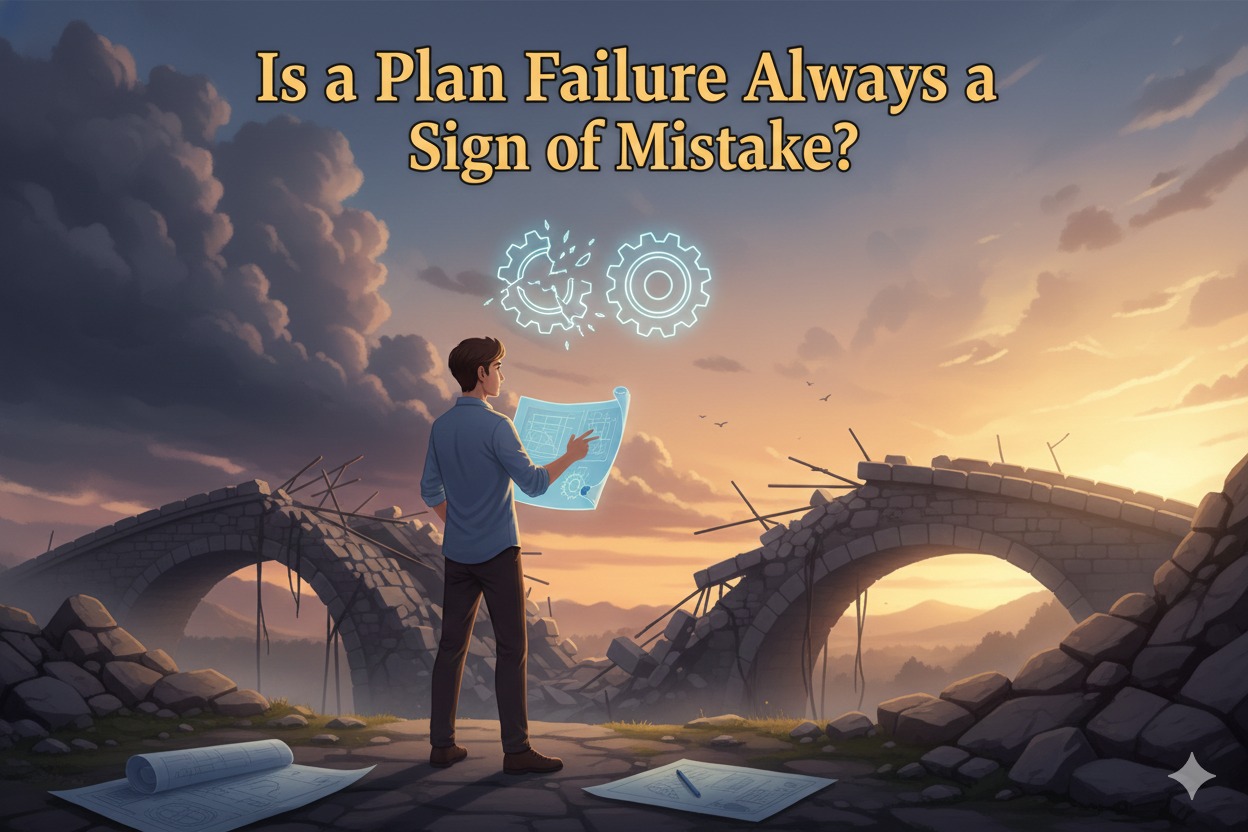
Failure Is Not Always a Mistake
Failure is often perceived as something negative. When a plan does not go as expected, many people immediately assume that a major mistake has occurred, either in the planning or in the execution. In reality, not every failed plan indicates an error. In some situations, failure is simply a natural part of the process toward success.
UNDERSTANDING THE MEANING OF FAILURE IN LIFE
Failure does not always mean the end of everything. In the context of life planning, failure can be understood as an outcome that differs from the original expectations. This difference does not automatically mean that the plan was wrong; rather, it may reflect changing conditions or unexpected challenges that arise along the way.
Understanding failure from a broader perspective helps individuals view situations more objectively.
UNCONTROLLABLE EXTERNAL FACTORS
Many plans fail not because of personal mistakes, but due to external factors beyond one’s control. Economic changes, social conditions, policies, or emergency situations can significantly affect the course of a plan. In such cases, failure is not a reflection of incompetence, but an adjustment to reality.
Recognizing the influence of external factors can reduce the tendency to blame oneself excessively.
MISTAKES AS PART OF THE LEARNING PROCESS
If failure does result from mistakes, it does not necessarily have a negative impact. Mistakes are an essential part of learning and personal growth. Through mistakes, individuals gain valuable experience that cannot be obtained solely through theory or careful planning.
This process builds deeper understanding and maturity in creating and executing future plans.
THE DIFFERENCE BETWEEN FAILURE AND UNEXPECTED OUTCOMES
Not all failures stem from poor decisions. Sometimes, the outcome simply differs from the original plan but still offers benefits or new opportunities. These mismatched outcomes are often mistaken for failure, even though they may lead to a more suitable direction.
Distinguishing between failure and unexpected results helps individuals evaluate situations more fairly.
TURNING FAILURE INTO CONSTRUCTIVE EVALUATION
Rather than viewing failure as absolute proof of error, a wiser approach is to use it as a basis for evaluation. Through honest and constructive reflection, individuals can improve strategies, adjust goals, and better prepare for future challenges.
This approach allows failure to function as a learning tool rather than an obstacle.
CONCLUSION
A failed plan does not always indicate a mistake. In many cases, failure results from changing circumstances, limited information, or a natural learning process. What matters most is not avoiding failure, but responding to it wisely in order to grow and improve. With the right perspective, failure can become a foundation for better planning and long-term success.
About the Author
Gusti Ayu Tita
Author — STEKOM University
An active author focused on academic issues, educational technology, and human resource development in the campus environment.