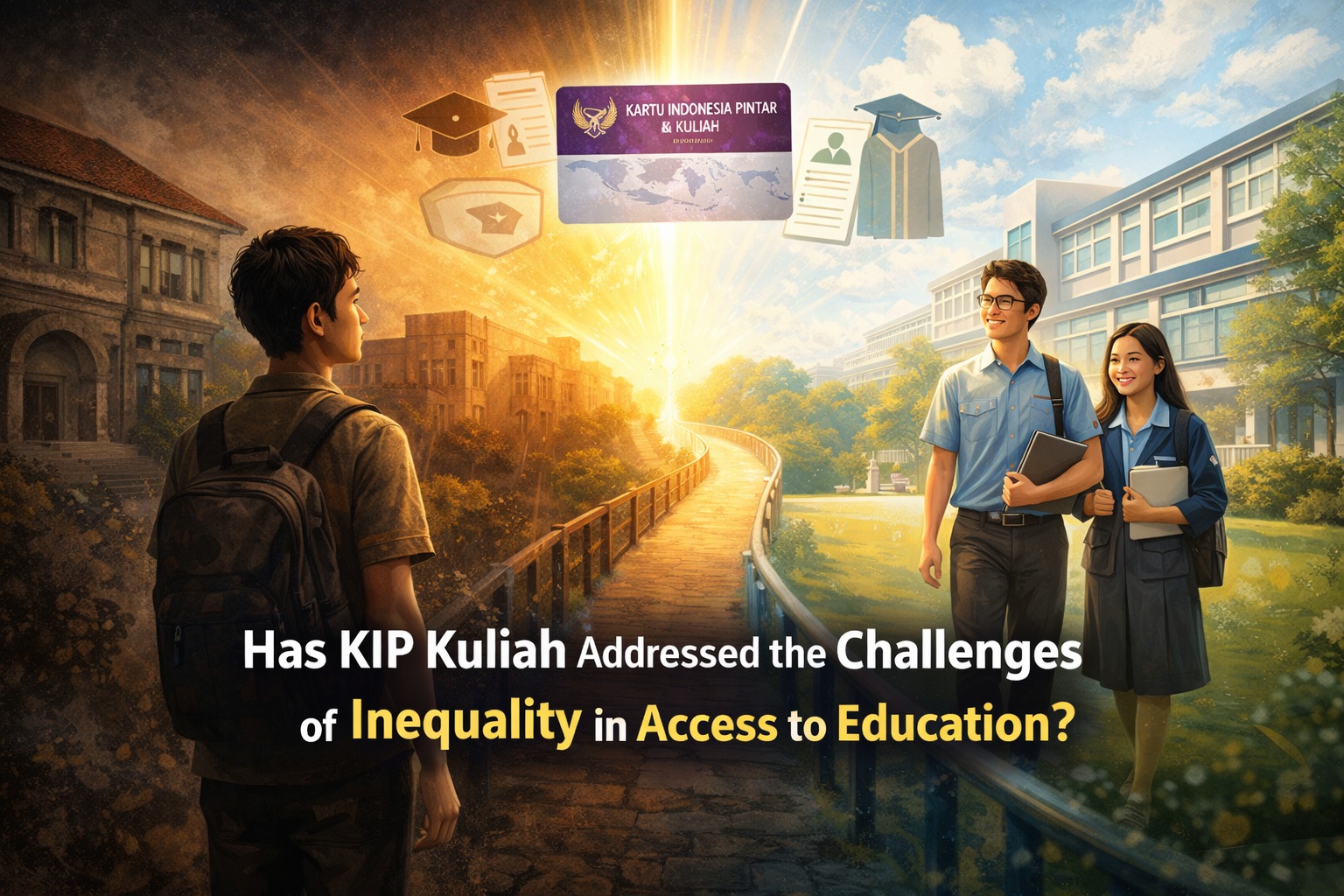
Education is a fundamental right of every citizen as stated in the 1945 Constitution of the Republic of Indonesia. However, in reality, inequality in access to education remains a serious issue in Indonesia. As a developing country with a very large population, Indonesia faces various challenges in ensuring equal educational opportunities, particularly at the higher education level. One of the government’s efforts to address this inequality is the *Kartu Indonesia Pintar (KIP) Kuliah* program. This program is designed to provide students from underprivileged families with the opportunity to pursue higher education. Nevertheless, an important question remains: has KIP Kuliah truly addressed the challenge of unequal access to education in Indonesia? This article explores that question in greater detail.
WHAT IS KIP KULIAH?
KIP Kuliah is an educational assistance program provided by the Indonesian government to help students from low-income families finance their higher education. First introduced in 2020, the program aims to offer scholarships to students who wish to continue their studies at both public and private universities at a more affordable cost. KIP Kuliah covers tuition fees, living expenses, and various supporting facilities intended to reduce the economic burden on students from lower- and middle-income backgrounds.
INEQUALITY IN ACCESS TO EDUCATION IN INDONESIA
Before discussing the impact of KIP Kuliah, it is important to understand the context of educational inequality in Indonesia. Although the country has made significant progress in the education sector, substantial disparities remain between urban and rural areas, between wealthy and low-income families, and among different ethnic and socioeconomic groups.
According to data from Statistics Indonesia (*Badan Pusat Statistik/BPS*), participation in higher education remains relatively low, particularly among economically disadvantaged communities. Several factors contribute to inequality in access to education, including:
- Limited family income: The high cost of higher education is a major barrier preventing students from low-income families from continuing their studies at the tertiary level.
- Limited educational facilities in remote areas: Many regions in Indonesia, especially outside Java, still lack access to high-quality higher education institutions.
- Gaps in educational quality: Although Indonesia has numerous universities, the quality of education is not evenly distributed. Many institutions in regional areas lag behind universities in major cities.
HOW DOES KIP KULIAH HELP ADDRESS EDUCATIONAL INEQUALITY?
KIP Kuliah has been introduced as one of the solutions to address these disparities. The program offers several significant benefits:
1. Reducing the Financial Burden of Higher Education
One of the greatest obstacles for students from low-income families is the cost of higher education. Through KIP Kuliah, eligible students no longer need to worry about high tuition fees, as the government provides financial assistance that can be used to cover educational expenses. This allows students to focus more on their studies rather than financial concerns.
2. Increasing Participation of Students from Underprivileged Families
KIP Kuliah provides greater opportunities for students from disadvantaged backgrounds to pursue higher education. The program has the potential to increase participation rates in higher education among low-income communities that previously felt excluded from such opportunities.
3. Improving Educational Quality
KIP Kuliah also encourages students to develop their potential by granting access to better-quality higher education institutions. With scholarships and supporting facilities, students can obtain a higher standard of education, which ultimately contributes to improving the quality of Indonesia’s human resources.
4. Reducing Geographical Disparities
The program opens opportunities for students from remote areas to access higher education institutions closer to their place of residence without being burdened by excessive costs. This is an important step toward reducing geographical inequality in access to higher education.
IS KIP KULIAH EFFECTIVE ENOUGH?
Although KIP Kuliah has had a positive impact on reducing educational inequality, several challenges must still be addressed to enhance its effectiveness:
1. Challenges in Fund Distribution
Despite the program’s positive intentions, issues remain in the distribution of funds to eligible students. Some students report complicated administrative processes that delay or hinder access to financial assistance.
2. Unequal Quality of Higher Education Institutions
While KIP Kuliah helps students from low-income families access higher education, another challenge lies in the quality of education itself. Students who receive scholarships but attend lower-quality institutions may not fully benefit from their education. Therefore, improving the overall quality of higher education institutions across Indonesia is essential to addressing educational inequality comprehensively.
3. Limited Coverage
KIP Kuliah currently reaches only a portion of students who need financial assistance. Many eligible students are unable to apply or do not pass the selection process. As a result, the program needs to be expanded and made more accessible to a broader range of prospective students.
CONCLUSION
KIP Kuliah represents a positive step taken by the Indonesian government to address inequality in access to education. The program provides students from underprivileged families with the opportunity to pursue higher education without being burdened by high costs. Nevertheless, several challenges must still be overcome for the program to become truly effective and reach more students across Indonesia.
Achieving greater educational equity requires synergy between government policies, improvements in the quality of higher education institutions, and comprehensive support for students so they can fully develop their potential. KIP Kuliah is not a standalone solution, but it is an important first step toward creating a more inclusive and equitable education system in Indonesia.
About the Author
Gusti Ayu Tita
Author — STEKOM University
An active author focused on academic issues, educational technology, and human resource development in the campus environment.