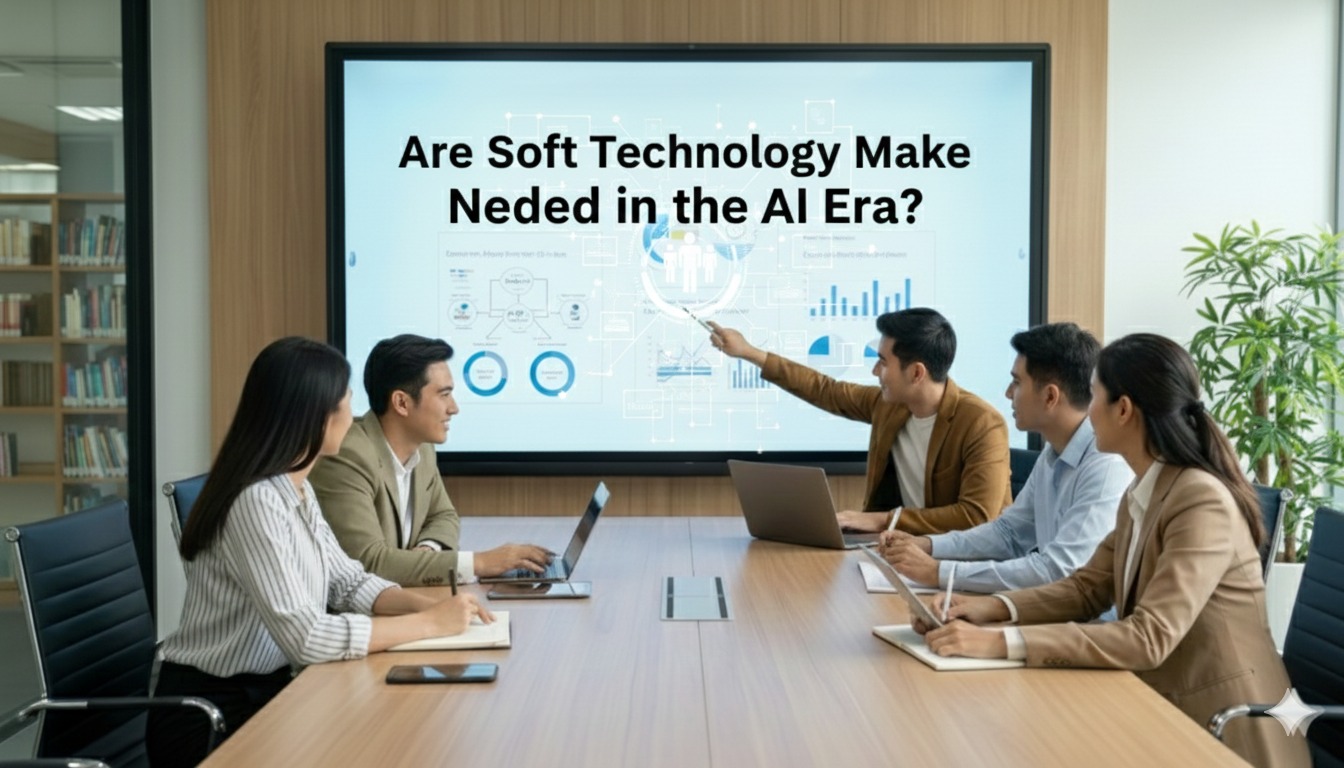
INTRODUCTION: WHEN AI TAKES OVER THE WORKPLACE
Artificial Intelligence (AI) is now present in almost every aspect of life—from business and education to the creative industry. Many jobs that once required human effort can now be done by machines quickly and accurately.
However, amid this technological advancement, an important question arises: *Are soft skills still needed in the era of AI?*
For Social and Humanities (Soshum) students, these skills are not only relevant, but they have become a key factor in adapting to the changing nature of work.
WHY SOFT SKILLS STILL MATTER IN THE AGE OF AI
AI excels in data analysis, automation, and efficiency. But there is one thing it cannot replace: human values.
Soft skills—such as communication, empathy, teamwork, and critical thinking—are uniquely human abilities. In the workplace of the future, machines may process data, but humans will still be required to make ethical decisions, build relationships, and drive innovation.
Key reasons soft skills remain essential:
💬 Effective communication is needed to bridge collaboration between humans and technology.
🤝 Cross-cultural and interdisciplinary teamwork is increasingly important in a digitally connected world.
💡 Creativity and problem-solving provide added value that machines cannot replicate.
❤️ Empathy and human-centered leadership are vital for managing teams and understanding societal needs.
CHALLENGES FOR SOCIAL SCIENCE STUDENTS IN THE DIGITAL AGE
Soshum students often face stereotypes that their field is less competitive than STEM. In reality, as AI advances, the world increasingly needs people who understand values, behavior, and human interaction.
The biggest challenge is integrating humanities knowledge with technological literacy. Without strong soft skills, technical ability alone is not enough to navigate a fast-changing workplace.
HOW SOSHUM STUDENTS CAN DEVELOP SOFT SKILLS IN THE AI ERA
To stay relevant, students must intentionally strengthen their non-technical abilities. Here are practical steps:
a. Join organizations and social activities
These teach communication, leadership, and adaptability with diverse people.
b. Strengthen critical and analytical thinking
Train yourself to question data, evaluate information, and draw logical conclusions.
c. Practice digital empathy
Even online, empathy matters. Try understanding others' perspectives in social media or virtual discussions.
d. Collaborate across disciplines
Work with students from STEM or business fields to broaden your perspective and adaptability.
e. Use technology to enhance soft skills
Take online courses on communication, leadership, and emotional management. AI can support human potential rather than replace it.
CONCLUSION: SOFT SKILLS—HUMAN STRENGTH IN THE AGE OF AI
AI may transform how we learn and work, but soft skills remain the primary distinction between humans and machines.
Soshum students play a crucial role in preserving human values in the digital era. By continuously developing communication, empathy, creativity, and collaboration, they can become leaders who are not only intellectually strong but also emotionally and socially wise.
Soft skills are not the past—they are the future that AI can never replace.
About the Author
Gusti Ayu Tita
Author — STEKOM University
An active author focused on academic issues, educational technology, and human resource development in the campus environment.