
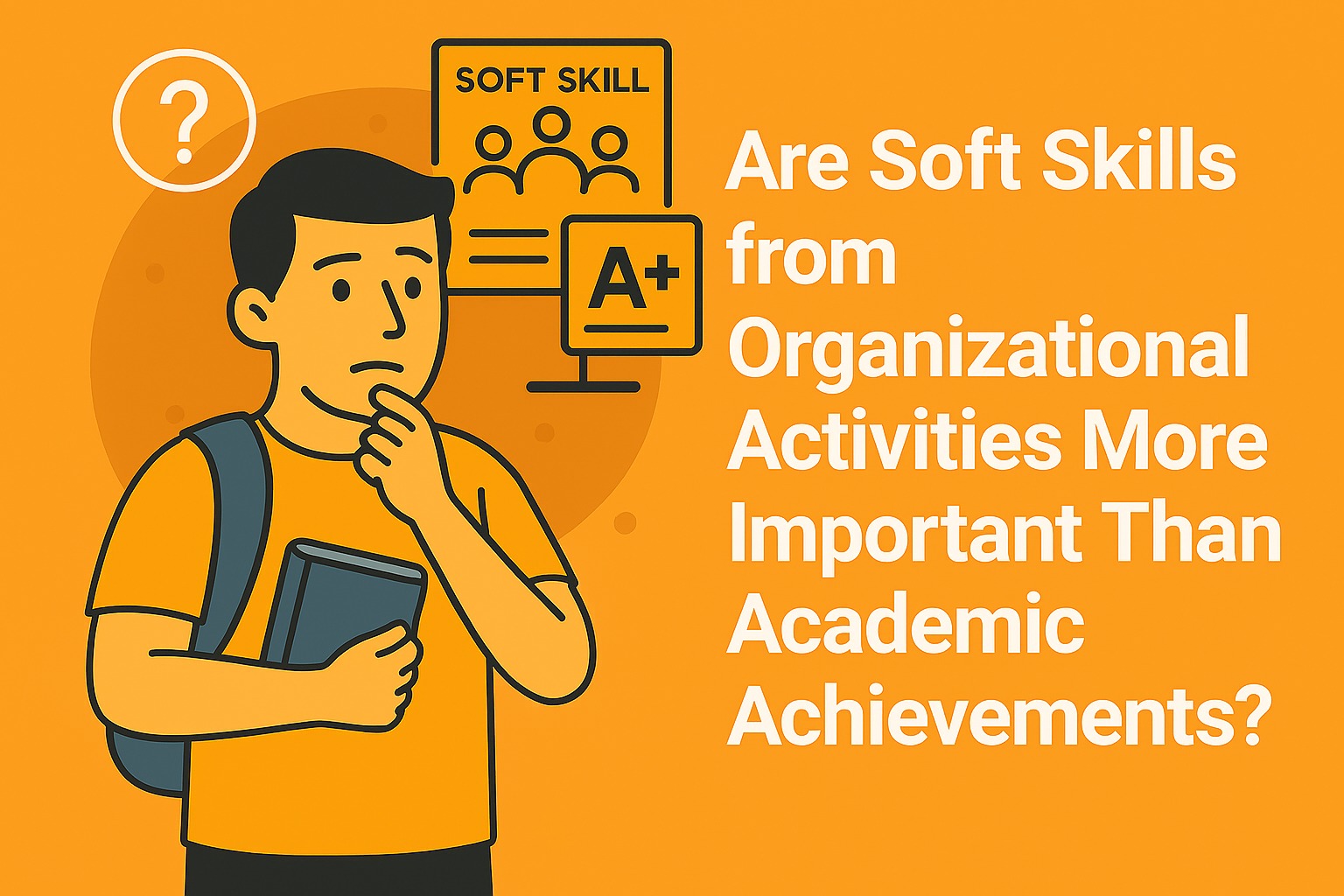
In higher education, students are often faced with two main priorities: achieving high academic performance or actively participating in various campus organizations. Both aspects provide their own benefits in preparing for future careers. However, an interesting question arises: are soft skills gained from organizations more influential than academic achievements?
Changes in workplace demands have made companies look beyond academic scores alone. Many employers now pay closer attention to interpersonal abilities, communication skills, and teamwork, commonly referred to as soft skills. To better understand this comparison, it is important to see how both aspects contribute to professional success.
THE ROLE OF ACADEMIC ACHIEVEMENT IN CAREERS
Academic achievement is one indicator of a student’s intellectual ability. A high GPA usually reflects discipline, persistence in learning, and the ability to understand academic material deeply.During recruitment processes, academic scores are often used as an initial requirement to filter candidates. This is especially common for positions that require strong technical or analytical abilities.
In addition, academic performance shows that a person can think logically and complete tasks in a structured way. These abilities are certainly important in many professional fields.However, academic achievement alone does not always guarantee success in a dynamic work environment.
THE IMPORTANCE OF SOFT SKILLS IN THE WORKPLACE
Soft skills are non-technical abilities related to how someone interacts, communicates, and collaborates with others. Examples of soft skills highly valued in the workplace include communication, teamwork, leadership, and time management.
Students who actively participate in organizations usually have greater opportunities to develop these skills. Through various organizational activities, they learn to face real challenges, coordinate with many people, and solve problems collaboratively.
These skills are crucial because most modern jobs require collaboration between individuals and teams. Therefore, companies often look for candidates who possess strong soft skills.
ORGANIZATIONS AS A PLACE TO DEVELOP PRACTICAL SKILLS
Campus organizations often become the best place for students to develop practical abilities. In organizations, students do not only learn theory but also face real situations such as managing events, leading teams, and resolving conflicts.
These experiences help students become more confident and adaptable in different situations. In addition, organizations teach responsibility and decision-making in certain conditions.The practical skills gained from organizational experience often become a valuable advantage when entering the workforce.
BALANCING SOFT SKILLS AND ACADEMIC ACHIEVEMENT
Although soft skills are very important, this does not mean academic achievement becomes irrelevant. Academic knowledge remains a crucial foundation for understanding specific professional fields.
Companies usually look for candidates who have a balance between academic ability and interpersonal skills. Students who possess strong theoretical knowledge along with good communication and teamwork skills tend to adapt more easily in the workplace.
Therefore, developing soft skills through organizational activities while maintaining academic performance is often the most effective strategy for students.
CONCLUSION
The question of whether soft skills from organizations are more influential than academic achievements does not have a single absolute answer. Both aspects play important roles in preparing students for the workforce.
Academic achievements demonstrate intellectual ability and theoretical understanding, while soft skills help individuals work effectively in professional environments. Students who can develop both aspects in balance usually have a greater chance of succeeding in their careers.
By gaining organizational experience while maintaining academic performance, students can build a strong foundation to face future professional challenges.
About the Author
Gusti Ayu Tita
Author — STEKOM University
An active author focused on academic issues, educational technology, and human resource development in the campus environment.



