
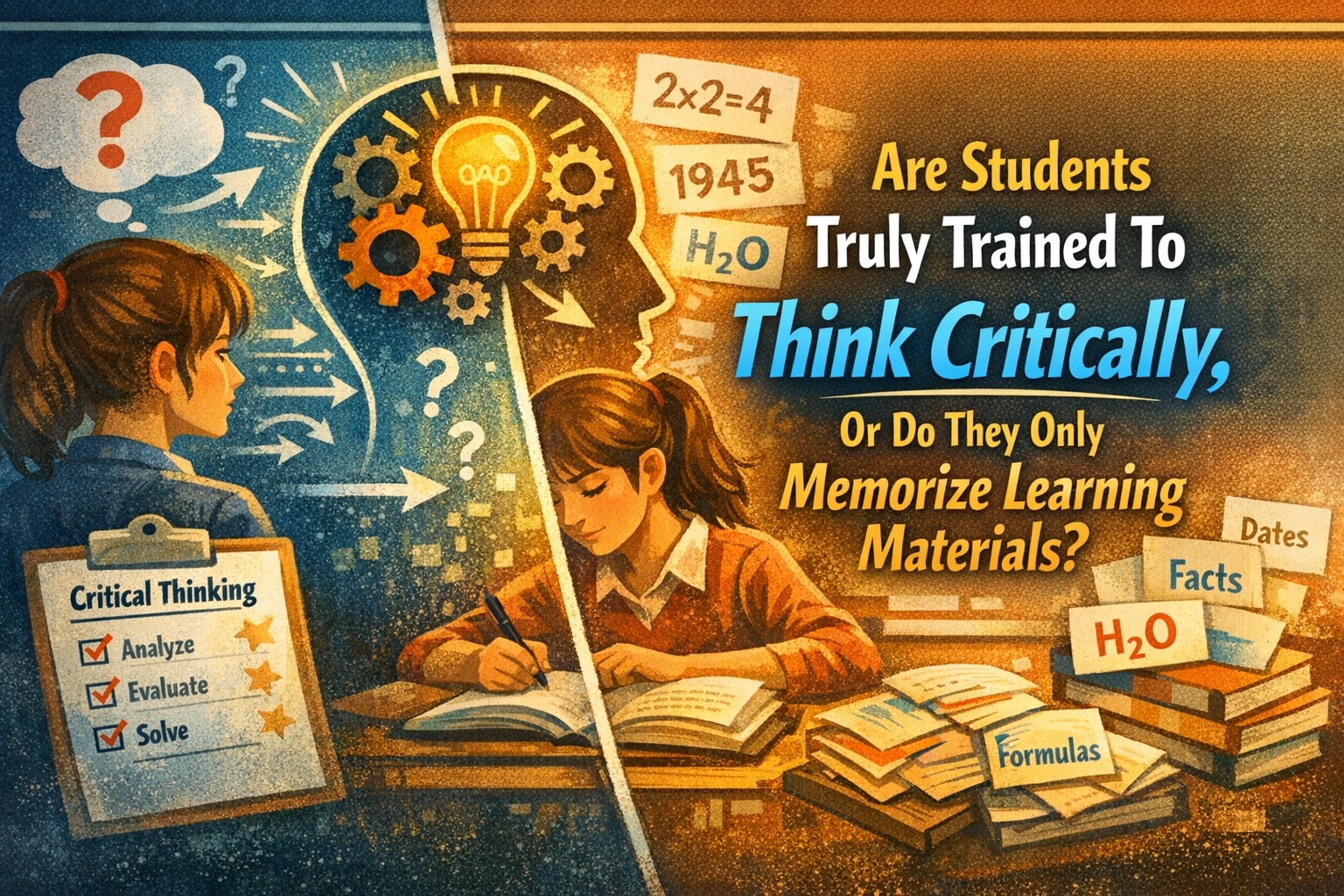
Education is often seen as the foundation for developing intelligent, capable, and responsible individuals. Schools and universities aim to equip students with knowledge and skills that prepare them for future challenges. However, an important question continues to emerge in academic discussions: are students truly trained to think critically, or do they only memorize learning materials?
In many educational environments, learning success is still strongly associated with how well students remember information. While memorization can help students retain facts, it does not necessarily develop the ability to analyze, question, or evaluate information. As a result, students may perform well academically but struggle when faced with complex problems that require deeper reasoning.
Understanding the difference between memorization and critical thinking is essential for improving the quality of education.
THE DIFFERENCE BETWEEN MEMORIZATION AND CRITICAL THINKING
Memorization focuses on storing and recalling information exactly as it was learned. This method is useful for remembering formulas, definitions, or historical facts. However, memorization alone does not require students to understand the meaning behind the information.
Critical thinking, on the other hand, involves analyzing ideas, evaluating evidence, comparing perspectives, and forming logical conclusions. Students who think critically are able to question assumptions, identify weaknesses in arguments, and develop their own interpretations.
While memorization supports basic knowledge acquisition, critical thinking transforms knowledge into meaningful understanding.
WHY MANY CLASSROOMS STILL PRIORITIZE MEMORIZATION
Several factors explain why memorization continues to dominate many educational systems. One major reason is the structure of traditional teaching methods. In teacher-centered classrooms, instructors often deliver information through lectures while students take notes and prepare for exams.
Another reason is the pressure to complete curriculum targets within limited time. Teachers may prioritize covering large amounts of material rather than encouraging deeper discussions that require more time.
Additionally, many assessment systems reward correct answers rather than thoughtful reasoning. When tests focus mainly on factual recall, students naturally adapt their learning strategies to memorization.
THE ROLE OF CLASSROOM ENVIRONMENTS IN DEVELOPING CRITICAL THINKING
The classroom environment plays a significant role in shaping how students learn. When students are encouraged to ask questions, challenge ideas, and engage in discussions, they begin to develop stronger analytical skills.
Interactive learning approaches such as debates, case studies, group discussions, and project-based learning can stimulate deeper thinking. These activities allow students to explore different perspectives and apply knowledge to real-life situations.
By contrast, passive learning environments may limit students’ ability to develop independent thinking.
THE LONG TERM IMPACT OF MEMORIZATION BASED LEARNING
Overreliance on memorization can have long-term consequences for students. While they may succeed in exams, they might struggle to apply their knowledge outside the classroom.
In professional environments, individuals are often required to analyze problems, evaluate information, and make informed decisions. These tasks demand critical thinking rather than simple recall of facts.
Therefore, education that focuses only on memorization may not fully prepare students for real-world challenges.
HOW EDUCATION CAN ENCOURAGE CRITICAL THINKING
To improve student learning outcomes, educational institutions must actively promote critical thinking. Teachers can integrate analytical questions into lessons, encourage open discussions, and design assignments that require problem-solving.
Students should also be given opportunities to reflect on their learning process, evaluate sources of information, and develop their own arguments. These practices help transform learning from passive memorization into active intellectual exploration.
When students are encouraged to think critically, they gain not only knowledge but also the ability to use that knowledge wisely.
CONCLUSION
The question of whether students truly learn to think critically or simply memorize learning materials remains highly relevant in modern education. Although memorization has its place in learning, it should not become the primary focus of academic development.
True education should cultivate curiosity, analysis, and independent reasoning. By creating learning environments that prioritize discussion, inquiry, and problem-solving, schools and universities can help students develop the critical thinking skills necessary for success in an increasingly complex world.
About the Author
Gusti Ayu Tita
Author — STEKOM University
An active author focused on academic issues, educational technology, and human resource development in the campus environment.



