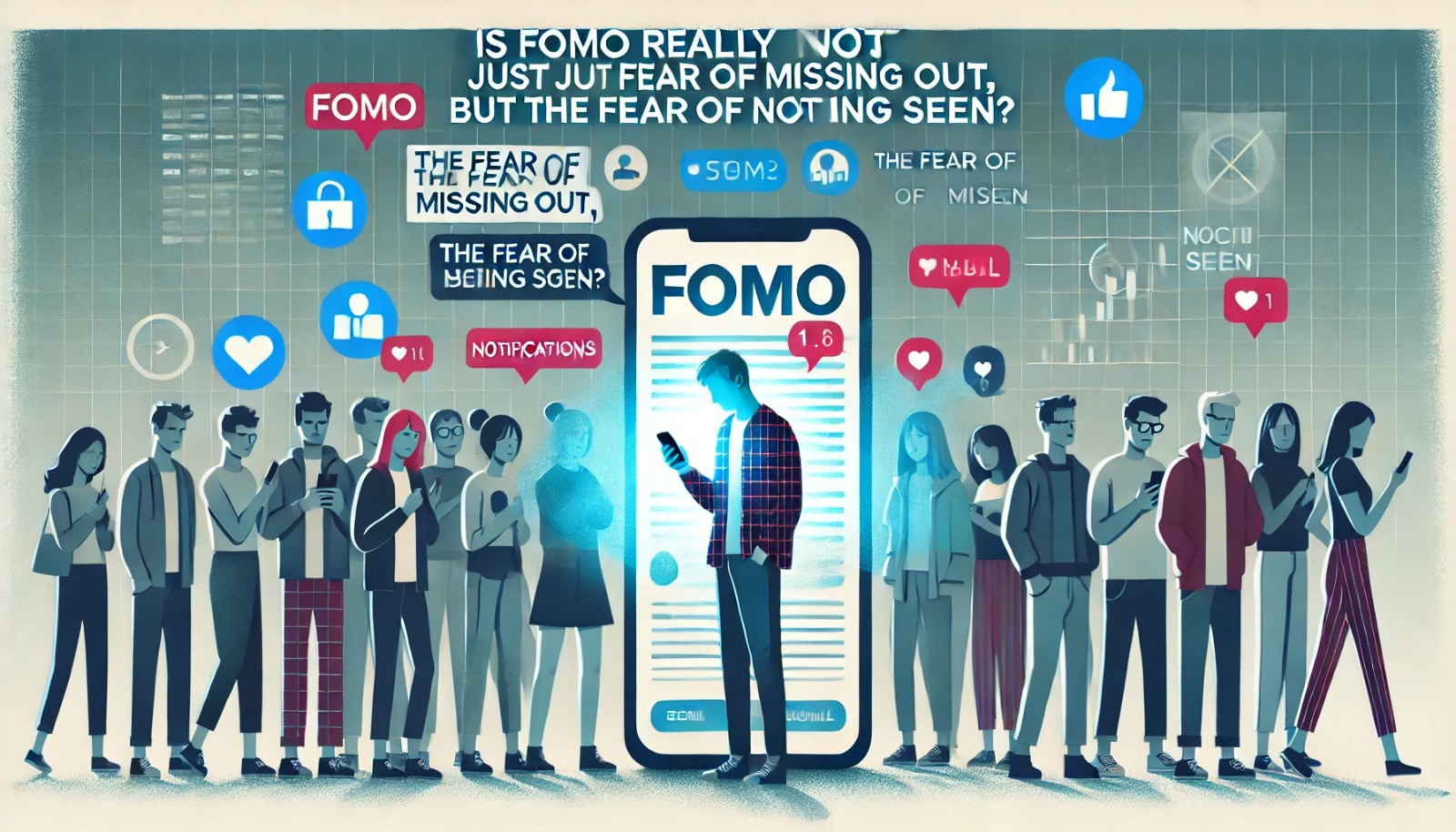
The phenomenon of Fear of Missing Out (FOMO) has long been part of digital life, especially for Generation Z. But recently, a new perspective has emerged: FOMO may not only be about the fear of missing trends or information, but a deeper fear—the fear of not being seen, not being acknowledged, or even not being considered “present” by one’s social environment.
This article explores the broader meaning of FOMO and its impact on the identity of today’s young generation.
FOMO IS NO LONGER ABOUT MISSING OUT
Initially, FOMO was understood as the fear of missing out on certain activities or opportunities. However, the evolution of social media has changed this concept. Generation Z does not only want to know what’s happening—they want to be seen as part of it.
When someone feels absent from a trend, discussion, or important moment, anxiety may arise as if they are not “in the circle” or not considered part of their community. FOMO then shifts into a fear of losing social existence.
SOCIAL MEDIA AS A STAGE FOR IDENTITY
Social media provides a space for everyone to showcase themselves. But behind this is an invisible pressure: who is active, who is sharing opinions, who appears in digital conversations—all become signals of existence.
Generation Z, raised in this culture, eventually sees “online presence” as a measure of self-worth. When they stop posting or become less active, they worry they might be forgotten or seen as unimportant.
This is why FOMO is no longer just about missing out—it becomes a fear of losing social validation.
SOCIAL PRESSURE THAT SHAPES A NEW KIND OF FEAR
High social expectations strengthen FOMO. The digital environment constantly moves fast: trends change, viral topics appear suddenly, and everyone rushes to react.
As a result:
- There is a need to always appear present, even when they don’t truly want to.
- Anxiety arises when they don’t join a trend, fearing they’ll be seen as irrelevant.
- They feel the urge to showcase activities rather than enjoy them genuinely.
Without realizing it, this pressure can disconnect someone from their true self.
THE IMPACT OF FOMO ON SELF-CONCEPT
When one’s sense of existence depends on external validation, self-concept becomes fragile. Generation Z may feel:
- Less valuable if their posts get little engagement.
- Less confident when they don’t follow popular trends.
- Unimportant when they are not visibly active online.
This can eventually lead to stress, identity confusion, and difficulty understanding what they truly want.
WAYS TO STRENGTHEN IDENTITY AMID DIGITAL PRESSURE
FOMO can be managed by building a stronger relationship with oneself. Several steps may help:
1. Reduce the need for validation by not measuring self-worth through others’ responses.
2. Prioritize real-life experiences, not just content to be showcased.
3. Recognize personal values and goals so social media presence doesn’t dominate identity.
4. Set digital boundaries to allow space for clearer thinking.
5. Connect with healthy communities that appreciate presence without requiring popularity.
CONCLUSION
FOMO has evolved into a reflection of a deeper need: the need to be perceived as existing. When social validation becomes central, identity becomes vulnerable. But with awareness and better digital habits, Generation Z can rediscover a more authentic sense of existence—not from screens, but from personal values and real-life experiences.
About the Author
Gusti Ayu Tita
Author — STEKOM University
An active author focused on academic issues, educational technology, and human resource development in the campus environment.