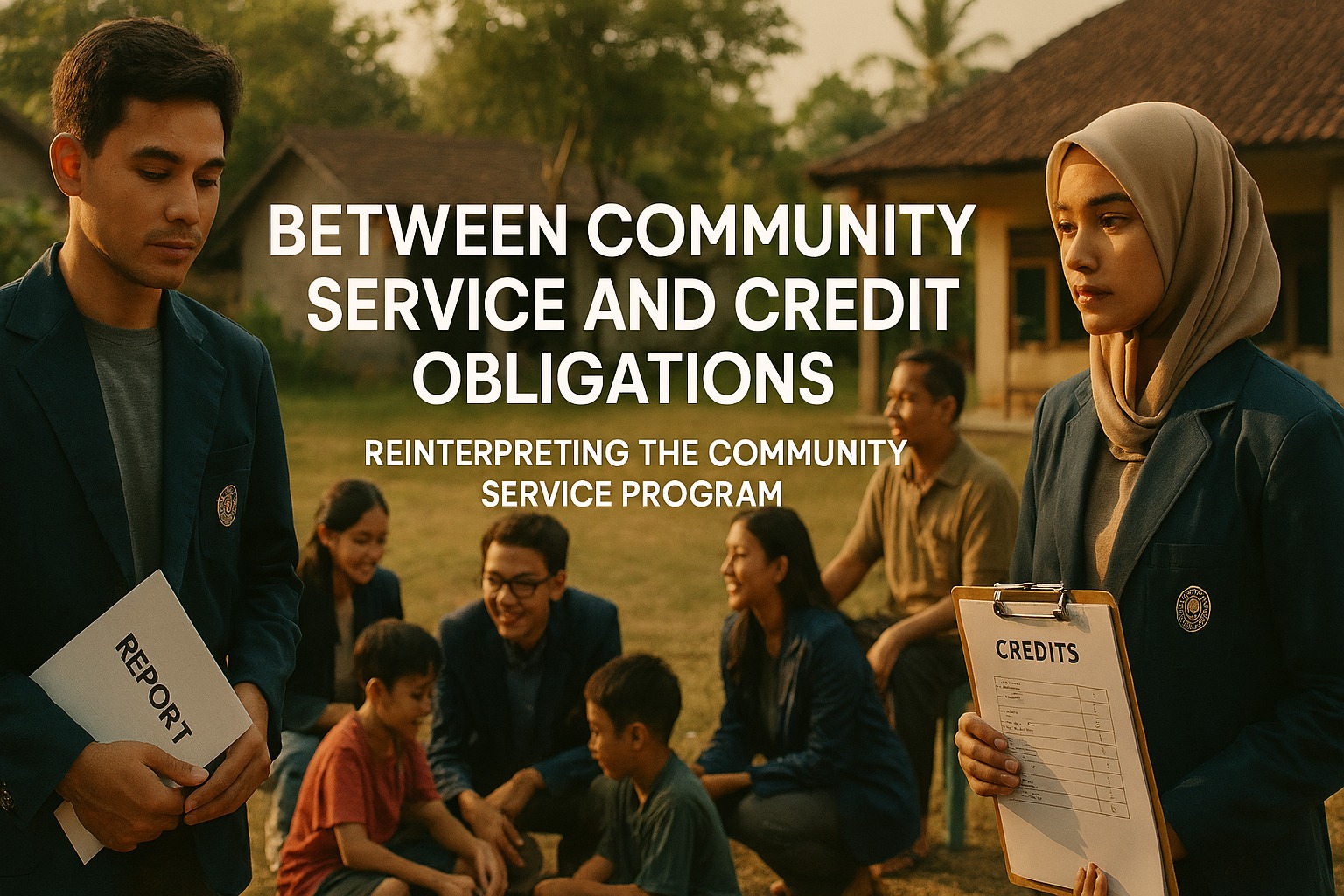
The Community Service Program has long been positioned as a bridge between higher education and society. Designed to connect academic knowledge with real-world challenges, this program encourages students to step outside the classroom and engage directly with communities. However, a recurring debate continues to surface: is the Community Service Program truly a transformative learning experience, or has it become merely a requirement to fulfill academic credits?
In many universities, participation in a Community Service Program is mandatory for graduation. While this ensures widespread involvement, it can also shift the focus from meaningful engagement to administrative completion. As a result, the essence of service learning risks being overshadowed by the urgency to accumulate credits.
Reinterpreting the Community Service Program requires a deeper examination of its purpose, implementation, and outcomes. By exploring its educational value and social impact, we can better understand whether it stands as a genuine platform for growth or simply another academic obligation.
THE ORIGINAL PURPOSE OF THE COMMUNITY SERVICE PROGRAM
The Community Service Program was initially designed to integrate academic learning with community engagement. It aimed to encourage students to apply theoretical frameworks in practical settings, addressing real social issues while enhancing their professional competencies. This model aligns with experiential learning principles, where knowledge is strengthened through direct experience.
At its core, the program emphasizes mutual benefit. Communities gain access to fresh ideas and academic resources, while students gain exposure to real-life complexities that textbooks often fail to capture. This reciprocal relationship is fundamental to the program’s philosophy.
Beyond skill application, the initiative seeks to cultivate social awareness and civic responsibility. Students are encouraged to recognize their role not only as learners but also as contributors to society. This perspective expands education beyond personal achievement.
When implemented as intended, the Community Service Program becomes a transformative academic journey. It moves students from passive recipients of information to active participants in social development.
CREDIT OBLIGATIONS AND THE SHIFT IN MOTIVATION
As universities formalized the Community Service Program into credit-bearing courses, its perception gradually shifted. For some students, the primary goal became meeting graduation requirements rather than embracing community engagement. This shift in motivation can influence both participation quality and program outcomes.
Credit obligations often introduce time pressure. Students may prioritize completing reports, documentation, and presentations over meaningful interaction with community members. The emphasis on assessment metrics sometimes outweighs genuine impact.
This structural approach is not inherently negative. Academic evaluation ensures accountability and maintains standards. However, when credits become the central focus, the program risks losing its experiential and reflective dimensions.
Reinterpreting the Community Service Program means finding balance. Academic recognition is important, but it should support, not replace, the deeper objective of service learning and personal growth.
EXPERIENCING REAL-WORLD COMPLEXITY
One of the most significant contributions of the Community Service Program lies in exposing students to real-world complexity. Social challenges rarely present themselves in neat, theoretical forms. Instead, they involve cultural nuances, limited resources, and unpredictable human factors.
Through direct engagement, students learn to adapt their academic knowledge to practical realities. A strategy that appears flawless in theory may require adjustments when applied in a specific community context. This process strengthens critical thinking and flexibility.
Students also encounter diverse perspectives during the program. Working with local leaders, families, and community groups broadens their understanding of social dynamics. These interactions foster empathy and cultural sensitivity.
Such experiences are difficult to replicate in traditional classroom settings. By navigating uncertainty and problem-solving in real environments, students gain insights that extend far beyond credit fulfillment.
DEVELOPING SOFT SKILLS AND PROFESSIONAL COMPETENCIES
The Community Service Program serves as an effective platform for developing soft skills. Communication, teamwork, leadership, and conflict resolution are continuously practiced throughout the project cycle. These competencies are highly valued in today’s professional landscape.
Living and working within a community often requires students to collaborate across disciplines. Interdisciplinary teamwork enhances their ability to negotiate ideas, manage differences, and build consensus. These are essential skills for future careers.
Moreover, presenting proposals to stakeholders strengthens persuasive communication. Students learn how to translate technical knowledge into accessible language that resonates with diverse audiences. This adaptability increases professional readiness.
In this sense, the program offers more than academic credits. It functions as a preparatory stage for employment, equipping students with practical abilities that complement theoretical expertise.
CHALLENGES IN IMPLEMENTATION AND SUSTAINABILITY
Despite its potential, the Community Service Program faces implementation challenges. Limited preparation time, insufficient needs assessment, and short project durations can reduce long-term impact. Without careful planning, initiatives may appear temporary rather than sustainable.
Another issue involves alignment between university objectives and community expectations. Programs designed without thorough consultation risk addressing perceived needs instead of actual priorities. This misalignment can weaken trust and effectiveness.
Administrative demands also contribute to challenges. Excessive documentation requirements may shift attention from engagement to paperwork. While accountability is necessary, it should not dominate the experience.
To reinterpret the Community Service Program meaningfully, institutions must continuously evaluate and refine their approach. Sustainable partnerships, extended project timelines, and reflective learning components can strengthen its value.
REDEFINING SUCCESS BEYOND ACADEMIC SCORES
Success in the Community Service Program should not be measured solely by grades or completed reports. True success lies in the depth of learning, the quality of engagement, and the sustainability of impact. These dimensions are less visible but far more significant.
Reflection plays a crucial role in redefining success. Encouraging students to critically analyze their experiences helps transform activities into long-term insights. Structured reflection sessions can connect fieldwork with academic theory.
Furthermore, recognizing community feedback as part of evaluation can provide a more holistic perspective. When beneficiaries acknowledge positive change, the program’s value becomes more tangible and meaningful.
By shifting evaluation criteria from purely academic performance to transformative learning outcomes, universities can preserve the integrity of the Community Service Program.
CONCLUSION REINTERPRETING THE BALANCE BETWEEN SERVICE AND OBLIGATION
The debate between community service and credit obligations reflects a broader tension in higher education. While academic structure ensures consistency and recognition, it must not overshadow the core mission of social engagement.
When approached with sincerity and institutional support, the Community Service Program becomes more than a graduation requirement. It evolves into a platform for character development, professional growth, and civic responsibility.
Ultimately, the program’s impact depends on collective commitment. Universities must design thoughtful frameworks, and students must approach participation with purpose. Only then can the Community Service Program fulfill its promise as a transformative bridge between theory and action.
About the Author
Gusti Ayu Tita P
Author — STEKOM University
An active author focused on academic issues, educational technology, and human resource development in the campus environment.